Optimize Your Cloud Hosting with Ubuntu VPS
When it comes to managing your server with flexibility,...








The cloud industry has experienced several defining moments over the past two decades.
The launch of Amazon Web Services changed how companies deploy applications. The rise of containerization transformed software delivery. Artificial intelligence is now reshaping infrastructure at an unprecedented pace.

And now, with SpaceX entering the public markets and becoming one of the world's most valuable technology companies, many investors and technologists are asking a bigger question:
What comes after today's cloud?
The answer is both exciting and disruptive.
The next generation of cloud computing will not simply be larger data centers or faster virtual machines. Instead, it will be built around AI-native infrastructure, global satellite connectivity, sovereign computing, distributed edge networks, and entirely new ways of delivering compute power. Recent industry forecasts suggest sovereign cloud spending alone could reach $80 billion in 2026 as governments and enterprises seek greater control over their digital infrastructure.
This article explores where cloud computing is heading over the next decade and why providers such as SurferCloud are well-positioned to benefit from these emerging trends.
For years, cloud adoption was primarily driven by migration.
Companies moved workloads from on-premises servers to public clouds.
That migration phase is now reaching maturity.
The next wave of cloud spending is increasingly driven by AI workloads rather than traditional application hosting. Industry analysts note that AI consumption, hybrid deployments, multi-cloud strategies, and specialized AI infrastructure are becoming the primary growth engines for cloud providers.
This means cloud providers must evolve from simply renting virtual machines to delivering intelligent infrastructure optimized for machine learning, inference, and autonomous systems.
The future cloud provider will not be judged by storage capacity alone.
It will be judged by:
By 2030, nearly every cloud service will be influenced by AI.
Today's cloud platforms are primarily managed by human engineers.
Tomorrow's clouds will largely manage themselves.
Artificial intelligence will automatically:
Instead of manually configuring infrastructure, businesses will increasingly interact with cloud environments through natural language.
Imagine saying:
"Deploy a multilingual AI customer service platform across Asia, Europe, and North America."
And having the infrastructure automatically provisioned within minutes.
The cloud becomes autonomous.
Human operators become supervisors rather than administrators.
Traditional CPU-based infrastructure is no longer sufficient for the AI era.
Large language models, image generation systems, autonomous agents, and scientific computing all require massive GPU resources.
This creates a significant opportunity for specialized cloud providers.
Rather than competing directly with hyperscalers, newer providers can focus on delivering:
This is where companies such as SurferCloud are becoming increasingly relevant.
Instead of forcing businesses into complex enterprise contracts, SurferCloud provides accessible GPU infrastructure designed for AI developers, startups, researchers, and growing enterprises.
As AI demand continues to expand globally, the market for specialized GPU cloud platforms could grow dramatically over the next decade.
This is where SpaceX changes the equation.
Most people view Starlink as an internet service.
That perspective is too narrow.
Starlink represents the foundation of a future space-based networking layer.
As satellite constellations expand, cloud providers will gain the ability to deploy workloads in locations previously considered impossible:
Instead of relying solely on terrestrial fiber networks, cloud platforms will increasingly integrate satellite connectivity into their architecture.
The distinction between cloud networking and telecommunications will gradually disappear.
Space-based connectivity may become a standard component of cloud infrastructure.
Not every workload belongs in a centralized data center.
AI applications increasingly require real-time processing.
Examples include:
These applications cannot tolerate long network delays.
As a result, computing resources will move closer to users through edge infrastructure. Researchers have long identified the convergence of cloud, edge, and AI systems as a major direction for future computing architectures.
By 2035, we may see millions of mini-cloud nodes operating around the world.
Instead of one massive cloud, businesses will use a distributed computing fabric spanning:
The cloud becomes everywhere.
One of the most important trends that receives relatively little public attention is digital sovereignty.
Governments and enterprises increasingly want control over:
Analysts forecast significant growth in sovereign cloud spending, driven by geopolitical concerns and regulatory requirements. Europe and other regions are investing heavily in local cloud ecosystems and sovereign AI capabilities.
For cloud providers, this means future success will require more than technical excellence.
Providers must also offer:
The future cloud market will likely be far more decentralized than today's hyperscaler-dominated landscape.
Perhaps the most fascinating prediction is that cloud computing itself may disappear from user awareness.
Today, businesses consciously choose cloud providers.
In the future, infrastructure may become invisible.
Applications will automatically select:
Workloads will move dynamically across providers.
The user will no longer care where the infrastructure resides.
Only outcomes will matter.
Cloud becomes a utility.
Just as we rarely think about electricity generation when turning on a light switch, future businesses may rarely think about cloud providers when deploying applications.
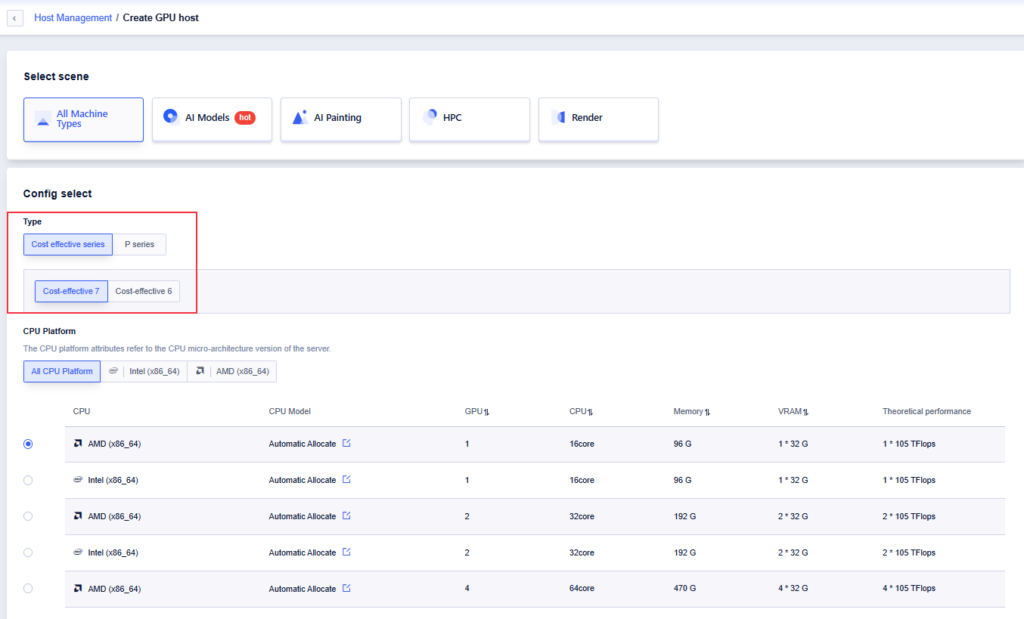
Get Started: https://console.surfercloud.com/uhost/uhost/gpu_create
While predicting the future is never easy, several trends appear increasingly clear:
SurferCloud is well positioned within this emerging landscape because it focuses on one of the most important resources of the AI era: accessible, high-performance computing infrastructure.
Whether developers are training models, deploying AI applications, running GPU-intensive workloads, or building next-generation digital services, demand for flexible cloud resources is likely to grow for many years to come.
As the industry moves beyond traditional virtual machines toward intelligent, distributed, AI-native infrastructure, platforms that combine performance, flexibility, and global reach may become some of the biggest beneficiaries of the next cloud revolution.
SpaceX's public debut is about more than rockets.
It symbolizes a broader shift toward a future where computing, connectivity, artificial intelligence, and infrastructure become deeply interconnected. Recent reporting indicates that SpaceX's market debut has attracted enormous investor attention and is being viewed as a catalyst for the next generation of technology IPOs.
The cloud industry of 2035 will look radically different from the cloud industry of today.
The winners may not necessarily be the largest companies.
They may be the providers that adapt fastest to AI, edge computing, satellite networking, sovereign infrastructure, and the growing demand for global GPU resources.
The future cloud will be intelligent.
It will be distributed.
It will be autonomous.
And perhaps one day, it may even extend beyond Earth itself.