Top 7 DevOps Monitoring Tools for 2026
Looking for the best DevOps monitoring tools in 2026? H...








As 2025 comes to a close, one thing is clear: cloud cost optimization is no longer a tooling problem—it’s a behavior and workflow problem.
Across engineering, SRE, and FinOps teams, the same patterns emerged this year. Dashboards alone didn’t move the needle. Generic advice like “right-size” and “buy reservations” delivered diminishing returns. The real savings came from automation, ownership, and changing where cost feedback appears in the engineering lifecycle.
Based on real-world experiences shared by practitioners, here’s a breakdown of what actually worked in 2025—and what didn’t.
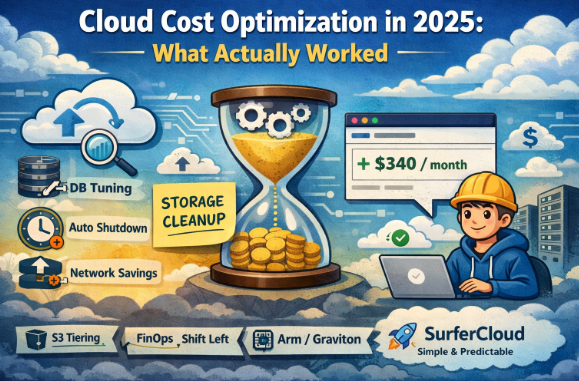
One of the most consistently cited wins was storage lifecycle hygiene.
? Lesson: Storage doesn’t page you at night, which is exactly why it gets ignored—and why it’s such fertile ground for savings.
Many teams assumed managed databases were already “right-sized.” That assumption proved expensive.
shared_buffers, work_mem, and effective_cache_size improved performance enough to downgrade instance classes.One notable trend: a few companies moved entirely off hyperscalers for compute and databases, keeping only object storage and messaging—achieving 3–4× cost efficiency.
Despite years of awareness, idle compute remains a top offender.
Some teams also saw 20–30% savings by migrating compatible workloads to ARM64/Graviton after proving performance first.
Networking costs quietly exploded for many teams in 2025.
These changes rarely affect application behavior but can slash monthly bills.
This was the loudest consensus of 2025:
Dashboards do not change behavior.
Engineers are overwhelmed. They don’t act on abstract recommendations, especially when:
The winning pattern was clear: remove work from engineers, and don’t add more dashboards.
Some of the biggest savings didn’t come from cloud providers at all:
Monitoring should not rival your compute bill.
Many of these lessons point to a broader conclusion: cost predictability and simplicity matter.
Platforms like SurferCloud Elastic Compute (UHost) resonate strongly with teams burned out by:
SurferCloud offers:
For teams rethinking their cloud strategy in 2025—whether that’s partial offloading, multi-cloud, or cost-controlled expansion—SurferCloud provides a simpler, more transparent alternative to hyperscalers.
The biggest lesson from 2025 wasn’t a new tool or service.
It was this:
Cost optimization only works when it aligns with how engineers already work.
Automation beat governance. Defaults beat policies. Feedback in CodeBeat dashboards. And simplicity beat complexity.
If 2026 really is the year FinOps shifts left, the winners will be the teams that stop asking engineers to care about costs—and instead design systems where the cheapest option is the easiest option.

Looking for the best DevOps monitoring tools in 2026? H...
? Pain Point Developers building Telegram bots often...
Introduction: The Hidden Costs of Cloud AI As we mov...