What is Ubuntu Xfce? How to Install Xfce on U
What is Ubuntu Xfce? Xfce is a lightweight desktop e...








The sticker price of a cloud server is the least useful number on the page, because the number you actually pay is set by four variables the sticker never shows — egress traffic, renewal pricing, idle hours, and the spec you normalize against — and two servers with identical monthly prices can differ by a factor of ten in effective cost once those variables land.
That redefinition is what a benchmark has to do to be useful. A pricing benchmark is not a leaderboard of who prints the lowest entry number; it is a normalized comparison that prices the same workload end-to-end — the same RAM, the same transfer volume, the same uptime — across providers, so the comparison reflects what leaves your account each month. As of October 2026, the entry market has compressed to a narrow band: DigitalOcean lists a $4 per month droplet, OVHcloud's entry VPS starts at $4.54, Vultr's IPv6-only tier sits at $2.50 with its 1 GB IPv4 tier at $5, Akamai's Linode 1 GB shared plan remains $5, Hetzner's CX22 delivers 2 vCPU and 4 GB for roughly €3.79 in its German locations, and Amazon Lightsail's Linux entry plan holds at $3.50. Those numbers look like a commodity market. They are not — because a single 1 TB traffic month costs anywhere from zero to $90 depending entirely on which provider's price sheet you read.
What follows is the benchmark done correctly: the entry-price table across eight providers as of October 2026, the normalization to dollars-per-GB and dollars-per-vCPU that makes unlike tiers comparable, the egress math that turns a $5 server into a $95 bill, the renewal cliff that doubles year-two costs on promotionally priced plans, the hourly-versus-monthly break-even arithmetic, and a 12-month total-cost worksheet you can run in ten minutes against any provider's price page — plus the five red flags in a price sheet that predict a billing surprise before it arrives. A closing table maps the five most common small-team workloads to the hosting model that each one legitimately costs least on.
The direct answer: as of October 2026, five dollars a month buys between 0.5 GB and 4 GB of RAM depending on the provider — a spread of eight-to-one for the same money — and the table below shows why no entry-price comparison is meaningful until the specs are normalized.
Prices below were read from the providers' own public pricing pages and the vpsticker.com price radar during its October 2026 refresh cycle, cross-checked October 19, 2026. Entry tier means the cheapest generally available Linux instance with an IPv4 address, excluding time-limited coupons and free-tier credits:
| Provider | Entry price (Oct 2026) | vCPU | RAM | Disk | Traffic included |
|---|---|---|---|---|---|
| Amazon Lightsail | $3.50/mo | 1 | 0.5 GB | 20 GB SSD | 1 TB |
| Vultr (Cloud Compute, IPv4) | $5.00/mo | 1 | 1 GB | 25 GB SSD | 1 TB |
| DigitalOcean | $4.00/mo | 1 | 0.5-1 GB* | 10-30 GB SSD | 0.5-1 TB |
| Akamai (Linode) Shared 1GB | $5.00/mo | 1 | 1 GB | 25 GB SSD | 1 TB |
| OVHcloud VPS entry | from $4.54/mo | 1 | 2 GB | 40 GB | metered |
| Hetzner CX22 (DE) | ≈€3.79/mo | 2 | 4 GB | 40 GB NVMe | 20 TB |
| IONOS VPS | from $2.00/mo | 1 | 0.5-1 GB | varies | varies |
| Promotional lightweight tiers | from $2.90/mo | 2 | 2 GB | 60 GB NVMe | metered (30 Mbps) |
Two rows break the pattern in opposite directions. Hetzner's CX22 at roughly €3.79 gives 2 vCPU, 4 GB RAM, and 20 TB of included traffic — the most RAM and transfer per dollar in the set, with the caveat that the price applies to German and Finnish locations and the US locations price higher, and the service is best suited to Europe-facing workloads with English-ticket support. The promotional lightweight row — $2.90 for 2 vCPU and 2 GB — prices below the commodity band but with two structural conditions: bandwidth is a 30 Mbps port rather than a transfer quota, and promotional plans are typically locked to one configuration per account. Neither caveat is a dealbreaker; both belong in the total-cost math, which is where the rest of this article goes.
The direct answer: divide monthly price by RAM and by vCPU before comparing anything, because that normalization collapses the eight-to-one spread in the entry table into a single number per unit of resource — and it is the only comparison that catches tiers that look cheap because they cut the spec instead of the price.
Run the division on the table above and the ranking inverts. Per gigabyte of RAM, Lightsail's $3.50/0.5 GB is $7.00 per GB; DigitalOcean's $4/1 GB is $4.00 per GB; Akamai's $5/1 GB is $5.00 per GB; Hetzner's €3.79/4 GB is under €1.00 per GB; and the $2.90/2 GB promotional tier works out to $1.45 per GB. The same arithmetic on vCPU puts Hetzner and the promotional tiers near €1.90 and $1.45 per vCPU respectively, against $3.50-5.00 per vCPU at the US commodity clouds. Three rules make the normalization honest:
The direct answer: hyperscaler egress is billed near $0.09 per GB, so one terabyte of outbound traffic costs roughly $90 — twenty times the price of the entry server — while VPS-oriented providers include 1 to 20 TB in the sticker price, which makes transfer volume, not compute, the deciding variable for any traffic-heavy workload.
The egress spread is the single widest gap in cloud pricing, and it is stable as of October 2026:
| Monthly outbound | Hyperscaler (~$0.09/GB after allowance) | Developer cloud (1 TB incl., ~$0.01/GB over) | High-quota host (20 TB incl.) |
|---|---|---|---|
| 10 GB | ~$0 (within free allowance) | ~$0 | ~$0 |
| 100 GB | ~$0-9 | ~$0 | ~$0 |
| 1 TB | ~$81-90 | ~$0-10 | ~$0 |
| 5 TB | ~$440-450 | ~$40-50 | ~$0 |
| 20 TB | ~$1,780-1,800 | ~$190-200 | ~$0 |
The practical reading of the table: below 100 GB a month, egress is noise on every model, and the instance price is the whole decision. Past 1 TB a month, egress is the decision — and the correct first move is a CDN in front of the origin, because caching the heavy objects at the edge cuts origin egress by 60-90 percent on content sites, which is worth more than any host switch. The origin then serves the cache misses, and a 1 TB-included tier covers most of what remains.
The direct answer: promotional entry prices are frequently one-time or first-cycle prices — a $2.90 first month that renews at $7 is not a $2.90 server, it is a $7 server with a discount coupon — so the number to compare across providers is the renewal rate, and the honest way to compare a promo plan against a list-price plan is to price the second year, not the first.
The renewal cliff takes three forms on 2026 price sheets, and they are worth distinguishing because they bind differently:
The comparison rule that follows: never divide the first invoice by twelve. Divide the twelve-month invoice by twelve — first year including any promo, then a second year at renewal rates — because the second number is the one the budget actually lives with.
The direct answer: hourly billing beats monthly billing once a server runs less than roughly 40-50 percent of the month, and monthly (or long-cycle) billing wins above that — because hourly rates are quoted at a premium that equals the monthly rate at full uptime, so the only question is what fraction of 720 hours your workload actually runs.
The arithmetic, using a $5-per-month-equivalent instance billed hourly at roughly $0.0075 per hour as of October 2026 — the same Akamai shared-tier pricing model used across the developer clouds:
One structural note for 2026: the hourly-billed clouds are also the ones that price reserved IPv4 addresses as a separate line — an Akamai IPv4 reservation and an AWS Elastic IP both bill hourly whether attached or not, because the address space itself is the scarce resource. On flat monthly VPS tiers the IPv4 address is inside the price. Two providers, identical $5 sticker, one of them bills the address separately — this is the exact class of difference the ten-minute worksheet at the end of this article is designed to catch.
The direct answer: a 24/7 workload pays the same on any model but multiplies badly across many small instances — ten always-on $5 agents are $600 a year before traffic — and the correct fix is consolidation or a cheaper always-on tier, not micro-optimizing the hourly rate.
Idle cost became a first-class line item in 2026 because of what runs 24/7 now: LLM-driven agents, webhooks listeners, monitoring probes, message-queue consumers, and scrapers with polite rate limits. Each is a workload with near-zero CPU but near-zero allowed downtime, which is the exact profile that punishes both extremes of the pricing spectrum:
The direct answer: each common workload has exactly one hosting model where it costs least without cutting corners — hobby sites on entry VPS tiers, traffic-heavy content sites behind a CDN on high-quota hosts, batch and CI on hourly billing, 24/7 daemons on consolidated low-cost monthly instances, and staging labs on promotional tiers with same-price renewal — and the table maps all five.
| Workload | Binding resource | Cheapest legitimate model | Why |
|---|---|---|---|
| Hobby site, blog, small app | RAM 1-2 GB | Entry monthly VPS, $4-6 class | List-price stability beats promo games at this scale; 1 TB covers the traffic |
| Content site serving media | Egress | CDN + high-quota origin (20 TB class) | Origin egress is 60-90 percent cheaper after caching; quota beats rate |
| CI runners, batch jobs, previews | Uptime fraction | Hourly billing | Runs 20-40 percent of the month; hourly saves over half |
| 24/7 agents, scrapers, listeners | Always-on, low CPU | Consolidated low-cost monthly instance | One box, many daemons; no hourly premium, no per-instance sprawl |
| Staging, drills, throwaway labs | Freedom to break things | Promotional lightweight tier, same-price renewal | Root access at $3-5; destroying and rebuilding is the workflow |
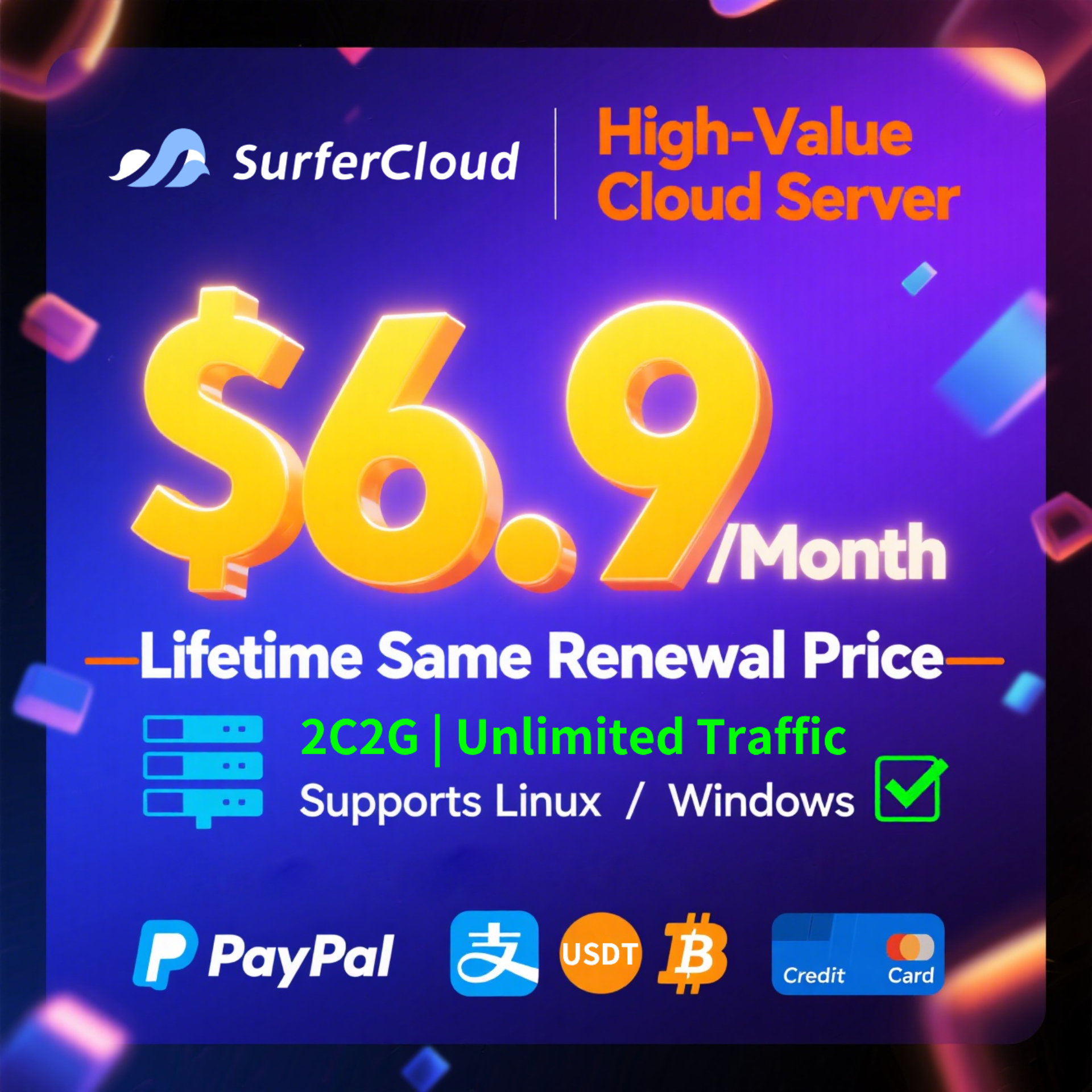
Two rows deserve prose. The consolidated-daemon row is where most small teams overspend in 2026 — agent sprawl is new, and the habit of spawning one instance per daemon came from the era when daemons were few. The staging-lab row is where promotional tiers fit honestly: a lab machine is destroyed and rebuilt by design, configuration changes are unwanted rather than limiting, and a same-price-renewal promotion — the model on SurferCloud's current ULightHost line, with configurations from $2.90 per month as of October 2026 — makes the machine a fixed budget line instead of a depreciation question. The full tier list, regional availability, and the renewal terms are on the ULightHost promotions page.
The direct answer: total cost of ownership for a small server is the sum of six lines — instance, transfer, storage, address, backup, and renewal adjustment — and running the worksheet below against any provider's price page takes ten minutes and reliably predicts the invoice to within a few dollars.
Sum the six lines, multiply by twelve, and add the first-cycle discount as a one-time credit. That single number — not the sticker — is what the twelve months cost, and it is comparable across any two providers regardless of how differently their price sheets are structured.
The direct answer: a price sheet predicts its own billing surprises if you know what to read — traffic counted in both directions, CPU credit models, unlisted renewal rates, port speed printed as "bandwidth," and backup priced at zero — and each flag is checkable in the pricing page itself before you commit.
The direct answer: the 2026 entry market has three stable floors — roughly $2-3 for promotional lightweight tiers, $4-5 for commodity developer clouds, and under €4 for the European high-quota hosts — and the differentiation has moved off price entirely onto egress policy, renewal behavior, and regional coverage, which is where every comparison in this article landed.
Three market-level observations that hold as of this month's price checks. First, the entry band has stopped compressing: the $4-5 commodity tier has held for multiple quarters across DigitalOcean, Vultr, and Akamai, and the sub-$3 price points are now almost exclusively promotional structures rather than list prices — which makes the renewal terms, not the entry number, the competitive variable. Second, egress pricing has bifurcated rather than converged: hyperscaler rates near $0.09 per GB coexist with 20 TB included on European hosts, and no movement between the two models has appeared in months of price-sheet tracking. Third, always-on small workloads have become a product category — lightweight tiers with fixed pricing, root access, and global region lists exist precisely because agent fleets and daemon sprawl are now a mass workload, and the category prices the profile correctly instead of charging hourly rates for 100 percent uptime.
The buyer's summary of the whole benchmark: normalize the spec, price the transfer, read the renewal, do the twelve-month sum. The sticker is marketing; the worksheet is the market.
"What's the cheapest cloud server I can get right now, in October 2026?"
On list prices, IONOS lists a $2 per month VPS tier and BuyVM's entry slice has appeared at $0.50 on the price radars; on promotional terms, lightweight tiers run $2.90 for 2 vCPU and 2 GB. But the cheapest honest answer is the one that survives the worksheet: a $2 tier with a $7 renewal is a $7 server, and a $4 list-price tier that never changes is cheaper than both by month eight.
"Is Hetzner really that much cheaper than DigitalOcean and Vultr?"
On the instance line, yes — the CX22 at roughly €3.79 for 2 vCPU, 4 GB RAM, and 20 TB included is several times the resource per dollar of the US commodity clouds' entry tiers. The trade-offs are regional: that price is for German and Finnish locations with US locations priced higher, support is English-ticket-based, and payment methods exclude some non-European options. For Europe-facing workloads the value is unmatched; for latency-critical US or Asia-Pacific audiences, the arithmetic changes.
"How much will egress actually cost me?"
Below 100 GB per month, effectively nothing on every model — the free allowances cover it. At 1 TB, hyperscalers charge roughly $81-90, developer clouds $0-10, and high-quota hosts zero. Past a terabyte, put a CDN in front of the origin before shopping for a new host: caching cuts origin egress 60-90 percent on content sites, which beats any provider switch.
"Should I pick hourly or monthly billing?"
Hourly if the machine runs less than roughly 40-50 percent of the month — CI runners, batch jobs, preview environments — because the hourly premium only equals the monthly rate at full uptime. Monthly for anything always-on. And remember that "stopped" on an hourly model often still bills the disk and reserved address; a machine sleeping for weeks should be destroyed with a snapshot, not stopped.
"Are those $2-3 promotional VPS plans a scam?"
Most are legitimate plans with structural restrictions rather than hidden bills — the honest ones print the renewal rate, and the best of them renew at the same promotional price. The scam pattern to reject is the unprinted renewal rate. Read the terms for three specifics before ordering: renewal price, whether the plan can change region or resize later, and how refunds are calculated if you delete the resource mid-term.
"Why is my cloud bill so much higher than the advertised price?"
One of six lines the sticker omitted: transfer over quota, extra storage volumes, a separately billed IPv4 address, snapshot or backup storage, the renewal adjustment after a first-cycle discount, or hourly instances running at full uptime with the premium. Run the six-line worksheet against your last invoice — the discrepancy is almost always one specific line, and once identified it is usually fixable in a single configuration change.
"Do I need to pay for a dedicated IP address?"
On flat monthly VPS tiers, no — the IPv4 address is part of the price on virtually all of them, including the promotional tiers. On hourly-billed clouds, a reserved IPv4 typically bills separately at around $0.005 per hour whether attached or not, because IPv4 space is the scarce resource. If your workload tolerates it, IPv6-only tiers exist at a further discount — Vultr's $2.50 entry tier is IPv6-only — but verify every client that connects to the server supports it before committing.