Why More Teams Are Rethinking Data Privacy in
In 2025, cloud computing is no longer just about perfor...








Every GPU rental listing leads with peak compute, and for the workload most teams actually run, peak compute is the one number that does not move the needle. A chat model generating an answer streams its entire weight set out of VRAM to produce each single token, so the ceiling on how fast it answers is memory bandwidth divided by the size of the model, a division anyone can do before signing a contract. Peak TFLOPS buys prefill throughput and training speed. It buys almost nothing inside the decode loop that produces the words a user reads. That mismatch, not any hardware defect, is the most expensive purchasing pattern in GPU procurement: you rent the number the chip is proudest of, and your workload never visits that part of the silicon.
The claim is worth stating plainly, because it inverts the way listings are sorted. An inference card is not a smaller training card. It is a different instrument, measured on a different axis, and the axis is bytes per second rather than floating-point operations per second. The roofline model that explains this was published in 2009, seventeen years before the first transformer, which means nobody has to take a vendor's word for it. One table, one division, and a short list of questions is the whole method.
Every large language model request has two phases, and they sit on opposite sides of the same chip.
Prefill processes the prompt. Hundreds or thousands of tokens go through the big matrix multiplies at once, each weight byte is read once and reused for every token in the batch, and the arithmetic intensity is high. Prefill is compute-bound, and peak TFLOPS is exactly what it consumes. This is where a model reads a 4,000-token retrieved context in a fraction of a second.
Decode generates the answer, one token at a time, in a loop. Each step is a streaming pass over essentially every weight in the model to produce a single output vector. The arithmetic intensity of that pass is roughly one floating-point operation per byte read. Decode is memory-bandwidth-bound, and peak TFLOPS is almost irrelevant to it. Chat assistants, coding agents, and anything whose output is long relative to its input live here.
The procurement consequence follows directly. If your product is a chat interface or an agent, you are overwhelmingly decode-heavy, and the per-stream speed each user feels is pinned by bandwidth no matter how much compute the card advertises. Batching can lift aggregate throughput toward the compute-bound regime, but it does not change the ceiling on a single stream. The question "is my workload prefill-heavy or decode-heavy" is really the question "which spec-sheet number am I actually buying".
The roofline model says a workload's attainable speed is the lower of two lines: a flat roof set by peak compute, and a sloped line set by memory bandwidth multiplied by arithmetic intensity. The two lines cross at the ridge point, which is peak floating-point throughput divided by memory bandwidth, expressed in operations per byte.
For decode, arithmetic intensity is about 1 operation per byte. That places decode far below the ridge on every card for sale, by two to three orders of magnitude. The published specifications of four cards a reader can rent today make the gap concrete.
| Card | VRAM | Memory bandwidth | FP16 tensor, dense | FP16 tensor, with sparsity | Ridge point |
|---|---|---|---|---|---|
| Tesla P40 | 24 GB GDDR5 | 346 GB/s | none (Pascal, FP32 only) | none | about 35 ops/byte (FP32) |
| RTX 4090 class | 24 GB GDDR6X | 1,008 GB/s | 165.2 TFLOPS | 330.3 TFLOPS | about 164 ops/byte |
| RTX 5090 | 32 GB GDDR7 | 1,792 GB/s | 209.5 TFLOPS | 419 TFLOPS | about 117 ops/byte |
| A100 80GB SXM | 80 GB HBM2e | 2,039 GB/s | 312 TFLOPS | 624 TFLOPS | about 153 ops/byte |
| H100 SXM | 80 GB HBM3 | 3,350 GB/s | 989.5 TFLOPS | 1,979 TFLOPS | about 295 ops/byte |
Read the last column against decode's arithmetic intensity of about 1. Every card is one to two orders of magnitude above the workload's operating point. The tensor cores are not broken. They are simply in a different room from the work.
Each GPU generation raises peak compute faster than it raises memory bandwidth, so the ridge point climbs while decode's arithmetic intensity stays flat. Put four cards from one vendor in a row and the trend is plain: bandwidth rises about 3.3 times from the RTX 4090 to the H100 SXM, while dense FP16 tensor throughput rises about 6 times. The gap widens with every release; none of them closes it. Newer silicon therefore does not solve the problem described here, it sharpens it.
This is why "just buy a newer card" is not a procurement strategy for a decode-heavy product. The newer card will be faster, and it will be faster by a smaller margin than its compute figure suggests, because the fraction of the chip the workload touches keeps shrinking.
Because decode reads the weights once per token, the single-stream ceiling is memory bandwidth divided by the number of bytes the model occupies. For a model in FP16, that is two bytes per parameter. A 7-billion-parameter model is about 14 GB of weights; a 70-billion-parameter model is about 140 GB.
| Card | Memory bandwidth | 7B FP16 ceiling | 70B FP16 ceiling |
|---|---|---|---|
| Tesla P40 | 346 GB/s | about 25 tokens/s | about 2.5 tokens/s |
| RTX 4090 class | 1,008 GB/s | about 72 tokens/s | about 7 tokens/s |
| RTX 5090 | 1,792 GB/s | about 128 tokens/s | about 13 tokens/s |
| A100 80GB SXM | 2,039 GB/s | about 146 tokens/s | about 14.6 tokens/s |
| H100 SXM | 3,350 GB/s | about 239 tokens/s | about 23.9 tokens/s |
Two honest caveats. First, this is a ceiling for one stream; a batched server can serve several streams inside the same weight read, and aggregate throughput climbs well above it. Second, a ceiling is enough to eliminate candidates. Any card whose ceiling sits below the token rate your product needs is out of the running before a trial budget exists, and the arithmetic that removes it takes one line and no benchmark.
Capacity is the second half of the same division, and it is where the slowest mistakes live. VRAM must hold the weights plus the KV cache plus headroom, and the KV cache grows with context length, not with model size. Sizing to the checkpoint alone passes every launch-day test and then fails at hour three of a long conversation. If you run models on general-purpose compute instead of a GPU, the same bandwidth ceiling applies with a CPU in front of it, and the RAM budget decides everything about what a plain VPS can serve. Whether self-hosting clears that bar at all is a separate VRAM budget question, and the cards that survive a KV-cache sizing pass are a shorter list than the catalogue suggests: the KV cache, not the model card, is what decides an inference GPU.
Vendors publish tensor throughput "with sparsity", which is twice the dense number, and the asterisk carries real weight. On the H100 specification table the FP16 tensor figure is 1,979 TFLOPS with the footnote "with sparsity"; the dense number for the same unit is 989.5. On the RTX 4090 the dense FP16 tensor figure is 165.2 TFLOPS and the sparse figure is 330.3. Structured 2:4 sparsity is what doubles the number, and most serving deployments do not use it.
There is a second layer of ambiguity worth knowing about. A card's headline "83 TFLOPS" in a consumer specification table is frequently the shader (FP32) figure, not the tensor figure at all, and the same silicon can carry 83 TFLOPS of shader throughput, 191 TFLOPS of ray tracing, and a separate AI TOPS number. Three different units, three different meanings, one listing. If a comparison deck does not say which precision and whether sparsity is included, the safe reading is that it means the largest available figure.
A GPU listing shows four numbers that matter, and each one buys something different. Only one of them is usually printed in the largest font.
There is a fifth habit that costs money without appearing on any spec sheet: ranking by VRAM and ignoring bandwidth. Two 24 GB cards at 300 GB/s each are not one 48 GB card at 600 GB/s. VRAM gets a model into the game; bandwidth decides the score. The RTX 5090 is a useful case because its numbers arrive close together, and what its 32 GB and 1,792 GB/s actually buy is a workload-fit decision, not a speed rating.
Every real lever changes one side of bandwidth divided by bytes per token, and none of them is a bigger compute rating.
Continuous batching amortises the weight read across concurrent streams. With a batch of B requests the weights are read once per forward step for all of them, so aggregate throughput climbs toward the compute-bound regime while each individual stream stays at the ceiling. This requires concurrent traffic; at 03:00 with two agent streams you are bandwidth-bound again. It is also the reason a well-configured cheap card can beat a badly configured expensive one.
Quantisation shrinks the denominator. A 70B model at 8-bit weights is about 70 GB, which roughly doubles the ceiling on the same card; FP8 on newer silicon does the same trick natively. It is the cheapest doubling in the stack because it is arithmetic, not procurement, and its only cost is an evaluation suite you should already be running.
KV cache discipline keeps bytes off the bus: grouped-query attention cuts the per-token cache by the KV-head ratio, paged cache allocation removes fragmentation waste, and honest context limits prevent late-session out-of-memory failures.
Speculative decoding spends the idle compute you already paid for. A small draft model proposes several tokens and the large model verifies them in one pass, so verification reads the weights once for several accepted tokens. It is the one technique that turns a TFLOPS-ranked purchase into fuel rather than waste.
That the biggest measured serving win of the decade came from memory bookkeeping rather than arithmetic is the strongest available evidence for this argument. The paper behind paged attention reported two to four times higher throughput than prior serving systems at the same latency, entirely from KV cache management (arXiv 2309.06180, SOSP 2023). Not one additional floating-point operation was purchased.
If decode efficiency is a software property, then the price of work should fall faster than the price of hardware. Two independent, freshly settled data sources say exactly that.
| GPU | Settled price per GPU-hour, 2026-11-18 | One-month change |
|---|---|---|
| H100 SXM | $2.93 | -2.0% |
| H200 | $7.11 | +13.4% |
| B200 | $9.21 | +9.5% |
| B300 | $11.66 | +1.7% |
| A100 SXM4 | $0.99 | -1.0% |
| RTX PRO 6000 | $1.54 | +3.4% |
Against those hourly rents, the same source publishes settled token prices: $0.75 per million tokens for one frontier lab, $0.32 for another, $0.78 for a third, and $0.04 for a low-cost provider, all settled on the same day. A third source, updated 2026-11-19 and covering 1,245 offers across 28 providers, measures the two ends of efficiency directly. One entry on older T4 silicon is benchmarked at 1,072 tokens per second and returns 3.6 million tokens per dollar, while an eight-way A100 640 GB configuration is benchmarked at 80,912 tokens per second and returns 29.8 million tokens per dollar. The same page reports that spot capacity runs 47 to 78 percent below on-demand for the middle half of matched offers, and twelve-month reservations 27 to 37 percent below.
Two conclusions follow, and both are actionable before you choose a card. First, per-dollar output is dominated by configuration and batching, not by the peak compute rating, which is why two offers of the same accelerator can differ several-fold in tokens per dollar. Second, when reservation depth and batching both matter more than the chip, pricing a purchase on the TFLOPS column is pricing the wrong variable. The efficient deployment is usually the one whose ceiling was computed first and whose kernel choices were tuned second.
The napkin ceiling governs inter-token speed. The other user-felt number is time to first token, and it is prefill compute plus queueing plus network round trips. A user three time zones from the model pays that round trip twice, once for the prompt and once for the answer's first token, on top of whatever the queue adds at peak.
This is where a placement decision quietly outranks a specification decision. A card with a 20-token-per-second ceiling sitting next to the user beats a 28-token-per-second card an ocean away, because the difference in bandwidth is smaller than the difference in distance. The arithmetic of region choice is not soft, and choosing a region is a latency-floor calculation before it is a shopping decision. The same trap exists in the network layer, where port speed and transfer volume are two different budgets that are routinely confused when a GPU is added to an existing deployment.
Put together, the three decisions that actually settle a rental are: a region near the traffic, a card whose bandwidth ceiling clears the required token rate, and capacity sized to the P95 context including the KV cache. None of them is the TFLOPS column.
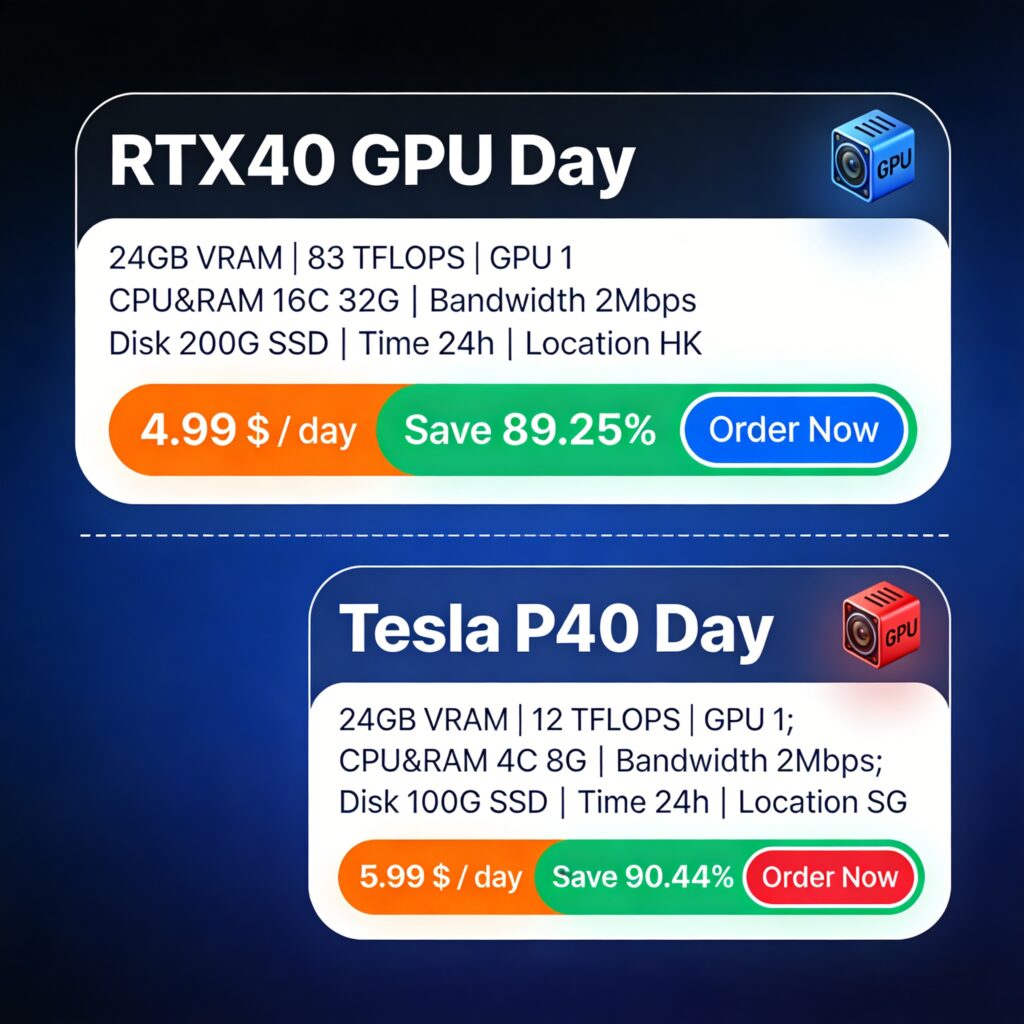
SurferCloud publishes GPU plans with explicit hourly, daily, weekly, and monthly pricing, and its listing illustrates the problem this article describes. The page's own label for the RTX40 entry is 24 GB of VRAM with 83 TFLOPS. That 83 TFLOPS figure is the shader throughput of the RTX 4090 class on NVIDIA's published specification page, and the number that decides how fast that card answers a chat prompt is its 1,008 GB/s of memory bandwidth, which the listing does not print. The honest reading of a plan like this is: check the capacity column for fit, check the bandwidth for speed, and treat the TFLOPS line as a prefill and training signal rather than a serving one.
Two card families are offered, at two locations. The RTX40 plans run in Hong Kong; the Tesla P40 plans run in Singapore. Daily and weekly offers are limited to one unit per model with renewal at standard price; monthly plans are limited to two per model with renewals at the same price. Billing supports hourly and monthly, traffic is unmetered, and the page states support for models including ChatGPT, GLM-4.5, and Qwen3.
| Plan | GPU | vCPU / RAM | Disk | Bandwidth | Location | Price | Listed saving |
|---|---|---|---|---|---|---|---|
| RTX40 GPU Day | 1 x 24 GB | 16C / 32 GB | 200 GB SSD | 2 Mbps | Hong Kong | $4.99 / day | 89.25% |
| RTX40 GPU Week | 1 x 24 GB | 16C / 32 GB | 200 GB SSD | 2 Mbps | Hong Kong | $49.99 / week | 84.41% |
| Tesla P40 Day | 1 x 24 GB | 4C / 8 GB | 100 GB SSD | 2 Mbps | Singapore | $5.99 / day | 90.44% |
| Tesla P40 Week | 1 x 24 GB | 4C / 8 GB | 100 GB SSD | 2 Mbps | Singapore | $59.99 / week | 86.06% |
| Plan | GPUs | vCPU / RAM | Disk | Bandwidth | Location | Price | Listed saving |
|---|---|---|---|---|---|---|---|
| RTX40 GPU-1 | 1 x 24 GB | 16C / 32 GB | 200 GB SSD | 2 / 5 / 10 Mbps | Hong Kong | $224.38 / month | 74.89% |
| RTX40 GPU-2 | 2 x 24 GB | 32C / 64 GB | 200 GB SSD | 2 / 5 / 10 Mbps | Hong Kong | $438.65 / month | 74.94% |
| RTX40 GPU-4 | 4 x 24 GB | 64C / 128 GB | 200 GB SSD | 2 / 5 / 10 Mbps | Hong Kong | $867.18 / month | 74.97% |
| Tesla P40 | 1 x 24 GB | 4C / 8 GB | 100 GB SSD | 2 / 5 / 10 Mbps | Singapore | $302.79 / month | 74.92% |
Applying the division from earlier: the single-card RTX40 monthly plan at 1,008 GB/s of bandwidth supports a single-stream ceiling of roughly 72 tokens per second for a 7B model in FP16 and roughly 7 tokens per second for a 70B model in FP16, before quantisation. Quantising to 8-bit weights roughly doubles both. Those two numbers, not the 83 TFLOPS label, are the ones that decide whether the plan fits a given product.
Payments are accepted by card, PayPal, Alipay, and cryptocurrency, and a free trial is available by contacting an account manager. The full set of plans, current prices, and terms is published here: GPU cloud server plans from $4.99 per day. Verify the figures against the page rather than against this article; prices and discount percentages move.
Does batching not fix all of this? It fixes utilisation, not latency. Batching amortises weight reads across concurrent streams and lifts aggregate throughput toward the compute-bound regime, but each stream's token rate stays pinned at the bandwidth ceiling, and it only helps when real concurrency exists.
Do newer generations solve it? They raise bandwidth, and they raise peak compute faster. Every generation widens the gap rather than closing it, which is why ranking by the newest compute figure is not a fix for a decode-bound product.
Is this only an LLM problem? No. Any autoregressive decode, along with many graph and embedding-lookup workloads, streams a data structure once per result instead of amortising reads across a large batch. Training and large-batch scoring are the regimes where compute pays rent. Always ask which regime a number was measured in.
Should I simply rent tokens from an API instead? If published token pricing beats your total cost of ownership at your volume, yes, and the same physics sets those prices. Knowing the ceiling makes any per-token quote legible: a price that implies throughput above the napkin ceiling for the claimed hardware is either better silicon than exists or an amortised loss. This article is for the teams that run models themselves for cost, privacy, or latency reasons.
What should GPU listings print instead of a sparse TFLOPS headline? Sustained memory bandwidth, dense throughput at each precision, and tokens per second on a named reference model at a stated context length. Any of those three would end the misdiagnosis this article is about. Until they do, the division is yours to run.
Rent the ratio your workload actually runs at, and inference goes back to being what it always should have been: divisible, predictable, and priced like plumbing rather than like peak silicon.