Comprehensive Guide to Windows Server Hosting
When it comes to hosting Windows-based servers, a hosti...








Quantitative trading has transformed the way financial markets operate. From traditional stock exchanges to cryptocurrency markets, trading decisions are increasingly powered by algorithms, mathematical models, and real-time data processing.
For traders and institutions seeking a competitive edge, strategy alone is no longer enough. The underlying infrastructure—network latency, server performance, and reliability—can significantly impact execution quality and profitability.
In this article, we'll explain what quantitative trading is, how it works, and why choosing the right cloud infrastructure is critical for success.
Quantitative trading (often called "quant trading") is a trading approach that uses mathematical models, statistical analysis, and computer algorithms to identify and execute trading opportunities automatically.
Instead of relying on emotions or manual decision-making, quant traders develop strategies based on:
Once a strategy is developed and tested, automated systems execute trades according to predefined rules.
High-frequency trading focuses on executing a large number of trades within milliseconds or microseconds.
Success depends heavily on:
Even a few milliseconds of delay can affect profitability.
Statistical arbitrage strategies identify temporary price discrepancies between correlated assets.
Examples include:
These opportunities often exist for only a short time, making execution speed essential.
Market makers continuously provide buy and sell quotes to earn the spread between bid and ask prices.
Requirements include:
The cryptocurrency market operates 24/7, creating ideal conditions for automated trading systems.
Popular crypto quant strategies include:
Because crypto markets never close, infrastructure reliability becomes even more important.
Many traders focus exclusively on strategy development while overlooking infrastructure.
However, even a profitable algorithm can underperform if execution is delayed.
When a trading signal is generated, every millisecond matters.
Lower latency means:
For example, if your trading server is located thousands of kilometers away from an exchange, network delays may reduce profitability.
Quantitative strategies often run 24 hours a day.
Unexpected downtime can result in:
Professional traders require infrastructure with enterprise-grade reliability and monitoring.
As trading volumes increase, systems must handle:
Cloud infrastructure allows traders to scale resources on demand without rebuilding their environments.
For traders looking to deploy automated strategies globally, SurferCloud offers cloud infrastructure specifically optimized for quantitative trading workloads.
SurferCloud's Quant Trading Cloud Servers are designed for environments where execution speed matters.
Key advantages include:
For high-frequency and arbitrage strategies, minimizing network distance to exchanges can provide a measurable advantage.
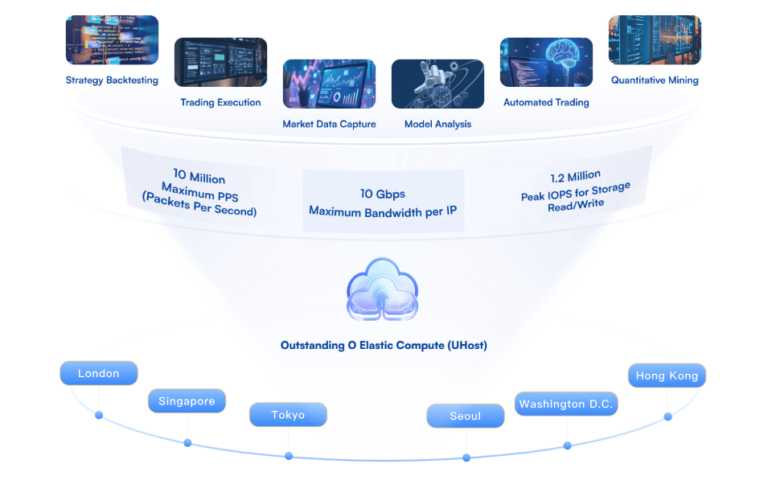
SurferCloud operates infrastructure across 17 global locations, including:
This allows traders to deploy systems close to the exchanges and markets they target.
Crypto traders can benefit from:
Whether running arbitrage bots, market-making engines, or automated portfolio strategies, SurferCloud provides a suitable deployment environment.
Trading infrastructure must protect both capital and intellectual property.
SurferCloud offers:
Activity Entrance: https://www.surfercloud.com/promos/quant
The current promotional plans are particularly attractive for small and medium-sized trading teams.
| CPU | RAM | Storage | Bandwidth | Monthly Price |
|---|---|---|---|---|
| 1 Core | 2 GB | 40 GB | 1-2 Mbps | $13.26/month Order Now |
| 2 Cores | 2 GB | 40 GB | 1-2 Mbps | $20.38/month Order Now |
| 2 Cores | 4 GB | 40 GB | 2-5 Mbps | $28.51/month Order Now |
| 4 Cores | 8 GB | 40 GB | 2-10 Mbps | $51.59/month Order Now |
| 8 Cores | 16 GB | 40 GB | 5-20 Mbps | $105.91/month Order Now |
| 16 Cores | 32 GB | 40 GB | 5-20 Mbps | $198.23/month Order Now |
Supported operating systems:
Popular deployment locations include:
These regions are especially useful for traders targeting crypto exchanges, U.S. equity markets, European exchanges, and global arbitrage opportunities.
A dedicated quant trading cloud server is ideal for:
Running automated trading strategies around the clock.
Executing opportunities between exchanges with minimal latency.
Maintaining stable connectivity and continuous quote generation.
Deploying bots, liquidity management systems, and blockchain infrastructure.
Backtesting strategies and processing large datasets efficiently.
Quantitative trading is increasingly driven by technology, automation, and infrastructure. While developing profitable strategies remains essential, execution quality often determines long-term performance.
For traders operating in cryptocurrency markets, high-frequency environments, arbitrage systems, or algorithmic strategies, a low-latency cloud platform can provide a meaningful competitive advantage.
SurferCloud's Quant Trading Cloud Servers combine global coverage, exchange-adjacent deployment locations, scalable resources, and enterprise-grade reliability, making them a strong option for traders seeking professional infrastructure without the complexity of managing physical hardware.
As quantitative trading continues to evolve, investing in the right infrastructure may be just as important as investing in the right strategy.