The Antitrust 'Hammer' Finally Strikes at Nvi
In a significant development in the tech industry, regu...








The financial markets have evolved dramatically over the past decade. Manual trading has gradually given way to algorithm-driven strategies, automated execution systems, and AI-powered decision-making models. Today, quantitative trading has become one of the most influential approaches in traditional finance, cryptocurrency markets, and decentralized finance (DeFi).
For professional traders, hedge funds, market makers, and Web3 developers, trading performance is no longer determined solely by strategy. Infrastructure has become a critical competitive advantage. A delay of just a few milliseconds can mean the difference between profit and loss.
This is why an increasing number of traders are deploying their systems on specialized low-latency cloud servers designed specifically for quantitative trading.
Quantitative trading, often referred to as "quant trading," uses mathematical models, statistical analysis, and automated algorithms to identify and execute trading opportunities.
Instead of relying on human emotions or subjective market opinions, quant systems analyze large volumes of market data and execute trades according to predefined rules.
Common quantitative trading strategies include:
Modern quantitative systems often operate continuously, monitoring markets 24 hours a day and reacting instantly to market movements.
Many traders spend months optimizing their strategies but overlook a major factor: network latency.
When two traders use the same strategy, the one with faster market access typically has a significant advantage.
Critical infrastructure requirements for quantitative trading include:
Trading opportunities often exist for only milliseconds.
Lower latency enables:
Unexpected packet loss or network interruptions can lead to:
A professional trading environment requires highly stable connectivity around the clock.
Unlike traditional stock markets, cryptocurrency and DeFi markets operate continuously.
Your infrastructure must remain online and responsive at all times.
As trading volume increases, systems require:
Cloud infrastructure provides the flexibility to scale without purchasing physical hardware.
The growth of blockchain ecosystems has introduced entirely new quantitative trading opportunities.
Today's Web3 traders are actively involved in:
These strategies depend heavily on fast RPC connectivity and low-latency access to blockchain networks.
Even a small delay can result in failed transactions, higher gas costs, or missed arbitrage opportunities.
As a result, cloud infrastructure has become a core component of modern Web3 trading systems.
One of the most important factors when selecting a trading server is geographic proximity.
The closer your infrastructure is to an exchange, the lower your network latency.
For example:
| Exchange Region | Recommended Server Location |
|---|---|
| New York | New York / New Jersey |
| Tokyo | Tokyo |
| Hong Kong | Hong Kong |
| Singapore | Singapore |
| London | London |
Professional traders often test network latency using ping and traceroute tools before deploying their systems.
Selecting a server within close proximity to an exchange can significantly improve execution speed and reduce slippage.
To address the growing demand for low-latency quantitative trading infrastructure, SurferCloud has launched a dedicated Quant Trading Cloud Server solution designed specifically for financial and Web3 workloads.
Activity Entrance:
https://www.surfercloud.com/promos/quant
SurferCloud deploys infrastructure close to major financial and cryptocurrency trading hubs, helping users achieve faster order execution and lower network delays.
Features include:
This is particularly valuable for:
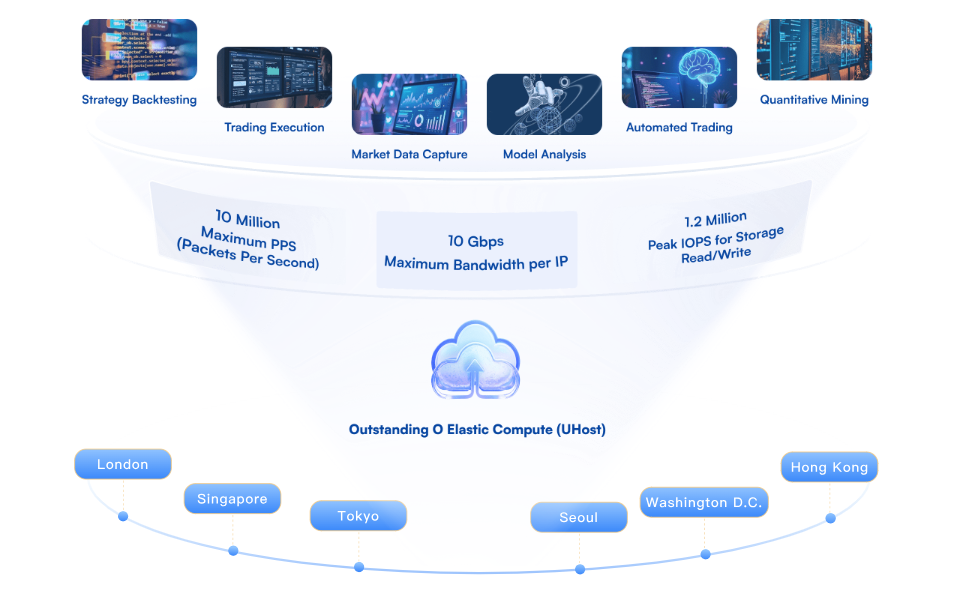
SurferCloud currently provides access to 17 global regions strategically positioned near major trading centers.
Coverage includes:
This allows traders to deploy workloads closer to their target exchanges and blockchain infrastructure.
Modern quantitative trading extends far beyond centralized exchanges.
SurferCloud's infrastructure supports:
Whether you're building a trading bot or managing a complex DeFi strategy, low-latency connectivity remains essential.
Trading systems cannot afford downtime.
SurferCloud provides:
This helps ensure continuous trading operations and business continuity.
SurferCloud's Elastic Compute platform is optimized for computationally intensive workloads.
Highlights include:
Traders can easily increase CPU, memory, or bandwidth resources as their strategies evolve.
SurferCloud's Quant Trading Cloud Servers are suitable for:
Before purchasing any cloud server for quantitative trading, consider the following:
Remember: in fast-moving markets, milliseconds matter.
Quantitative trading is no longer reserved for large hedge funds. With the growth of cloud computing, Web3 infrastructure, and algorithmic trading platforms, traders of all sizes can access professional-grade technology.
However, strategy alone is not enough. The quality of your infrastructure directly impacts execution speed, reliability, and profitability.
SurferCloud's Quant Trading Cloud Server promotion provides a compelling solution for traders seeking globally distributed, low-latency, and scalable cloud infrastructure. With coverage across major financial hubs, Web3-ready architecture, and enterprise-grade reliability, it offers a strong foundation for modern quantitative trading operations.
If you're looking to optimize your trading environment, deploying closer to exchanges and blockchain networks may be one of the most effective upgrades you can make.
Learn More: https://www.surfercloud.com/promos/quant