SurferCloud: Get Windows VPS without Extra Fe
In the world of VPS hosting, it's common for providers ...








In the high-stakes world of scientific research, "Compute Time" is often the most scarce resource. Whether you are a PhD candidate simulating molecular dynamics, a data scientist running large-scale Monte Carlo simulations, or a bioinformatician folding proteins, the cost of high-end GPU clusters can consume an entire grant budget in a matter of months. While the industry fixates on the latest NVIDIA H100s or the upcoming RTX 5090s, a growing community of savvy researchers has rediscovered a "budget powerhouse": the NVIDIA Tesla P40.
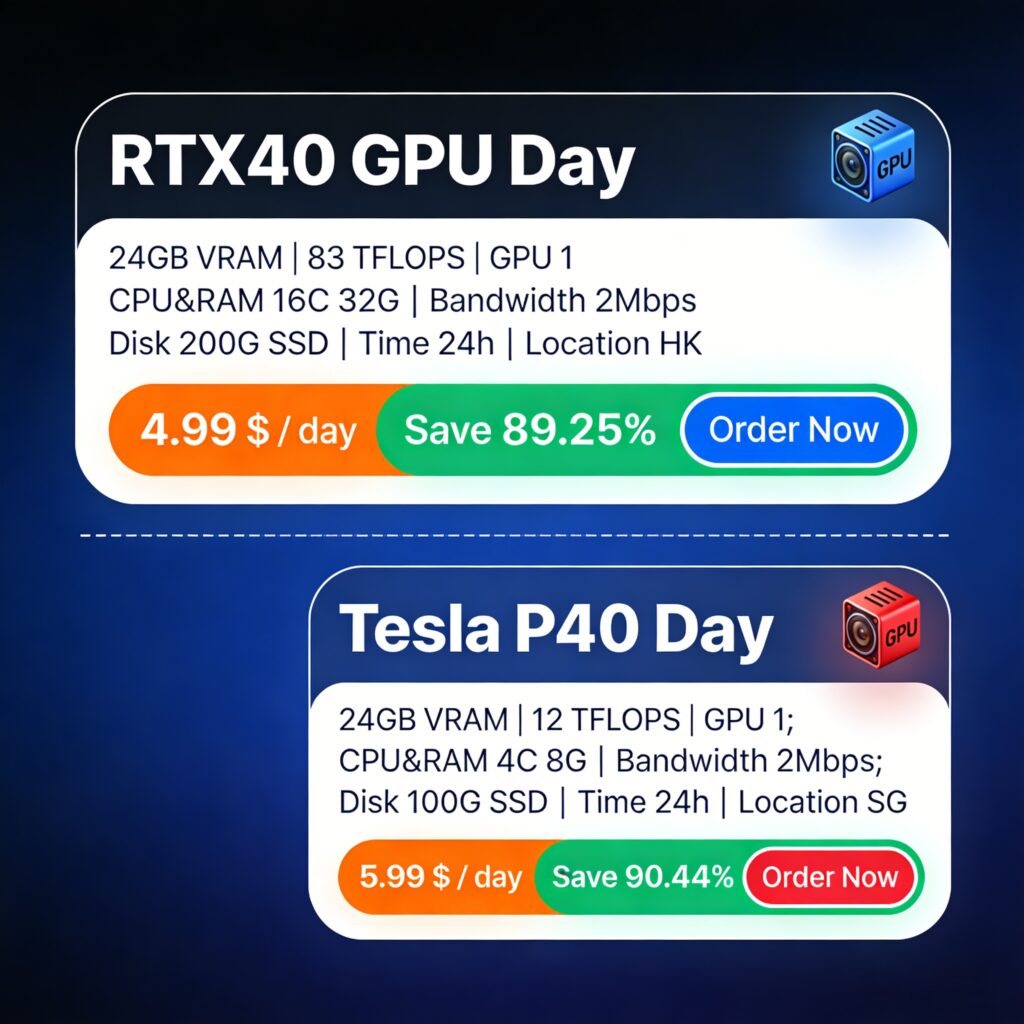
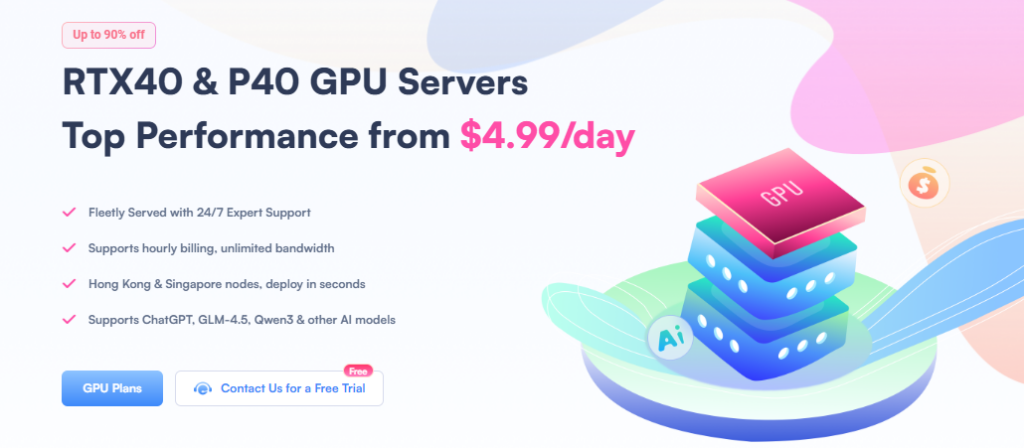
With SurferCloud’s GPU special offers, a single Tesla P40 server in Singapore now starts at just $5.99/day. This 1,000-word deep dive explores why the Tesla P40 remains a strategically superior choice for scientific computing in 2026, offering 24GB of VRAM at a price point that makes long-term experimentation finally sustainable.
For many scientific applications, the bottleneck isn't the number of floating-point operations per second (FLOPS); it's whether the entire dataset can fit into the GPU's memory.
While modern AI cards focus heavily on FP16 (half-precision) and INT8 for inference speed, many traditional scientific "HPC" (High-Performance Computing) applications still require FP32 (Single Precision) for numerical stability.
Consider a research team using GROMACS—a versatile package for performing molecular dynamics, i.e., simulating the Newtonian equations of motion for systems with hundreds to millions of particles.
SurferCloud’s choice to host P40 nodes in Singapore is a major benefit for international researchers.
Deploying a scientific stack on SurferCloud is streamlined for the non-DevOps researcher.
On the promotions page, select the Tesla P40 Week plan ($59.99/week) to give yourself enough time for a full simulation run.
Most researchers rely on the Conda ecosystem. Here is a quick-start for a P40 node:
Bash
# Install Miniconda
wget https://repo.anaconda.com/miniconda/Miniconda3-latest-Linux-x86_64.sh
bash Miniconda3-latest-Linux-x86_64.sh

# Create a scientific environment with CUDA support
conda create -n research_env python=3.10
conda activate research_env
conda install -c conda-forge numpy scipy pandas matplotlib
conda install -c dglteam dgl-cuda12.1 # For Graph Neural Networks
Since scientific jobs can run for days, use screen or tmux to keep your session alive:
Bash
tmux new -s simulation_run
# Start your long-running script
python my_molecular_sim.py
# Press Ctrl+B, then D to detach. The simulation continues in the background!
While the RTX 40 (Hong Kong) is the undisputed king of AI training and AIGC, the Tesla P40 (Singapore) is the strategic choice for budget-conscious scientific computing.
In 2026, scientific breakthroughs shouldn't be limited to those with million-dollar budgets. The "democratization of compute" is real, and it’s happening on platforms like SurferCloud. By utilizing the 90% discount on Tesla P40 nodes, independent researchers and academic labs can bypass the gatekeepers of expensive cloud providers.
Whether you are testing a new hypothesis in deep learning or simulating the next life-saving drug, the Tesla P40 provides the 24GB VRAM foundation you need at a price you can afford.
Ready to launch your simulation? Claim your $5.99 Tesla P40 Day Pass on SurferCloud today.
In the world of VPS hosting, it's common for providers ...
Simplify Cloud Storage Planning with Our Free Converter...
When it comes to cloud hosting, one of the most overloo...