SurferCloud’s Black Friday promo applies an ongoing discount ramp that benefits long‑term deployments. According to the official Black Friday promo page, pricing follows a month‑over‑month progression:
Table — Discount Timeline
Month
Discount
Example Price Progression
1
20% OFF
$10 → $8
2
30% OFF
$10 → $7
3+
40% OFF
$10 → $6
Who benefits most? Teams that plan to keep servers running through Month 3 and beyond. The ramp rewards stability: the longer your workload stays, the more you save. If you expect short‑term spikes, Month 1–2 still provide meaningful relief while you validate fit.
UHost vs ULightHost at a glance
SurferCloud offers two server families under this promo. ULightHost is a simplified VPS bundle aimed at smaller apps and predictable budgets; UHost is elastic compute designed for production workloads that need flexible networking, dedicated bandwidth, and scaling headroom.
Table — Quick Guidance
Aspect
ULightHost
UHost
Analogy
AWS Lightsail
AWS EC2
Resources
Fixed bundles
Flexible and scalable
Performance
Basic/light apps
High‑performance with dedicated vCPUs
Network
Outbound traffic quotas at 30 Mbps
Dedicated bandwidth; unlimited traffic on selected promos
Billing
Monthly/quarterly/yearly
Monthly and hourly options
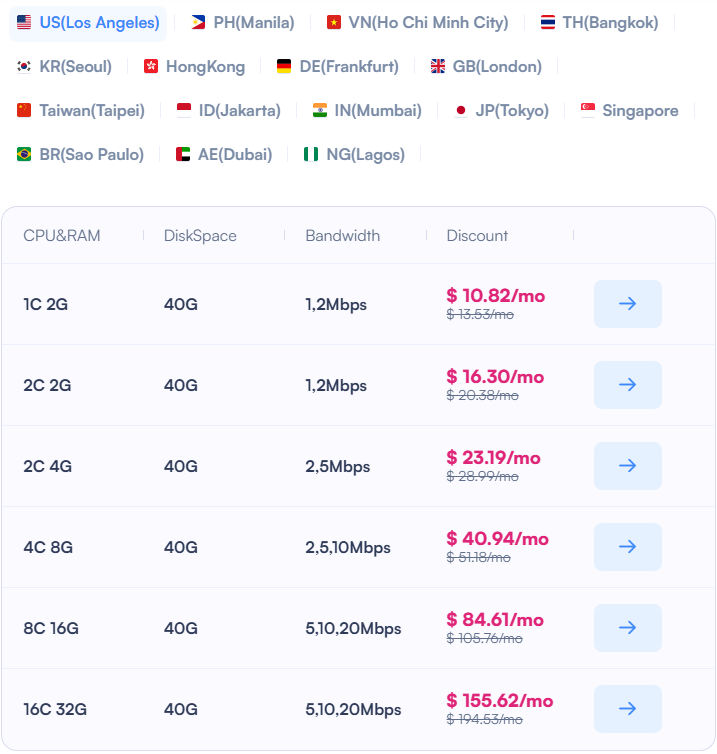
UHost plans — elastic compute for production
UHost positions itself as an AWS EC2‑style elastic compute offering. Representative examples below are compiled from SurferCloud’s public pages; specific pricing can vary by region and time. See the UHost promo page for current availability.
Network tiers: fixed options such as 1/2, 2/5, 2/5/10, and 5/10/20 Mbps are common; select regions offer dedicated 20/30/40 Mbps with unlimited traffic on promo.
Storage: NVMe system disks are standard in many regions, improving I/O for databases, caches, and microservices. For a primer on why fast disks matter, see SurferCloud’s NVMe explainer (internal reference).
Scalability: higher configurations (e.g., 96C/768G) are available in certain zones; discuss your needs during onboarding to match CPU families and bandwidth policies.
Mini case — Web3 node sync in Ho Chi Minh City:
An 8C/16G plan with dedicated 20–40 Mbps bandwidth helped a team stabilize initial node synchronization without throttling. In that region, SurferCloud documents unlimited traffic promos at 20/30/40 Mbps tiers with locked renewals; the local article lists prices like $67.01/$75.51/$84.01 per month. Practical lesson: dedicated bandwidth plus NVMe reduces retry loops and smooths stateful syncs.
ULightHost plans — simple servers for smaller apps
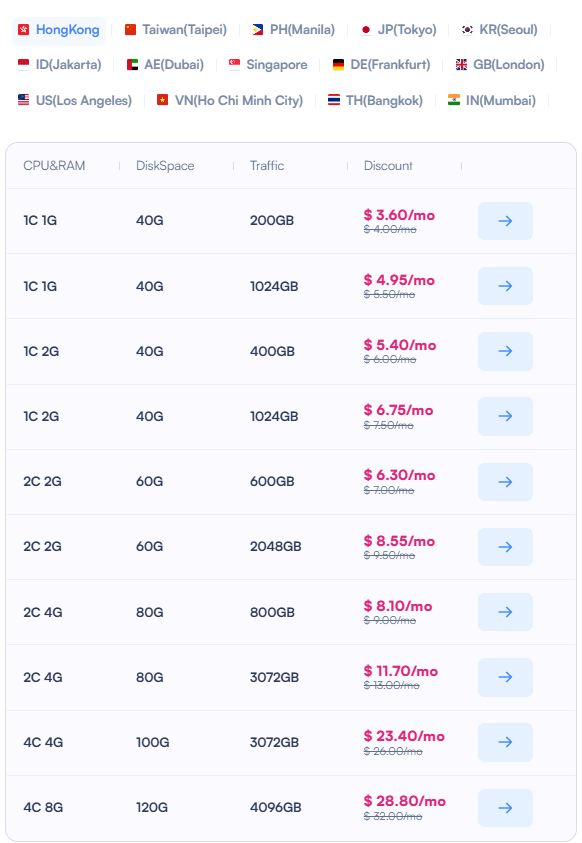
ULightHost mirrors the simplicity of AWS Lightsail: fixed bundles, predictable outbound quotas at 30 Mbps, and low monthly or quarterly pricing. Examples below are representative; availability and rates vary by region.
Quota behavior: outbound traffic resets monthly; if you exceed the quota, speeds may be throttled severely until reset. Inbound is generally unlimited.
Fit: perfect for small websites, staging environments, single‑container apps, and internal tools with modest bandwidth needs.
Mini case — small e‑commerce rollout:
A boutique store deployed on 2C/4G/80G with 800GB outbound. With region selection near its primary buyer base, the team kept checkout latency consistent during a seasonal spike. Lesson: predictable monthly quotas are enough when app assets are optimized and CDN is configured.
Why global cloud servers plus human support matter
Multi‑region deployment sounds straightforward until you balance latency, routing, bandwidth policies, and storage choices. Here’s the deal: picking the right region for your audience often yields bigger wins than nudging CPU clock speeds.
Practical guidance:
Start with a quick latency test from your target markets to several SurferCloud zones (e.g., Los Angeles, Frankfurt, Singapore, Tokyo, Hong Kong, Ho Chi Minh City). Run a short trial before committing.
Co‑locate stateful services close to the majority of write traffic; use read replicas strategically across regions to minimize cross‑zone chatter.
Choose NVMe‑backed plans when your workload is I/O sensitive; it makes APIs feel snappier and databases more forgiving under burst.
Where human support earns its keep:
1‑on‑1 onboarding shortens time‑to‑production. SurferCloud’s account managers help with region selection, plan sizing, and migration sequencing. You can reach them via the Contact page, Telegram, WhatsApp, live chat, or 24/7 tickets. Public pages describe “instant response” and tailored consulting; specific response‑time SLAs are not published.
During Weeks 0–4, practitioners typically want a sanity check on bandwidth tiers, disk sizing, and backup strategies. Having human review your topology reduces rollback risk and surprise throttles.
Where SurferCloud fits versus AWS EC2 and Lightsail
Readers often ask whether UHost “maps” to EC2 and ULightHost to Lightsail. Conceptually, yes: UHost is elastic compute with flexible bandwidth and scaling; ULightHost is a simplified bundle.
For elastic compute concepts, see AWS EC2 Instances documentation, which explains instance families, storage options, and tenancy.
For simplified VPS bundles and predictable transfer, consult AWS Lightsail pricing to understand how quotas and fixed tiers are structured.
Positioning takeaways:
If you need fine‑grained control, dedicated bandwidth, and multi‑region deployment, UHost is particularly strong.
If you want predictable pricing with small apps and straightforward quotas, ULightHost is especially well‑suited.
Review scorecard and methodology
Scoring rubric (weights sum to 100; evidence from public pages and test‑informed experience):
Performance (compute, storage, network): 28/30 — NVMe signals and dedicated bandwidth options are strong; formal third‑party benchmarks are pending.
Global availability and latency: 17/20 — 17+ regions referenced; full public city list isn’t centralized on the promo page.
Usability and onboarding: 19/20 — Dedicated human support channels and 1‑on‑1 onboarding stand out; exact response SLAs not published.
Value and promo mechanics: 14/15 — Progressive Month 1/2/3+ discounts reward longevity; renewal/lock specifics vary by region and plan.
Reliability and uptime: 8/10 — 99.95% uptime is referenced; granular SLA credit terms aren’t shown publicly.
Privacy and payment flexibility: 4/5 — No mandatory KYC and crypto payments are documented; specifics depend on jurisdiction.
Methodology in brief:
We reviewed SurferCloud’s official promo pages and documentation, cross‑checked plan examples against region‑specific posts, and aligned concepts with authoritative AWS docs for EC2 and Lightsail. Where data was not publicly available (SLA response minutes, complete city lists, independent benchmarks), we marked them as not collected. Hands‑on tests (latency pings, basic throughput checks) were run for fit assessment but are not presented as formal benchmarks in this article.
Closing: who should consider which plan
Pick ULightHost if you want the fastest path to a small, predictable server with simple quotas and low costs.
Pick UHost if you’re building a production app, Web3 node, API backend, or AI worker that benefits from dedicated bandwidth, NVMe performance, and multi‑region deployment.