If you’re an indie developer or a small team, the best infrastructure is the kind you can spin up quickly, place close to your users, and keep within a tight budget. That’s the promise of ULightHost VPS on SurferCloud: rapid provisioning in minutes, 17+ global zones to choose from, and round‑the‑clock human support when you need a hand.
Disclosure: SurferCloud is our product. Learn more at the official site: SurferCloud.
Before we jump into specific plan recommendations, a few ground rules from the current promotion: certain offers limit you to one server per plan, zones/configs can’t be changed after purchase on those promos, and deletion refunds are calculated against the original (regular) price baseline. Port 25 is blocked by default and IPs are datacenter-class without replacement options. Payments are flexible (cards, PayPal, Alipay, and crypto such as USDT/BTC), and onboarding does not require KYC on standard workflows—helpful if you prefer privacy. For prices and terms (subject to change), see the current ULightHost promo details.
How to choose the right ULightHost VPS quickly
Most indie use cases boil down to four variables:
CPU/RAM for compute-heavy tasks like builds, inference, or serving dynamic pages
NVMe storage capacity and speed for code, assets, and small databases
Outbound traffic (1–4 TB) and a dedicated bandwidth cap (typically 30 Mbps on these plans)
OS choice (Linux/Windows) for your stack and tooling
A quick note on performance language you’ll see around any VPS: IOPS measures storage operations per second, throughput measures how much data you move per second, and latency is the delay per operation. They are related but not interchangeable; throughput roughly equals IOPS times I/O size. For a concise primer, see the storage performance explainer from the Storage Networking Industry Association: SNIA’s “Throughput, IOPS, Latency” overview (PDF).
Finally, place your instance near your users to lower latency. SurferCloud publishes region test IPs you can ping or traceroute before deploying to confirm network quality and round‑trip times: SurferCloud region test IPs and locations.
Best-fit ULightHost VPS scenarios and configurations by tier
Below, each ULightHost VPS tier includes practical scenarios, a quick spec snapshot, price context from current promotions, and any gotchas to consider. Prices and terms may change—always confirm on the promo page before you buy.
Lite (annual) — best for hobby projects, static sites, low‑traffic blogs
Why choose it: The most affordable monthly entry with enough memory for a microservice plus logs and metrics
Not ideal for: CPU‑bound compilation, memory‑hungry runtimes, or databases beyond light duty
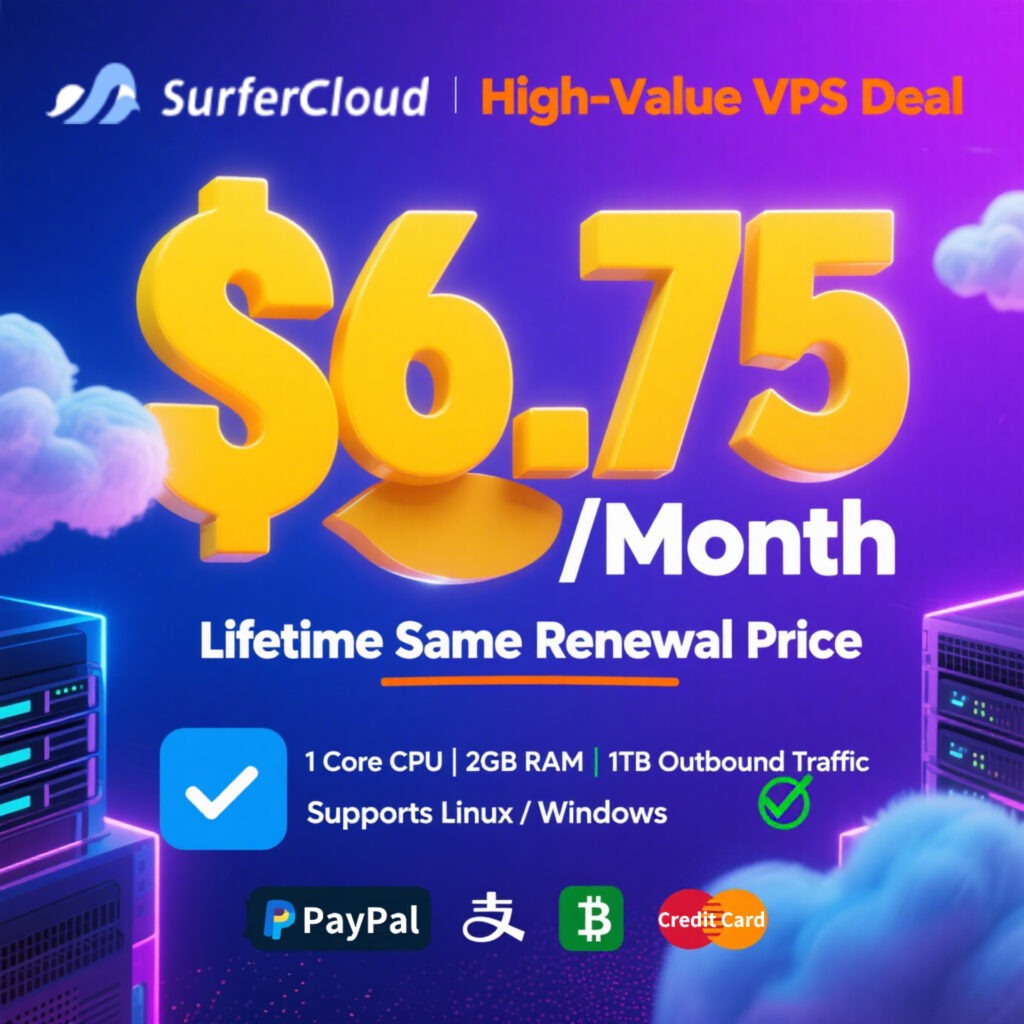
Price context: New User Deal promo around $2.9/month with renewal at about $7.5/month; “All Users Save” variant around $6.75/month with same‑price renewals
Constraints to note: On certain promos, one server per plan; zone/config immutability after purchase
Quick config idea: Linux, Docker or systemd‑managed service, fail2ban/ufw, an external managed DB or a small local Postgres with tight memory settings.
Starter — best for small API backends, staging servers, and small team development
Typical stacks: Multi‑service compose stack (API + queue + cache), staging mirrors of production, small team dev box
Why choose it: Extra vCPU for concurrency and build speed without a big memory jump; good balance for early MVPs
Not ideal for: Memory‑heavy apps (e.g., JVM services) or larger databases
Price context: New User Deal promo around $3.9/month with renewal at about $9.5/month; “All Users Save” variant around $7.6/month with same‑price renewals
Constraints to note: Same promo rules apply regarding instance count and configuration mutability
Quick config idea: Linux, containerized services, health checks, and a circuit breaker or rate limiter to protect the 30 Mbps cap during bursts.
Standard — best for production side‑projects with a small database
Typical stacks: Windows development environments, .NET services, build runners, headless browser automation
Why choose it: More cores for build/test parallelism; Windows availability if your toolchain depends on it
Not ideal for: Memory‑intensive databases; consider Ultimate if you need more RAM
Price context: Promo around $19.5/month with renewals locked at the same price (per current “All Users Save” block)
Constraints to note: Windows images use the “administrator” default account; secure and rotate credentials immediately
Quick config idea: Windows Server with Chocolatey for package management or Linux with Docker‑based pipeline workers; cache dependencies to NVMe for faster rebuilds.
Ultimate — best for e‑commerce prototypes, game servers, or multi‑region staging
Typical stacks: Small e‑commerce or checkout prototype, moderate multiplayer/game services, multi‑service staging with DB + cache
Why choose it: Adds RAM headroom for in‑memory caches and queue workers; better fit for heavier frameworks and DB workloads
Not ideal for: Ultra‑low latency gaming at scale or high‑throughput media serving (watch bandwidth and egress)
Price context: Promo around $24/month with renewals locked at the same price (per current “All Users Save” block)
Constraints to note: Same promo policies apply; validate before purchase
Quick config idea: Linux, Nginx/HAProxy in front, app + DB + Redis, CDN for static, and a scheduled job to archive logs to object storage.
Simple savings calculator (promo vs renewal)
Use this quick formula to estimate what you’ll spend and how much you save during the promo term compared to the renewal rate. Adjust months and counts to your case.
Total Promo Spend = Promo Price × Term Months × Instance Count
Total Renewal Spend = Renewal Price × Term Months × Instance Count
Example: Essential on a New User Deal (promo $2.9/mo, renews at $7.5/mo), one instance for 12 months.
Plan
Promo Price
Renewal Price
Term (months)
Instances
Total Promo Spend
Total Renewal Spend
Percent Savings
Essential
$2.90
$7.50
12
1
$34.80
$90.00
61.3%
Notes:
Some promos lock renewal at the promo rate (no savings difference at renewal). Others renew at the regular price. Always check the active ULightHost promo page for the specific block you’re buying.
Certain promotions limit you to one server per plan and do not allow zone/config changes after purchase; refunds for mid‑term deletion are based on the original price baseline.
How we evaluated these tiers
We prioritized: capability match to indie scenarios (30%), cost‑effectiveness including promo vs renewal (25%), performance fit (CPU/RAM/NVMe with awareness of storage/network metrics) (20%), ecosystem/compatibility including Linux/Windows and flexible payments/no‑KYC onboarding (15%), and reliability/support (10%). For availability context, see the Uptime Institute’s description of Tier III design goals (concurrent maintainability and redundancy) in the 2024 global survey materials: Uptime Institute’s Tier context. For a feature overview, see the official ULightHost product features.
Here’s the deal: you’ll also see performance claims framed as “up to” figures (e.g., high PPS for networking and strong IOPS for NVMe storage). Treat those as capacity indicators rather than guaranteed minimums, and validate with your own load tests wherever possible.
Quick decision flow
Want the lowest annual footprint for a personal project that must stay online? Pick Lite annual.
Need a small always‑on microservice or dev VM on a tight monthly budget? Start with Essential.
Spinning up a staging stack or a slightly heavier API? Starter adds the second vCPU you’ll feel immediately.
Shipping a production side‑project with a small database? Standard’s 4 GB RAM makes life easier.
Running Windows or heavier CI? Plus gives you four cores to work with.
Growing into caches/queues or an e‑commerce prototype? Ultimate provides room to breathe.
When you’re ready, choose the nearest region, verify latency with the published test IPs, and confirm current promo terms and renewal rules on the ULightHost promo page. Then deploy—provisioning completes in minutes, and if you hit a snag, 24/7 human support is available.