SurferCloud Blog SurferCloud Blog
  • HOME
  • NEWS
    • Latest Events
    • Product Updates
    • Service announcement
  • TUTORIAL
  • COMPARISONS
  • INDUSTRY INFORMATION
  • Telegram Group
  • Affiliates
  • English
    • 中文 (中国)
    • English
SurferCloud Blog SurferCloud Blog
  • HOME
  • NEWS
    • Latest Events
    • Product Updates
    • Service announcement
  • TUTORIAL
  • COMPARISONS
  • INDUSTRY INFORMATION
  • Telegram Group
  • Affiliates
  • English
    • 中文 (中国)
    • English
  • banner shape
  • banner shape
  • banner shape
  • banner shape
  • plus icon
  • plus icon

x86 vs ARM Servers: Performance, Efficiency, and Real-World Use Cases Compared

May 25, 2026
3 minutes
INDUSTRY INFORMATION
4 Views

The server CPU landscape has been dominated by x86 architecture for decades, primarily through Intel Xeon and AMD EPYC processors. However, ARM-based servers have rapidly evolved, driven by cloud providers and chip designers focusing on power efficiency, scalability, and custom silicon.

Today, both architectures are widely used in production environments—but they differ significantly in design philosophy, performance behavior, and workload suitability.
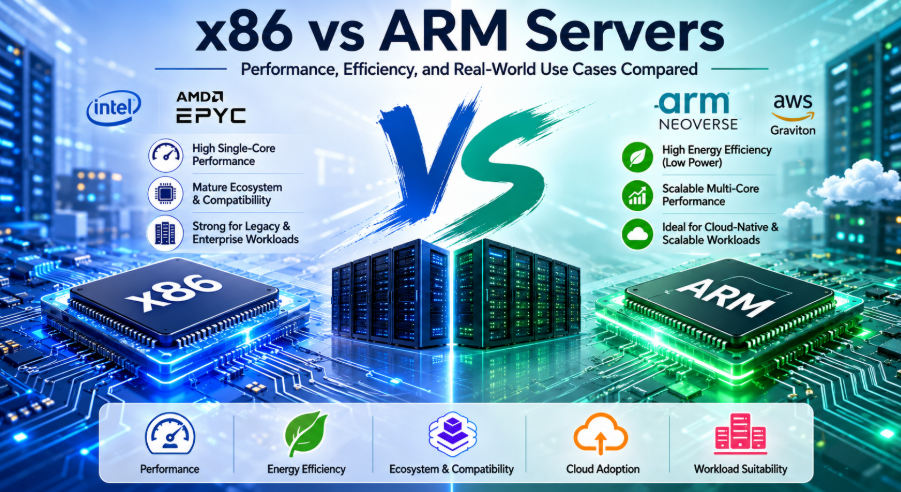
x86 vs ARM Servers: Performance, Efficiency, and Real-World Use Cases Compared

1. Architecture Overview

x86 Servers

x86 is a Complex Instruction Set Computing (CISC) architecture. It has been optimized over many generations for high compatibility and strong single-thread performance.

Key characteristics:

  • Mature ecosystem and software compatibility
  • Strong per-core performance
  • Widely used in enterprise and legacy systems
  • Dominated by Intel Xeon and AMD EPYC

ARM Servers

ARM is a Reduced Instruction Set Computing (RISC) architecture designed for efficiency and simplicity.

Key characteristics:

  • High energy efficiency per watt
  • Scalable core designs
  • Often used in hyperscale cloud environments
  • Powered by designs such as ARM Neoverse and custom silicon (e.g., AWS Graviton)

2. Performance Comparison

Single-Core Performance

x86 processors traditionally lead in raw single-thread performance, which benefits:

  • Databases with heavy transactional logic
  • Legacy enterprise applications
  • Certain high-frequency trading systems

ARM has significantly improved but still depends on specific implementations and workloads.


Multi-Core Performance

ARM architectures scale efficiently with many cores due to:

  • Lower power per core
  • Dense core designs

However, modern AMD EPYC processors also deliver extremely high core counts and competitive multi-thread performance.

In many cloud-native workloads, ARM can match or exceed x86 in throughput-per-watt efficiency.


3. Power Efficiency and Cost

One of ARM’s strongest advantages is energy efficiency.

ARM advantages:

  • Lower power consumption per compute unit
  • Reduced cooling requirements
  • Better performance-per-watt in many cloud workloads

x86 advantages:

  • Higher absolute performance per node
  • Better suited for compute-heavy or latency-sensitive workloads

In large-scale data centers, power efficiency often translates directly into lower operational cost, making ARM increasingly attractive.


4. Software Ecosystem and Compatibility

x86 ecosystem

x86 has the most mature software ecosystem:

  • Nearly all enterprise software supports x86
  • Extensive optimization over decades
  • Broad vendor support

ARM ecosystem

ARM support has improved significantly:

  • Major Linux distributions fully support ARM
  • Cloud-native tools (Docker, Kubernetes) are well-optimized
  • Many SaaS and open-source projects run natively

However, some legacy enterprise applications still require x86 compatibility layers or recompilation.


5. Cloud Adoption Trends

ARM adoption is accelerating in cloud computing:

  • Hyperscalers deploy ARM for cost efficiency
  • ARM instances are widely available in major cloud platforms
  • Cloud-native workloads (microservices, containers) benefit most

x86 remains dominant in:

  • Traditional enterprise IT
  • High-performance databases
  • Mixed legacy environments

6. Workload Suitability

Best for x86:

  • Enterprise databases (Oracle, SQL Server)
  • High-frequency trading systems
  • Legacy enterprise applications
  • Compute-heavy simulations

Best for ARM:

  • Web servers and microservices
  • Containerized workloads
  • Scalable cloud applications
  • Media streaming and CDN edge nodes

7. Future Outlook

The industry is moving toward a heterogeneous computing model, where both architectures coexist:

  • x86 continues to dominate legacy and high-performance enterprise systems
  • ARM grows rapidly in cloud-native and energy-sensitive environments

Rather than replacing x86, ARM is expanding the range of choices for infrastructure design.


Conclusion

x86 and ARM servers are not direct replacements for each other—they are optimized for different priorities.

  • x86 prioritizes compatibility and peak performance
  • ARM prioritizes efficiency and scalability

Choosing between them depends on workload type, cost structure, and deployment scale.

As cloud computing continues to evolve, both architectures will remain essential pillars of modern infrastructure.
Tags : ARM cloud computing ARM server performance server CPU comparison x86 architecture x86 vs ARM servers

Related Post

15 minutes INDUSTRY INFORMATION

FaaS Event Triggers vs. Polling: Key Differen

When working with Function-as-a-Service (FaaS), there a...

3 minutes INDUSTRY INFORMATION

Server Uptime Checker for Reliability

Monitor Your Website with a Server Uptime Checker Ensur...

3 minutes INDUSTRY INFORMATION

How to Deploy a High-Performance WordPress Si

The Evolution of WordPress Hosting WordPress powers ...

3-Day & 7-Day Trial at $1.9

GPU Special Offers

RTX40 & P40 GPU Server

Light Server promotion:

ulhost

Cloud Server promotion:

Affordable CDN

ucdn

2025 Special Offers

annual vps

Copyright © 2024 SurferCloud All Rights Reserved. Terms of Service. Sitemap.