Introduction: The Compute Gold Rush
The year 2026 marks a pivotal moment in the evolution of Artificial Intelligence. With the release of groundbreaking models like GLM-4.5 and the anticipation of Qwen3, the barrier to entry for AI innovation is no longer just "data" or "algorithms"—it is access to high-performance compute. For independent developers, startups, and even large-scale enterprises, the cost of purchasing physical hardware like the NVIDIA RTX 4090 or professional data center cards has become prohibitive due to supply chain fluctuations and rapid generational turnover.
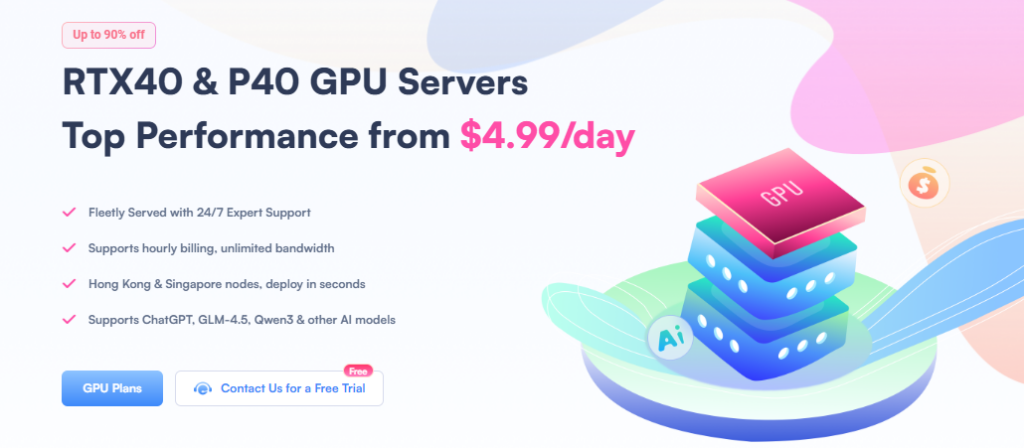
Enter SurferCloud’s GPU Cloud Promotion. By offering up to 90% off on RTX 40 and Tesla P40 servers, SurferCloud is democratizing AI. But with prices starting as low as $4.99/day, users often ask: “Which GPU is right for my specific workload?” In this 1,000-word deep dive, we will analyze the architecture, performance metrics, and cost-efficiency of these two powerhouses to help you make an informed decision.
1. Architecture Deep Dive: Ada Lovelace vs. Pascal
To understand why these GPUs perform differently, we must look at their underlying architecture.
The RTX 40 Series: The Modern Speed Demon
The RTX 40 series, built on the Ada Lovelace architecture, is a masterpiece of efficiency. It is designed for high-throughput tasks that utilize modern AI frameworks.
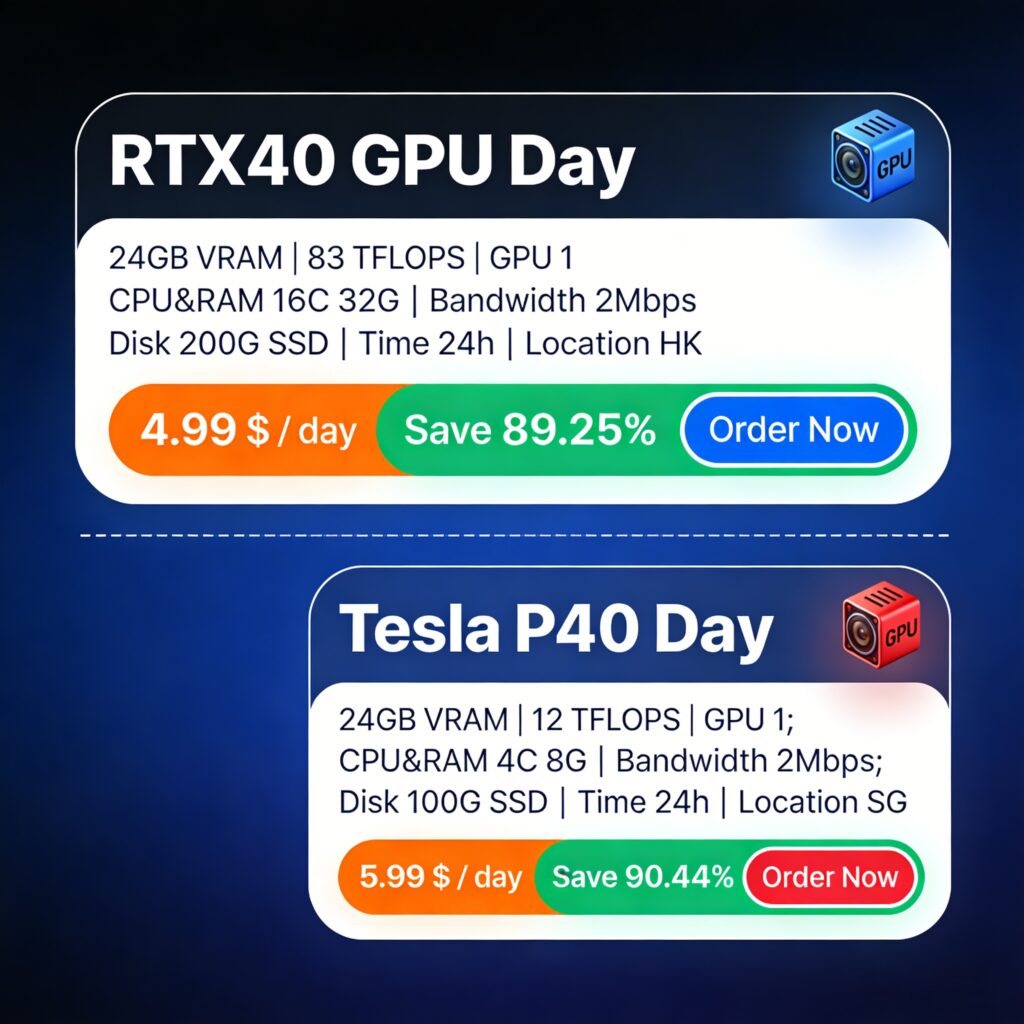
- TFLOPS Power: With 83 TFLOPS of single-precision compute power, the RTX 40 is nearly 7 times faster than the P40 in raw calculations.
- 4th-Gen Tensor Cores: These cores are the "secret sauce" for AI. They support FP8 (8-bit Floating Point) data types, which allow large models like Llama-3 or GLM-4.5 to run faster and use less memory without losing accuracy.
- Ray Tracing & AIGC: For users involved in AI-generated content (AIGC), such as Stable Diffusion or video generation, the 3rd-Gen RT cores ensure that rendering and pixel manipulation happen in real-time.
The Tesla P40: The Reliable Veteran
The Tesla P40 is based on the Pascal architecture. While it lacks the specialized AI-acceleration cores of the Ada Lovelace generation, it possesses a unique advantage: Enterprise-Grade Stability.
- Massive VRAM: Like the RTX 40, the P40 boasts 24GB of VRAM. In the world of LLMs (Large Language Models), VRAM is often more important than raw speed. If a model doesn't fit in VRAM, it won't run. The P40 ensures you can load large model weights for a fraction of the cost.
- Passive Cooling & Durability: As a data center card, the P40 is designed for 24/7 continuous operation under 100% load—something consumer-grade cards sometimes struggle with over long durations.
2. Performance Benchmarking for AI Tasks
When choosing a server on SurferCloud, you should match the GPU to your specific task phase: Training, Fine-Tuning, or Inference.
Scenario A: Large Model Training & Fine-Tuning
If you are performing LoRA (Low-Rank Adaptation) fine-tuning on a 70B parameter model, time is money.
- RTX 40 Performance: Thanks to its high clock speeds and modern architecture, a fine-tuning job that takes 10 hours on an RTX 40 might take 40+ hours on a P40.
- Recommendation: Use the RTX 40 GPU-1 or GPU-2 Monthly Plans. At $224.38/month, the cost-per-hour of compute is incredibly low compared to Amazon AWS or Google Cloud.
Scenario B: Inference and Chatbot Deployment
Inference is the process of running a pre-trained model to answer user queries.
- Tesla P40 Performance: For a standard chatbot based on Qwen3-7B, the response latency difference between a P40 and an RTX 40 might only be a few milliseconds—hardly noticeable to a human user.
- Recommendation: Use the Tesla P40 Day or Week plans. At $5.99/day, you can host a fully functional AI service for an entire week for less than $45.
3. Geographical Strategic Advantage: Hong Kong vs. Singapore
SurferCloud doesn't just provide hardware; it provides strategic location.
- Hong Kong Nodes (RTX 40): Hong Kong is the premier gateway for Asian AI development. It offers low-latency connections to mainland China and Southeast Asia. For developers using Chinese-origin models like GLM-4.5, hosting in Hong Kong ensures the fastest data transfer and model pulling speeds.
- Singapore Nodes (Tesla P40): Singapore is a global connectivity hub. If your application serves a global audience, particularly in India, Australia, and the ASEAN region, the Singapore P40 nodes offer the most stable "Five Nines" (99.999%) uptime environment.
4. Step-by-Step: Setting Up Your SurferCloud GPU Server
One of the key selling points mentioned is "Deploy in Seconds." Here is how the workflow looks for a typical developer:
- Selection: Navigate to the SurferCloud GPU Promo page.
- Model Choice: Choose the RTX40 GPU Day plan for a quick test ($4.99).
- OS Image: Select an image with Ubuntu 22.04 + CUDA 12.x pre-installed. This saves you hours of driver troubleshooting.
- Environment Setup:Bash
# Update system and install basic tools sudo apt-get update && sudo apt-get install -y python3-pip # Install common AI libraries pip install torch torchvision torchaudio pip install transformers accelerate vllm
- Run Inference: Within 5 minutes, you can have a model like Stable Diffusion or a Qwen-7B model running on your public IP.
5. Analyzing the "90% Off" Economics
Why is this promotion a big deal? Let's look at the market comparison.
A standard RTX 4090 cloud instance on mainstream "big tech" cloud providers can cost between $0.80 and $1.50 per hour.
- SurferCloud RTX 40 Daily: $4.99 / 24 hours = $0.20 per hour.
- SurferCloud Tesla P40 Daily: $5.99 / 24 hours = $0.25 per hour.
This represents a 75% to 85% discount compared to the industry average. Furthermore, the Unlimited Bandwidth policy is crucial. Most providers charge "Egress Fees" when you download your trained model weights. At SurferCloud, if you train a 100GB model, you can move it for free.
6. The Verdict: Which Plan Should You Buy?
- Choose the RTX 40 (Hong Kong) if: You are an AIGC artist, a developer fine-tuning the latest models, or a research student needing the absolute fastest CUDA performance for complex simulations.
- Choose the Tesla P40 (Singapore) if: You are an enterprise running a stable inference API, a student learning the basics of deep learning, or a researcher performing long-running but less compute-intensive "stress tests."
Conclusion: Don't Wait for the Future, Build it Now
With the RTX 5090 arriving in February 2026, the current RTX 40 and P40 offers are the perfect way to build your pipeline and codebase today. By taking advantage of SurferCloud’s 75% off monthly plans or the $4.99/day daily special, you are not just renting a server—you are securing the competitive edge needed in the AI era.
Ready to start? Join thousands of developers today. Click here to claim your Free Trial or Order Now.