SurferCloud 2025 Special Offers: 55% Off Unbe
SurferCloud is kicking off 2025 with incredible special...








An AI agent that only works while your laptop is open is not really an agent — it is a script with good manners. The promise of an always-on assistant collapses the moment you close the lid, lose Wi-Fi, or need to run it while you sleep.
This guide explains why OpenClaw belongs on a cloud server rather than a local machine, what changes when you make that move, and what the current deployment promotion costs.
OpenClaw works fine on a personal machine during testing. The trouble starts when you depend on it. Five failure modes show up repeatedly:
None of these are OpenClaw bugs. They are consequences of the environment. Move the agent to a server and all five disappear at once.
Deploying OpenClaw to a cloud instance replaces an intermittent local process with a continuously available service.
| Dimension | Local machine | Cloud server |
|---|---|---|
| Uptime | Only while powered on and connected | Runs continuously, independent of your devices |
| Network | Residential NAT, dynamic IP, unstable | Public IPv4, stable inbound and outbound routes |
| Setup effort | Manual environment configuration | Prebuilt OpenClaw image, ready in about three minutes |
| Isolation | Shares the OS with everything else you run | Dedicated instance, separated from your personal environment |
| Scaling | Buy new hardware and migrate | Resize CPU, memory, and bandwidth on demand |
| Regional access | Limited by your physical location | Deploy in the region closest to your users and APIs |
| Cost profile | Hardware purchase, electricity, maintenance | Monthly subscription from a few dollars |
The practical difference is this: on a local machine you are operating an appliance. On a cloud server you are operating a service. Only one of those can be relied on by a team.
OpenClaw connects a language model to tools, files, and messaging platforms. That combination covers more ground than most people expect.
The common thread is that none of these tolerate interruption. An agent that processes invoices is useless if it stops at 6 p.m. when you shut your laptop.
OpenClaw is model-agnostic. You connect it to whichever provider fits your budget and latency requirements, and switch later without redeploying.
Supported model families include GPT-5 and GPT-4, Claude, Gemini, DeepSeek, and GLM. Beyond the named integrations, any OpenAI-compatible endpoint works, and you can point OpenClaw at a custom model endpoint if you run your own inference.
On the tooling side, built-in integrations cover Slack, Discord, Telegram, email over SMTP, generic webhooks and REST APIs, and GitHub or GitLab. This matters more than it sounds: the value of an agent is proportional to how easily it reaches the systems you already use.
SurferCloud ships OpenClaw as a prebuilt image on CentOS Stream 9, available in Japan, Singapore, and US data centres. Three deployment options are currently discounted.
| Option | Specification | Bandwidth | List price | Promo price |
|---|---|---|---|---|
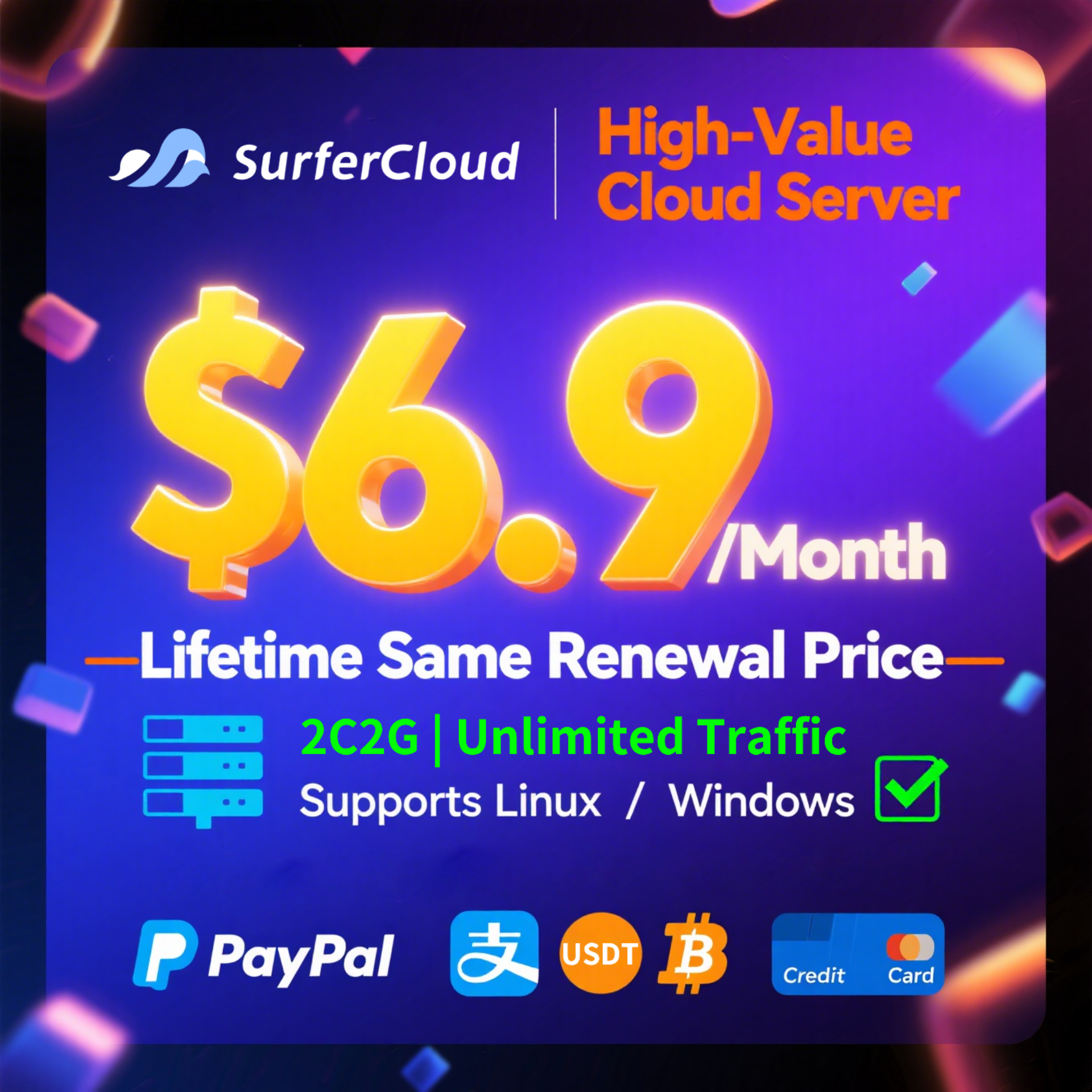
| ULightHost — monthly | 1 vCPU / 2 GB / 40 GB RSSD, 1 IPv4 | 30 Mbps peak | $7.50/mo | $6.75/mo |
| UHost — first month | 2 vCPU / 2 GB / 40 GB RSSD, 1 IPv4 | 1–2 Mbps dedicated | $34.16/mo | $6.90/mo |
| UHost — first quarter | 1 vCPU / 2 GB / 40 GB RSSD, 1 IPv4 | 1–2 Mbps dedicated | $20.49/mo | $4.66/mo |
Two things are worth noting about these tiers, because they suit different intents.
The ULightHost monthly option at $6.75 is the straightforward one: a fixed monthly price, 30 Mbps peak bandwidth, and no commitment beyond the current month. If you want to run OpenClaw continuously as an always-on assistant and prefer predictable billing, this is the cleanest choice.
The UHost promotional tiers are the better value if you want to test properly before committing. The first-quarter option works out to $4.66 per month — roughly a 77% reduction against list price — which buys enough time to move real workloads onto the instance rather than just checking that it boots. The trade-off is dedicated bandwidth in the 1–2 Mbps range rather than peak bandwidth, which is ample for agent traffic but not for bulk data transfer.
A practical rule: if your agent mostly exchanges text, calls APIs, and processes documents, either tier is comfortable. If you plan to move large files or run high-frequency market data through it, the higher-bandwidth monthly option is the safer start.
End-to-end, this is about three minutes of work. The absence of a manual environment build is the point — it removes the most common reason local deployments fail.
Place the instance close to whatever the agent talks to most, not close to yourself. An agent polling an exchange API benefits far more from proximity to that exchange than from proximity to your desk.
If you intend to combine an agent with latency-sensitive trading, note that SurferCloud also runs promotional low-latency instances in additional zones — worth comparing against the three OpenClaw regions before you commit.
Do I need to know Linux to deploy OpenClaw?
No. The image is preconfigured, and the documented path is browser-based selection plus an API key. Command-line access is available if you want it, but it is not required to get running.
Can I switch AI providers after deploying?
Yes. OpenClaw supports GPT-5, GPT-4, Claude, Gemini, DeepSeek, and GLM, along with any OpenAI-compatible endpoint. Changing provider is a configuration change, not a redeployment.
Is 1 vCPU and 2 GB enough?
For an assistant handling text, documents, and API calls, yes. The workload is dominated by waiting on model responses rather than local computation. If you plan to run local inference, process large batches, or handle high-frequency data, start higher.
What bandwidth do I actually need?
Agent traffic is light — text and JSON. Dedicated 1–2 Mbps sustains normal use comfortably. The exception is bulk file transfer or streaming market data, where peak bandwidth matters.
Can I run more than one agent on a single instance?
Yes, within resource limits. Multiple lightweight agents generally coexist on a 2 vCPU instance. Separate them onto different instances when their workflows must fail independently.
How does this compare with running it on my own computer?
The agent becomes always available, reachable over the public internet, isolated from your personal files, and resizable as needs change — for less per month than most people spend on coffee.
OpenClaw is capable on a local machine and dependable on a server. The difference is not performance — it is whether the agent keeps running when your computer does not.
At current promotional pricing, the cost of that reliability starts at $4.66 per month. Given that a single missed overnight job or a broken dependency chain costs far more in time, the economics are not close.
For specifications, region availability, and current terms, see the OpenClaw cloud deployment page. If your agent's work touches markets, the low-latency quant instances are worth a look as well, and the ULightHost lineup covers general-purpose workloads beyond agent hosting.