LightNode Review: A Disappointing Experience
In the ever-growing world of web hosting, user reviews ...









Managing multi-cloud environments is complex. From inconsistent security policies to fragmented APIs, organizations face challenges that lead to cost overruns and performance bottlenecks. AI-powered tools are stepping in to simplify operations, optimize resources, and cut costs. Here are five standout solutions:
Each tool offers unique ways to improve multi-cloud operations. Choose based on your priorities - cost control, performance, or compliance.
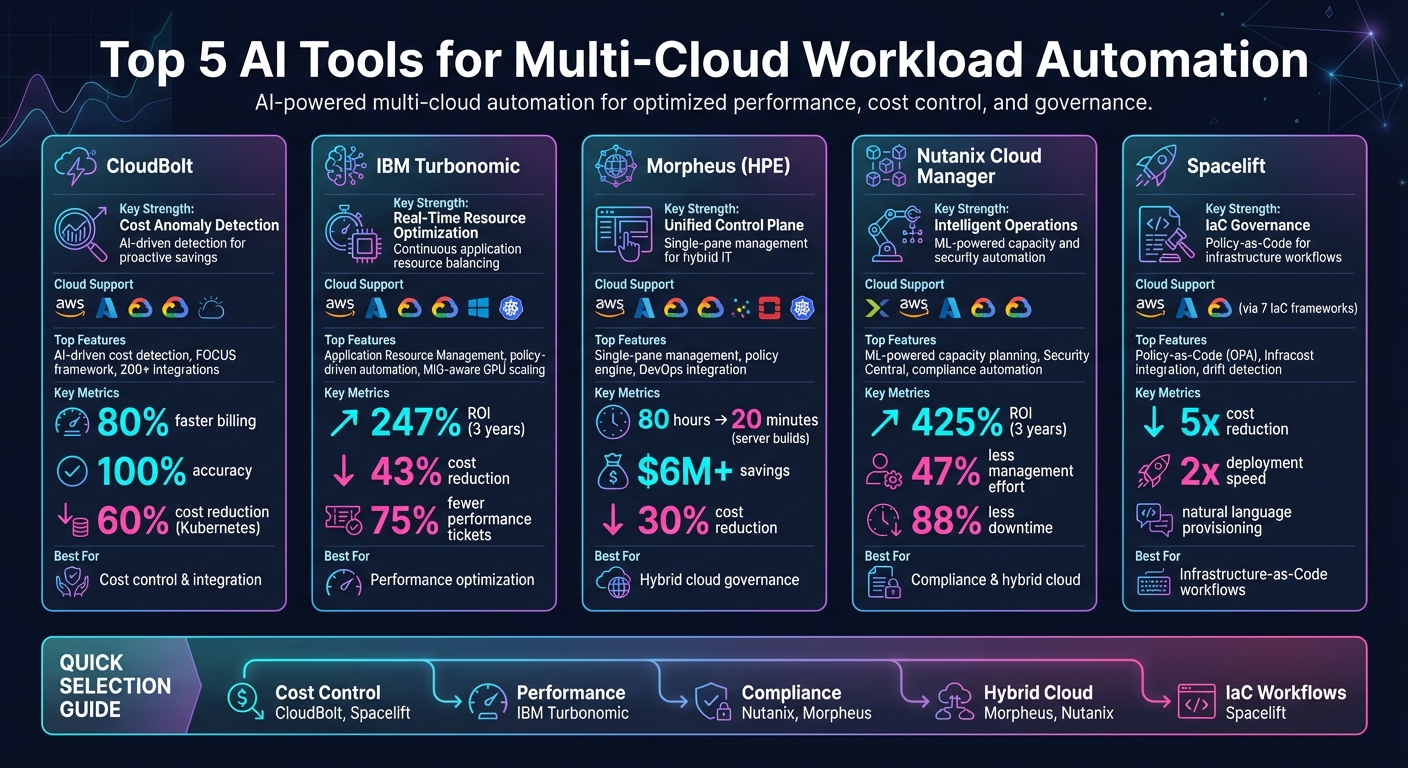
Comparison of Top 5 AI Tools for Multi-Cloud Workload Automation
CloudBolt tackles the challenges of managing multiple cloud environments with its AI-powered platform that works seamlessly across AWS, Azure, Google Cloud, VMware, and IBM Cloud. By leveraging machine learning, it analyzes workload behavior to automatically adjust and place resources in the most efficient way possible [6]. This approach ensures smarter and more cost-effective resource management.
When it comes to cost control, CloudBolt offers standout features like AI-driven anomaly detection to catch unusual spending patterns. It also uses the FOCUS (FinOps Open Cost & Usage Specification) framework to allocate costs with precision. The platform’s efficiency is reflected in its ability to speed up billing cycles by 80%, ensure 100% billing accuracy, and deliver savings 90% faster [6]. For Kubernetes users, CloudBolt integrates StormForge’s machine learning capabilities to optimize container resources, cutting resource usage costs by as much as 60% [6].
CloudBolt also enforces strict policy-as-code governance, ensuring every deployment meets security and compliance requirements right from the start. With over 200 pre-built integrations - including tools like Terraform, Ansible, and ServiceNow - it fits easily into existing IT environments [6]. This integration and governance make managing diverse cloud setups more streamlined.
Take Lobster, a German data integration company, as an example of CloudBolt’s impact. After adopting the platform, Lobster reduced manual work by 90% and sped up provisioning by six times. This enabled them to scale their operations fivefold with just two additional engineers, all while handling 30,000 jobs per month at a 90% success rate [6].
Richard Vester, Chief Executive of Cloud & AI at iOCO, shared: "CloudBolt continues to transform the way we deliver cloud services at iOCO. By streamlining cloud management and automating complex workflows, we've significantly accelerated service delivery while reducing operational costs" [6].
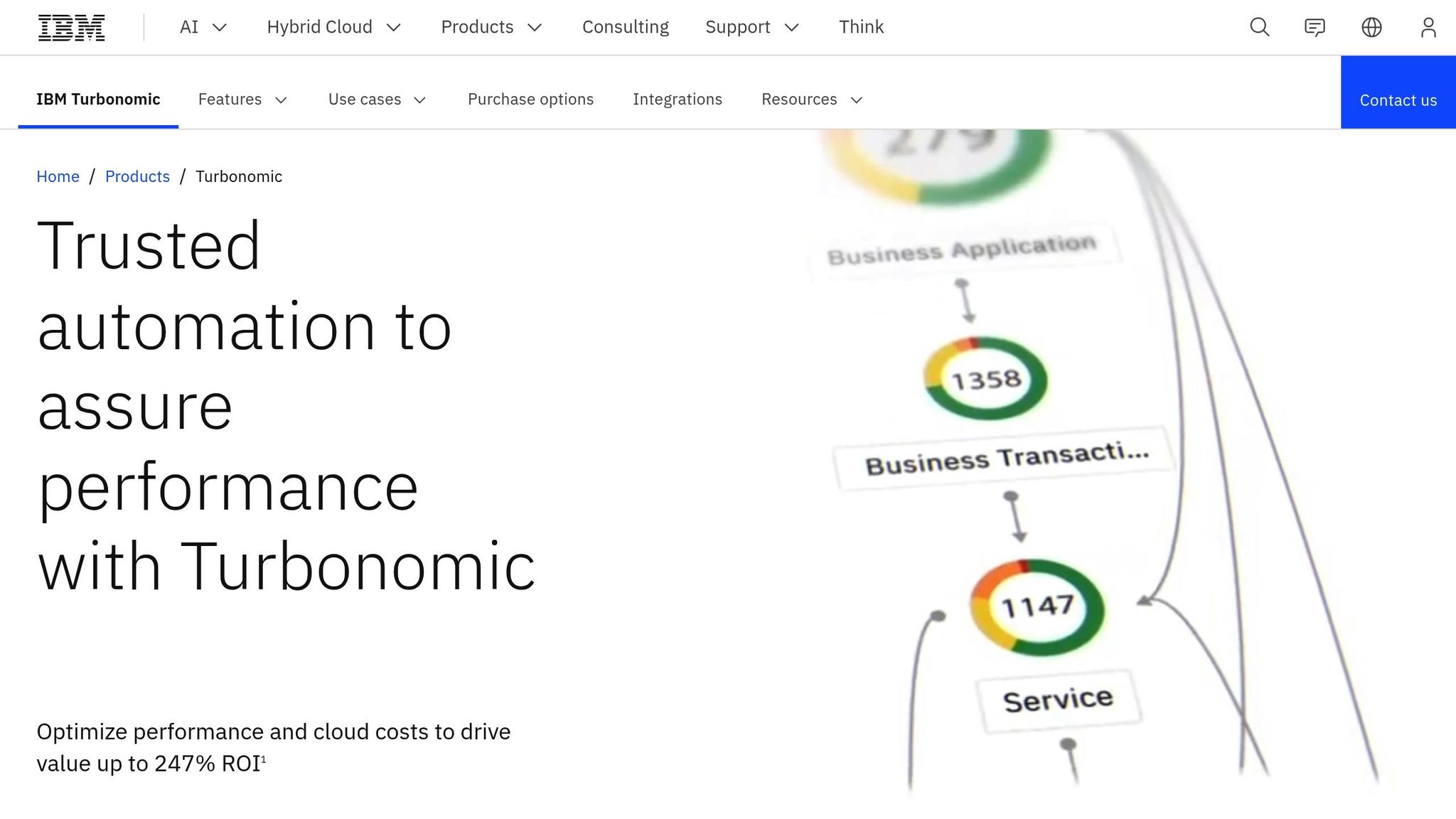
IBM Turbonomic is designed to optimize multi-cloud environments by continuously analyzing real-time application demands and automatically adjusting resources like compute, storage, network, and GPU to meet exact requirements. This fine-tuned approach ensures that resources are allocated efficiently, which is especially important in complex multi-cloud setups [7]. By mapping dependencies from the application layer all the way down to the physical infrastructure, the platform helps teams spot and address potential issues before they can disrupt performance [7]. The result? Tangible improvements in cost management and operational efficiency.
Take these examples: In 2024, Evides managed to cut its cloud costs by 43% in just three months while also increasing its cloud footprint by 8%. Similarly, Samsung SDS America saved $400,000 in six months, and Komatsu achieved annual savings of $650,000 alongside a 33% decrease in server run rates [11].
What sets Turbonomic apart is its policy-driven automation. The platform doesn’t just offer recommendations - it acts on them, following user-defined business rules to ensure compliance and maintain audit trails [7][8]. It supports a wide range of environments, from AWS, Azure, and Google Cloud to VMware vSphere, Microsoft Hyper-V, IBM PowerVM, Nutanix AHV, and even container platforms like EKS, AKS, GKE, and OpenShift. Plus, its integration with Terraform enables real-time recommendations for infrastructure management [10].
For AI workloads, Turbonomic employs MIG-aware scaling, which enhances GPU utilization and increases idle GPU availability by 5.3× [9]. It also optimizes cloud discount programs by factoring in existing Reserved Instances when making scaling adjustments, helping organizations maximize savings. The results speak for themselves: companies have reported a 247% ROI over three years and a 75% drop in performance-related tickets [7][8].
"Turbonomic doesn't stop at recommendations. It executes safe, policy-driven actions across hybrid and multicloud... every action is auditable and enables IT teams to operate at enterprise scale without manual intervention."
– IBM Product Overview [7]
Morpheus, now part of HPE under the name HPE Morpheus Enterprise, offers a centralized control platform that bridges public clouds like AWS, Azure, and Google Cloud with private setups such as VMware, KVM, OpenStack, and Kubernetes clusters [28, 30]. This single-pane-of-glass approach allows IT teams to manage everything from bare metal servers to containers and multi-tier applications, all from one place. The result? Simplified operations, better governance, and improved cost management.
The platform's built-in policy engine strengthens governance through features like role-based access controls, automated approval workflows, and quota enforcement, effectively curbing shadow IT [28, 32]. On the financial side, its AI-driven analytics optimize resource allocation and enforce spending limits, often reducing cloud costs by up to 30% [28, 32].
A real-world example of its impact is AstraZeneca. By adopting HPE Morpheus Enterprise, the pharmaceutical giant transformed its hybrid-cloud operations. Server build times dropped dramatically - from 80 hours to just 20 minutes. Additionally, they automated regulatory compliance and achieved over $6 million in savings [28, 32].
"AstraZeneca achieved exceptional agility and cost savings with HPE Morpheus Enterprise, reducing server build times from 80 hours to 20 minutes, automating regulatory compliance, and saving over $6 M."
– HPE Morpheus Case Study [12]
When it comes to daily operations, Morpheus handles the entire workload lifecycle - scaling, logging, monitoring, backups, and even cloud migrations [30, 32]. It integrates seamlessly with popular DevOps tools like Ansible and Terraform, as well as ITSM platforms like ServiceNow, ensuring a streamlined workflow [13]. The platform's excellence hasn’t gone unnoticed: it was named a representative vendor in the 2025 Gartner Market Guide for Infrastructure Automation and Orchestration Tools [14] and recognized as a leader in the GigaOM Radar for Cloud Management Platforms [15].
Nutanix Cloud Manager (NCM) brings AI-powered automation to hybrid and multi-cloud setups, seamlessly connecting Nutanix clusters with AWS, Microsoft Azure, Google Cloud, and VMware by Broadcom [19][20]. One standout feature, Intelligent Operations, uses machine learning to predict capacity needs, identify inefficiencies, and deliver AI-driven root cause analysis. This reduces management effort by as much as 47% [16]. Businesses using NCM report impressive results, including 88% less planned downtime and a 21% boost in developer productivity [19].
Cost governance is a key area where NCM excels. The platform automates chargebacks, improves cost allocation, and sends budget alerts - helping organizations cut multi-cloud spending by 35% or more [16]. For example, in June 2019, Declan Fleming, Enterprise Architect for Cloud at UC San Diego, implemented NCM’s cost governance tools. The result? The university significantly reduced cloud sprawl, saving thousands of dollars each month [19]. Similarly, in December 2023, Kevin Priest, Senior Director at The Home Depot, used NCM Intelligent Operations to monitor clusters and manage capacity proactively, using clear metrics to address oversubscription and utilization [18][19].
On the compliance side, NCM Security Central ensures organizations stay audit-ready 24/7. It automates reporting for standards like HIPAA, ISO 27001, SOC 2, GDPR, NIST, and PCI-DSS [17][19]. The platform simplifies security operations with automated incident response, vulnerability detection, and tools for planning Zero Trust architectures [17]. For day-to-day tasks, NCM offers a self-service marketplace and customizable blueprints, making it easy to deploy complex applications with just one click - no coding required [19]. It also integrates seamlessly with ITSM tools like ServiceNow and supports infrastructure-as-code workflows [19][20].
NCM’s value is further amplified by its flexible licensing options and proven financial benefits. Organizations have reported a 425% ROI over three years, up to 42% cost reductions, and a #1 ranking on PeerSpot [19][16]. For instance, in June 2025, WesBanco Bank’s Systems Engineer, Mitchell Blake, consolidated multiple management consoles into NCM’s unified interface, cutting infrastructure management time by 20–30% [18]. NCM is available in three licensing tiers - Starter, Pro, and Ultimate - with consumption options like Bring Your Own License (BYOL), Pay-As-You-Go (PAYG), and Cloud Commit [19][20].
Spacelift offers a unified solution for automating multi-cloud workloads, supporting seven Infrastructure as Code (IaC) frameworks like Terraform, OpenTofu, Pulumi, AWS CloudFormation, Kubernetes, Ansible, and Terragrunt. This broad compatibility allows organizations to standardize workflows across different cloud environments. The platform also integrates Open Policy Agent (OPA) to enforce guardrails, giving platform teams control over resource creation, setting approval thresholds based on change impact, and attaching policies to new environments using labels. By combining automation with cost and policy management, Spacelift simplifies multi-cloud operations.
A standout feature is Spacelift's integration with Infracost, which embeds cost tracking directly into deployments. It automatically estimates expenses for AWS, Azure, and Google Cloud Platform (GCP), offering detailed cost breakdowns and state differences within the Spacelift interface and version control system (VCS) pull requests. As Flavius Dinu from Spacelift puts it, "having Infracost as part of your IaC process and seeing the details in both Spacelift and the VCS PR will save costs because it will make everybody more aware of the impact of their changes" [21]. Beyond passive monitoring, teams can use OPA "plan policies" to block deployments automatically if estimated costs exceed predefined thresholds.
Spacelift also tackles challenges like scaling and skill gaps. Its drift detection feature automatically identifies and corrects configuration drift by comparing live infrastructure with its intended state. For teams without extensive IaC expertise, Spacelift provides "Blueprints", a self-service catalog that enforces best practices without requiring manual code reviews. Furthermore, the "Intent" feature allows developers to provision environments using natural language commands, while platform teams retain full control over policies and audits.
The platform's real-world success stories highlight its effectiveness. In 2025, the Odos team reported a fivefold reduction in IaC costs and doubled their deployment speed, while Logixboard significantly reduced troubleshooting time after adopting Spacelift [22]. The platform’s pricing model remains consistent, regardless of the number of resources managed.
Spacelift doesn't stop at automation - it also adapts policy controls to fit development workflows. Teams can define actions for pull request events and customize notification routing at the Git level. Additional flexibility comes from native integrations with AWS, Azure, and GCP for dynamic credentials, as well as support for custom Docker images and script hooks for pre- and post-runner phases. For those looking to explore the platform, Spacelift offers a free tier that includes access to plan and approval policies, unlimited integrations, and compatibility with multiple IaC tools.
Each tool approaches cost management, scaling, and governance in multi-cloud environments differently. CloudBolt leverages AI-driven anomaly detection to manage costs across AWS, Azure, GCP, and VMware. It also uses policy-based guardrails to curb shadow IT sprawl and maintain control [3][5][2]. On the other hand, IBM Turbonomic focuses on Application Resource Management (ARM), delivering real-time actions like resizing and workload placement. This ensures continuous scaling across platforms like AWS, Azure, GCP, VMware, Hyper-V, and Kubernetes [3][23][1].
Governance and integration capabilities further set these tools apart. Morpheus provides unified cost visibility and built-in guardrails, aligning seamlessly with DevOps tools for smooth multi-cloud governance [1]. Nutanix Cloud Manager stands out with features tailored for hybrid cloud strategies, such as automated capacity analysis, advanced security insights, and tools for regulatory compliance [23][1]. Meanwhile, Spacelift focuses on governance for infrastructure-as-code (IaC) workflows, incorporating Policy-as-Code through Open Policy Agent (OPA). It supports platforms compatible with Terraform and OpenTofu, centralizing policy management [23][2].
Pricing models also vary across these platforms. IBM Turbonomic uses instance-based subscriptions, while Spacelift ties its pricing to the resources under management [23]. For CloudBolt and Morpheus, enterprise licensing typically requires direct vendor contact [2]. Each tool offers distinct advantages to streamline multi-cloud operations, ensuring efficiency, compliance, and performance across diverse environments.
AI-powered automation is transforming the way organizations handle multi-cloud management. By offering unified visibility across platforms like AWS, Azure, GCP, and on-premises environments, it helps tackle challenges like cloud sprawl while slashing deployment times and cutting large-scale workload costs by as much as 70% [4].
When choosing the right tools, focus on your primary needs - whether it's cost control, performance optimization, or compliance. If managing budgets is your top concern, prioritize tools that automate spot instance management and clean up idle resources. For performance-heavy workloads, look for solutions that excel in real-time scaling and GPU optimization. And if compliance is critical, consider platforms that include Policy-as-Code features and automated drift remediation.
Proactive infrastructure management is no longer optional. As multi-cloud adoption continues to grow, leveraging the right automation tools is key to staying competitive. Start small by migrating non-critical workloads, then expand as you confirm cost savings and performance benefits.
Whether it’s CloudBolt for cost anomaly detection, IBM Turbonomic for real-time resource optimization, Morpheus for a unified self-service catalog, Nutanix for hybrid cloud capabilities, or Spacelift for IaC governance, each tool brings unique strengths to the table. Align these tools with your organization's needs to streamline and secure your cloud operations. By addressing issues like cloud sprawl and fragmented workflows, these solutions enable continuous, efficient, and proactive management.
AI tools make managing costs in multi-cloud environments much easier by processing large volumes of usage and pricing data from providers like AWS, Azure, and Google Cloud. With the help of machine learning, these tools can forecast future expenses, flag unusual spending patterns, and recommend ways to cut costs - like resizing resources or shutting down unused ones - before budgets get out of hand.
Some advanced AI solutions take it a step further by automating cost-saving measures in real time. For example, they can apply spot-instance pricing or enforce financial policies automatically. When paired with platforms like SurferCloud, these tools offer a centralized dashboard for tracking expenses across various regions and services. This allows businesses to move workloads to more affordable resources without compromising on performance or security.
When you're choosing an AI tool for automating workloads across multiple cloud platforms, there are a few critical things to keep in mind to ensure it aligns with your goals:
Focusing on these aspects will help you choose an AI solution that is reliable, efficient, and secure, making workload automation across various cloud platforms a hassle-free experience.
Policy-driven automation takes the complexity out of compliance by transforming regulatory and governance requirements into machine-readable policies that automatically enforce rules across all cloud platforms. These policies-as-code ensure that security, access, and operational guidelines are applied consistently, cutting down on the need for manual checks.
Automation keeps resources in check by continuously evaluating them against these policies. If something goes off track, real-time corrective actions kick in to address misconfigurations immediately. Plus, versioned and auditable policies provide a detailed compliance trail, logging exceptions, approvals, and remediations with timestamps and ownership details. This creates clear, real-time evidence of compliance, making it easier for businesses to meet standards like CIS or other industry frameworks while reducing manual work and avoiding policy inconsistencies.