How to Choose a Reliable Game Server: 10 Expe
Whether you're setting up a private server for friends,...








Hybrid cloud storage tools help businesses connect on-premises systems with cloud storage for efficient data management. These tools use standard protocols like NFS, SMB, and iSCSI, enabling seamless integration without modifying existing applications. Core benefits include scalability, cost-effective pay-as-you-go pricing, and improved business continuity through fast data replication. Below are the top tools for hybrid cloud storage, each offering unique features for different needs:
Each tool supports hybrid cloud setups with features like local caching, strong security, and integration with existing workflows. Pricing models vary, but most operate on a pay-as-you-go basis, with options for cost savings through tiered storage or efficient data transfer methods.
| Tool | Key Features | Pricing | Best For |
|---|---|---|---|
| SurferCloud UHost | Elastic compute, secure connectivity, customizable resources | Starting at $6/month | Scalable hybrid environments |
| SurferCloud US3 | Unlimited storage, lifecycle management, cross-region replication | Pay-as-you-go | Large-scale storage with cost control |
| SurferCloud UDB | High-performance databases, strong security, seamless cloud integration | Starting at $3.50/month | Hybrid database management |
| SurferCloud UCDN | Global content delivery, edge caching, traffic management | Prepaid packages | Content-heavy hybrid setups |
| AWS Storage Gateway | Local caching, multiple gateway types, robust security | Pay-as-you-go | Enterprise-grade hybrid storage |
| Microsoft Azure Arc | Unified management, GitOps support, strong compliance | Custom pricing | Hybrid and multi-cloud infrastructure |
| Google Storage Transfer | High-speed data migration, detailed logging, secure transfers | $0.0125/GB (file systems) | Large-scale data transfer and migration |
These tools simplify hybrid cloud adoption, offering options for various workloads, budgets, and compliance needs.

Hybrid Cloud Storage Tools Comparison: Features, Pricing, and Best Use Cases
SurferCloud UHost offers elastic virtual servers that seamlessly integrate on-premises systems with cloud storage. Designed as "Hybrid Cloud Ready," it bridges your existing data center with cloud-based storage nodes, ensuring smooth operation across environments [7].
UHost stands out with its customizable CPU-to-memory ratios, ranging from 1:1 to 1:8, allowing you to fine-tune resources for optimal performance and cost efficiency [5]. Through API access, you can adjust these specifications on the fly. Some models even support hot upgrades, letting you expand CPU and memory without any downtime - keeping your operations uninterrupted during scaling [5].
Storage options are equally versatile, offering a mix of standard local disks, local SSDs, and cloud disks (UDisk) in standard, SSD, and RSSD formats [5]. This tiered storage system helps you balance performance and capacity based on your needs. Additionally, UHost instances connect to SurferCloud's US3 Object Storage via high-speed intranet, ensuring reliable upload and download speeds - critical for hybrid workflows [6]. The platform also supports basic and private network modes, giving you secure connectivity between cloud and on-premises resources [5].
SurferCloud UHost prioritizes security with features like network isolation through external firewalls and private modes [5]. The UDataArk feature offers continuous data protection, allowing recovery to any second within a 12-hour window, safeguarding against data loss or corruption [5]. It also integrates with SurferCloud's broader security suite, including DDoS protection and SSL encryption for secure data transmission [6]. All nodes meet ISO 27001 certification standards and adhere to regional data sovereignty regulations [7].
UHost is built to simplify hybrid cloud adoption. It supports custom images and major Linux/Windows distributions, making it easier to migrate existing workloads to the cloud [5]. With under 60ms latency from its Dubai hub to global users, it ensures fast and reliable performance [7]. For high availability, UHost can be combined with the ULB (Load Balancing) product, distributing traffic across hybrid or cloud-only setups [5]. SurferCloud also provides free data migration services, streamlining the transition from your current infrastructure to their platform [7]. These features create a flexible and scalable hybrid cloud solution.
UHost offers flexible billing options, including hourly, monthly, and annual prepayment plans [5]. In regions like Dubai, pay-per-second billing is available, delivering up to 60% cost savings for burstable workloads compared to traditional pricing models [7]. With customizable resource allocation, you only pay for what your applications actually require, ensuring efficient use of your budget.
SurferCloud US3 Object Storage provides virtually limitless cloud storage, accommodating single files as large as 5TB[6]. This makes it an excellent choice for businesses handling extensive media libraries, user-generated content, or big data workloads - all without the hassle of manual capacity management. With 99.999999999% (11 nines) data durability, your data is safe thanks to multiple copies stored across different clusters, even in the event of hardware failures[6].
US3 comes with three distinct storage tiers - Standard, Infrequent Access, and Archive - allowing you to balance costs based on how often your data is accessed[9]. Its lifecycle management feature automates file transitions or deletions according to predefined rules[9]. For businesses operating worldwide, cross-region replication ensures data synchronization between data centers, achieving near real-time updates for files as small as 2MB[8].
US3 ensures 99.95% availability and employs multiple security layers to safeguard your data[9]. Private buckets require API key authorization for all operations, while token-based security provides granular, time-sensitive permissions[9]. Data is transmitted securely with SSL encryption[6], and the platform integrates seamlessly with SurferCloud's DDoS defense system, which can mitigate attacks with up to 5Tbps of capacity[7]. Additional features like anti-leeching and token whitelisting further protect against unauthorized access[6]. These security measures are designed to work effortlessly with hybrid setups.
US3 is fully compatible with AWS S3 APIs, enabling smooth integration into existing workflows with minimal coding adjustments[6]. The US3FS tool allows cloud storage to be mounted as a local file system, so on-premises applications can operate as if they’re using local files[6]. For seamless data migration, the US3SYNC tool transfers files from local systems or other cloud environments to US3 without service interruptions[6]. Big data teams can also use tools for Hadoop, Hive, Spark, and Flink to interact with US3 just as they would with HDFS[6]. Additionally, UHost users enjoy high-speed intranet access to US3, enabling faster transfers without consuming public bandwidth[6]. These features make US3 a powerful solution for hybrid environments, combining speed, security, and flexibility.
US3 follows a pay-as-you-go pricing model, with no upfront costs or minimum commitments[6]. You only pay for the storage and bandwidth you actually use. The Infrequent Access and Archive tiers offer reduced per-gigabyte costs for data that isn’t accessed often[9]. However, keep in mind that cross-region replication involves additional traffic and request fees, which should be factored into disaster recovery budgets[8].
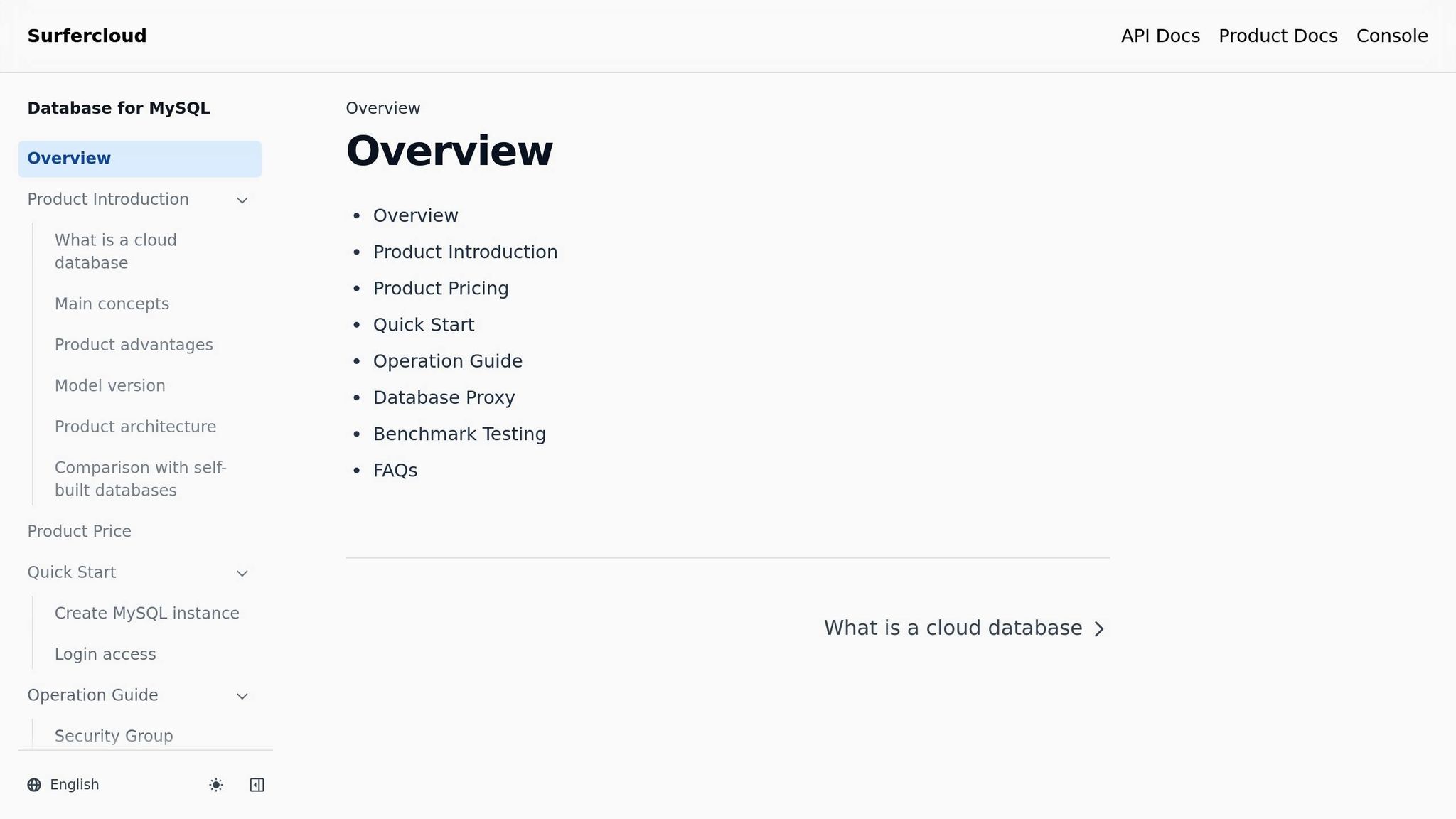
SurferCloud UDB (User Database) MySQL is a managed cloud database service tailored for hybrid cloud environments. It’s part of a larger ecosystem that includes UHost for computing, US3 for storage, and UNet for networking[10]. Powered by 4th Gen AMD EPYC CPUs, it offers up to 40% faster performance compared to older Intel Xeon processors, making it ideal for compute-heavy database tasks[7]. With NVMe storage delivering over 1 million IOPS, UDB is built to handle demanding workloads seamlessly[7].
UDB is designed for hybrid cloud setups, allowing direct integration with on-premise legacy systems. This ensures businesses can maintain data residency while scaling operations in the cloud[7]. The service connects effortlessly with Cloud Enterprise Network (UGN) and UNet, enabling smooth communication between on-premise infrastructure and cloud environments[10]. This is particularly beneficial for companies transitioning to the cloud at their own pace, without disrupting existing workflows. Advanced security measures further strengthen its hybrid capabilities.
Security is a cornerstone of UDB’s architecture. Your data is safeguarded with AES-256 encryption, the same encryption standard used by financial institutions[7]. VPC-based network isolation ensures database traffic is kept separate from public networks[7]. Additionally, SurferCloud partners with Cloudflare to provide DDoS protection with a mitigation capacity of up to 5Tbps[7]. For businesses in regulated sectors, UDB’s data centers are ISO 27001 certified and meet compliance requirements for specific regions, including UAE Federal Decree No. 45 of 2021[7]. Operations in Dubai are further supported by compliance with DIFC and ADGM standards[7].
UDB’s seamless integration within the SurferCloud ecosystem enhances its utility in hybrid setups. Its global network includes direct routes connecting major hubs like Frankfurt, Mumbai, and Singapore, ensuring low-latency performance[7]. Internal data transfers between services such as UHost and US3 occur over high-speed intranet connections, bypassing public bandwidth entirely. This tight integration simplifies workflows, enabling applications on UHost to query UDB databases and store results in US3 object storage with minimal setup.
SurferCloud UDB uses a flexible, pay-as-you-go pricing model with no upfront costs. Starting at just $3.50 per month, it’s an affordable option for small businesses experimenting with hybrid cloud solutions[7]. You’re charged only for the compute and storage resources your database uses, with the ability to scale up or down as needed - completely free of penalty fees.
SurferCloud UCDN (Content Delivery Network) acts as a distributed caching layer between your origin storage - whether that's US3 Object Storage or on-premises servers - and your audience. With a strong global footprint spanning North America, Europe, the Middle East, Africa, and South America, it minimizes latency by delivering content from the edge server closest to the user. This setup ensures reliable performance for users no matter where they are [11]. Its distributed structure is well-suited for managing dynamic traffic and scaling with ease.
Thanks to its global reach, UCDN is designed to handle peak traffic efficiently, making it a great fit for hybrid cloud setups. By offloading concurrent requests to edge servers, it prevents your origin storage from becoming overwhelmed during periods of high demand. Seamlessly integrated with core SurferCloud services, it offers smooth edge caching and content delivery. Additionally, the Cloud Enterprise Network (UGN) and UNet provide stable connectivity across various data centers and public cloud platforms [10].
Security is a core aspect of UCDN. It uses tools like Referer and User-Agent verification, IP blacklists and whitelists, and timestamp encryption to block unauthorized access and prevent hotlinking. The platform also includes protection against DDoS and CC attacks, along with HTTPS acceleration. Origin protection features, such as automatic failover and origin merging, help maintain stability during traffic spikes. UCDN integrates with UMON resource monitoring, offering detailed, minute-by-minute insights into bandwidth usage and request data for performance analysis [11].
UCDN works seamlessly with US3 Object Storage, creating a powerful combination of elastic cloud storage and global content delivery. This integration is particularly useful for managing large-scale unstructured data, like videos and images, as it optimizes both storage costs and delivery speeds. With an Open API, users can automate tasks such as content refreshing and log retrieval, all while supporting a wide range of file types to ensure smooth performance [10][11].
UCDN uses a prepaid billing model, with traffic packages valid for 12 months. The cost per unit decreases as the package size increases. Regional pricing is straightforward: $0.03 per GB for APAC-1 (about $32.76 for a 1,024 GB package), $0.04 per GB for Europe and the US (roughly $40.96 for the same package), and $0.08 per GB for global coverage (around $81.92 total) [10][11].
AWS Storage Gateway is a powerful tool designed to connect on-premises systems with AWS cloud storage. It allows local applications to tap into the virtually unlimited storage capacity of AWS, offering seamless integration with standard protocols like NFS, SMB, iSCSI, and iSCSI-VTL. To ensure fast performance, frequently accessed data is cached locally, while the main dataset is securely stored in AWS [1].
AWS Storage Gateway offers four distinct gateway types to cater to different storage needs:
Each gateway type is built to handle specific workloads. For example, a single gateway can support up to 50 file shares and offers a local cache of up to 64 TiB when deployed on virtual machines [13]. Its stateless architecture makes it easy to deploy new instances as storage needs evolve. When running on VMware with vSphere High Availability, the system can recover from service interruptions in under 60 seconds, ensuring minimal downtime [1][15].
AWS Storage Gateway prioritizes data security and compliance. Data in transit is encrypted using SSL/TLS, while data at rest can be secured with server-side encryption via S3-SSE or customer-managed keys using AWS Key Management Service (KMS) [1][2][13]. Integration with AWS IAM and Microsoft Active Directory ensures robust access control, including support for Access Control Lists (ACLs).
For organizations with strict regulatory requirements, the service provides FIPS 140-2 compliant endpoints in AWS GovCloud regions and supports WORM (Write Once, Read Many) storage for compliance needs [2][3][12]. Additionally, AWS CloudTrail records all API activity, and Amazon CloudWatch monitors health metrics and logs SMB file share operations for comprehensive auditing [1][2].
AWS Storage Gateway seamlessly integrates with key AWS services like Amazon S3, Amazon FSx for Windows File Server, Amazon EBS, and AWS Backup [1]. It can be deployed as a virtual machine, a physical appliance, or an EC2 instance, offering flexible options for hybrid cloud setups [2][12].
To optimize data transfer, the service uses asynchronous uploads, delta transfers (transmitting only changed blocks), and data compression, reducing bandwidth usage [1][13]. S3 File Gateway supports individual files up to 5 TB in size, making it a versatile solution for large-scale data management [13].
AWS Storage Gateway operates on a pay-as-you-go pricing model, eliminating upfront hardware costs. Features like efficient data compression and delta transfers help lower operational expenses. Additionally, new customers can take advantage of AWS's Free Tier [1][2][12][13][14]. For long-term storage, Tape Gateway can move virtual tapes to S3 Glacier or S3 Glacier Deep Archive, significantly reducing archiving costs [1][2].
Microsoft Azure Arc is a key part of Microsoft's hybrid cloud strategy, designed to extend Azure's management capabilities beyond its native environment. It creates a unified control plane, allowing organizations to manage on-premises servers, Kubernetes clusters, and databases through Azure Resource Manager. This approach ensures consistent management across on-premises, edge, and multicloud setups, complementing other hybrid integration tools seamlessly.
Azure Arc supports a range of environments, including any CNCF-certified Kubernetes distribution, as well as both Windows and Linux servers - whether physical or virtual. Its elastic scaling for data services allows compute and memory resources to expand on demand, all without causing downtime. Additionally, its flexible connectivity ensures services can operate even in the absence of a constant connection.
For instance, the Royal Bank of Canada (RBC) utilized Azure Arc–enabled data services to manage its extensive SQL Server infrastructure. Khaled Zaky, Director of Product Management at RBC, highlighted its benefits:
"RBC has a large SQL Server presence, and that's where we see the biggest benefit for Azure Arc-enabled data services.... We get the latest and best technology and can bring that experience on-premises while maintaining control in a consistent way." [17]
SKF Group also implemented a hybrid solution combining Azure Stack HCI, Azure Kubernetes Service, and Azure Arc–enabled data services. Sven Vollbehr, Head of Digital Manufacturing at SKF Group, explained:
"a unified dashboard for managing workloads across on-premises, cloud, and edge - all with a single pane of glass while driving costs down." [17]
Azure Arc enhances security and compliance by extending Azure Policy to non-Azure resources, enabling centralized management of security baselines across hybrid setups. It integrates Microsoft Defender for Cloud, offering threat protection and vulnerability assessments for workloads regardless of their location. Each resource is assigned a managed identity for secure, password-free authentication. Microsoft’s commitment to security is underscored by its $1 billion annual investment in cybersecurity and its team of over 34,000 security experts [16][17]. Furthermore, Azure Arc supports more than 100 compliance certifications, including over 50 tailored to regions like the US, EU, Germany, Japan, and India.
Azure Arc uses GitOps to streamline configuration management and application deployment from Git repositories to Kubernetes clusters, no matter where they’re running. John Deere’s Principal Architect, Jason Wallin, shared his experience with Azure Arc–enabled data services, which supported factory solutions using cloud-native methods on-premises:
"Azure Arc-enabled data services help make this possible for us... Cloud-native patterns and practices help us deliver the factory solutions that are a key to our future success." [17]
Azure Arc’s pricing model is designed to be cost-efficient, with basic control plane features offered at no charge. Costs are incurred only for additional services like Microsoft Defender for Cloud and data services, which follow a pay-as-you-go model. According to a 2025 Forrester Consulting study, organizations using Azure Arc with cloud-based management services achieved a 304% ROI within three years [18]. SQL Server customers can also save further by taking advantage of the Azure Hybrid Benefit, which allows them to apply existing licenses to Arc–enabled instances.
Google Cloud Storage Transfer Service is a managed tool designed to handle large-scale data transfers between on-premises systems, multi-cloud setups, and Google Cloud Storage. By automating retries, failovers, and providing detailed logging, it eliminates the need for custom scripts. This service is particularly effective for transferring data volumes exceeding 1 TiB, with the capability to move petabytes of data efficiently thanks to its highly parallelized architecture [19].
This service offers two-way data transfer options: moving data from on-premises storage to Google Cloud Storage, from Cloud Storage back to on-premises, or even between on-premises systems [19]. For hybrid setups, lightweight agents can be deployed in Docker containers to access locally mounted NFS data and manage uploads or downloads [35, 39]. Each agent typically achieves about 1 Gbps throughput, and projects can use up to 100 agents concurrently to speed up large-scale migrations [22].
A notable example is TIM Brasil, which used 30 concurrent agents to maximize a 20 Gbps connection, successfully migrating petabyte-scale data [22]. For transfers over 1 GB, deploying at least three agents (each with 4 vCPUs and 8 GB RAM) on separate virtual machines ensures fault tolerance and optimal performance. The service performs best with files 16 MB or larger, so when dealing with numerous small files, batching them (e.g., using tar) can significantly improve efficiency [22].
Security is a key aspect of Google Cloud Storage Transfer Service. Data in transit is protected using TLS 1.3, and end-to-end encryption ensures secure handling [19]. The service also includes built-in data integrity checks, automatically verifying object metadata, checksums, and file sizes to maintain data accuracy during transfers [33, 42]. Users can leverage VPC Service Controls to establish secure perimeters that protect resources and data from unauthorized access [21].
To configure permissions, specific IAM roles like Storage Transfer Admin (roles/storagetransfer.admin) are required for user accounts, Google-managed service agents, and transfer agents [23]. The service also integrates with Google Cloud's Sensitive Data Protection to identify and classify sensitive information in storage [21]. For added transparency, Cloud Logging and Cloud Audit Logs monitor data access and operations. Additionally, users in hybrid environments can set bandwidth limits at the agent pool level to ensure transfer traffic doesn’t interfere with other critical network activities [23].
Pricing for the service depends on the type of transfer. Transfers from file systems cost $0.0125 per GB, while agentless transfers or those from S3-compatible storage or HDFS are free [20]. Transfers from Amazon S3 via a managed private network cost $0.03 per GiB in North America, $0.04 per GiB in the EU, and $0.08 per GiB in APAC [20]. The service also supports recurring scheduled transfers and incremental copies, charging only for files that have changed since the last transfer. However, standard Cloud Storage operation costs and external cloud provider egress fees still apply [20].
The table below provides a clear side-by-side comparison of the key features offered by each tool, making it easier to evaluate their capabilities at a glance.
| Tool | Scalability | Global Coverage | Security Features | Pricing Structure | Hybrid Integration |
|---|---|---|---|---|---|
| SurferCloud UHost | Elastic compute with flexible resource scaling | 17+ global data centers | Integrated DDoS protection, robust security | Starting at $6/month | Native support for hybrid deployments across all data centers |
| SurferCloud US3 | Unlimited object storage capacity | 17+ global data centers | Integrated DDoS protection, encryption at rest and in transit | Starting at $6/month | Seamless integration with on-premises systems and cloud environments |
| SurferCloud UDB | Auto-scaling database instances | 17+ global data centers | Integrated DDoS protection, automated backups | Starting at $6/month | Multi-cloud database synchronization support |
| SurferCloud UCDN | Global content distribution network | 17+ global data centers | Integrated DDoS protection, SSL/TLS encryption | Starting at $6/month | Edge caching for hybrid infrastructure |
| AWS Storage Gateway | Supports petabyte-scale transfers | Multiple AWS regions worldwide | SSL encryption, AWS KMS, FIPS 140-2 compliance [1] [2] | Pay-as-you-go model [25] | Supports NFS, SMB, iSCSI protocols [1] |
| Microsoft Azure Arc | Enterprise-grade scalability | Global Azure infrastructure | Azure Security Center integration, policy enforcement [26] [27] | Custom pricing (contact sales) | Unified management for on-premises and multi-cloud [26] [27] |
| Google Cloud Storage Transfer Service | Up to 100 concurrent agents, 1 Gbps per agent [22] | Google Cloud global network | Default encryption at rest, IAM, CMEK/CSEK support [24] | $0.0125 per GB (file systems), $0.03-$0.08 per GiB (S3 transfers) [20] | Optimized for large-scale data migrations [22] |
Each platform brings unique strengths to the table, particularly in the realm of hybrid cloud integration. AWS Storage Gateway stands out with its enterprise-level compliance and security, while Microsoft Azure Arc offers unified management for multi-cloud and on-premises systems. Google Cloud Storage Transfer Service excels in handling large-scale data migrations with impressive speed and flexibility. Meanwhile, SurferCloud's straightforward pricing and robust security features make it an appealing option for budget-conscious businesses managing hybrid environments.
Hybrid cloud storage integration tools play a key role in combining the control of on-premises systems with the scalability offered by the cloud. These solutions enable smooth operations, cost efficiency, and better continuity by replicating essential data across multiple environments. Businesses can keep sensitive information on-premises to meet regulatory standards while taking advantage of cloud resources for tasks like analytics, testing, and managing sudden traffic surges.
When choosing the right tool, it all comes down to your specific needs. Evaluate options based on factors like latency, support for protocols such as NFS, SMB, or iSCSI, and compliance with regulations like HIPAA or GDPR. It's also worth examining how a platform manages data tiering - offloading archives to lower-cost cloud storage can help cut expenses significantly.
Real-world examples highlight how organizations have successfully adopted hybrid cloud strategies. For instance, in 2020, S&P Global Ratings migrated over 100 applications to AWS in just one month using VMware Cloud on AWS. This move allowed them to scale operations quickly without needing to expand their on-premises infrastructure [4]. Similarly, Morningstar utilized AWS Outposts to integrate public cloud services with their private infrastructure, giving developers the ability to test applications and migrate workloads more efficiently using consistent APIs across environments [4].
Hybrid cloud storage tools offer businesses a smart way to manage their data. They let companies keep sensitive information on-premises while taking advantage of the cloud for tasks that need scalability. This setup ensures a smooth connection between systems, making failovers hassle-free and keeping data safe with replication policies.
Another big plus? Cutting costs and streamlining operations. These tools work seamlessly with existing systems using familiar protocols like NFS or SMB, so there’s no need for major changes to applications. Plus, hybrid solutions provide on-demand scalability without requiring hefty upfront hardware investments, all while delivering the security and performance of on-site storage.
SurferCloud takes it a step further. With a global network of over 17 data centers, their hybrid cloud storage platform offers secure, scalable, and high-performance solutions, supported by 24/7 expert assistance.
SurferCloud UHost places a strong emphasis on protecting data and meeting regulatory standards by employing top-tier security practices. It uses data encryption both during transmission and while stored, ensuring sensitive information stays protected. To further enhance security, the platform undergoes regular security audits, helping it stay resilient against potential vulnerabilities.
On top of that, SurferCloud adheres to major compliance frameworks, giving businesses the assurance they need to meet regulatory obligations. Its globally distributed infrastructure is built to enable secure operations, backed by 24/7 expert support to handle security issues and maintain compliance with ease.
SurferCloud US3 Object Storage is built to manage massive data volumes effortlessly, providing scalable capacity, strong performance, and secure storage options. Its design ensures easy access to data and long-term reliability, making it a trusted option for businesses dealing with extensive information.
Packed with features like adaptable storage capacity, advanced redundancy for data protection, and round-the-clock expert support, SurferCloud US3 Object Storage helps organizations expand their operations while keeping costs under control. It's a smart choice for industries needing dependable and flexible storage to handle increasing data demands.
Whether you're setting up a private server for friends,...

Looking for the best cloud storage for your startup? He...
SurferCloud is proud to announce the official launch of...