Best Game Server CPUs for Running Minecraft S
If you’re a fan of Minecraft or planning to set up a ...









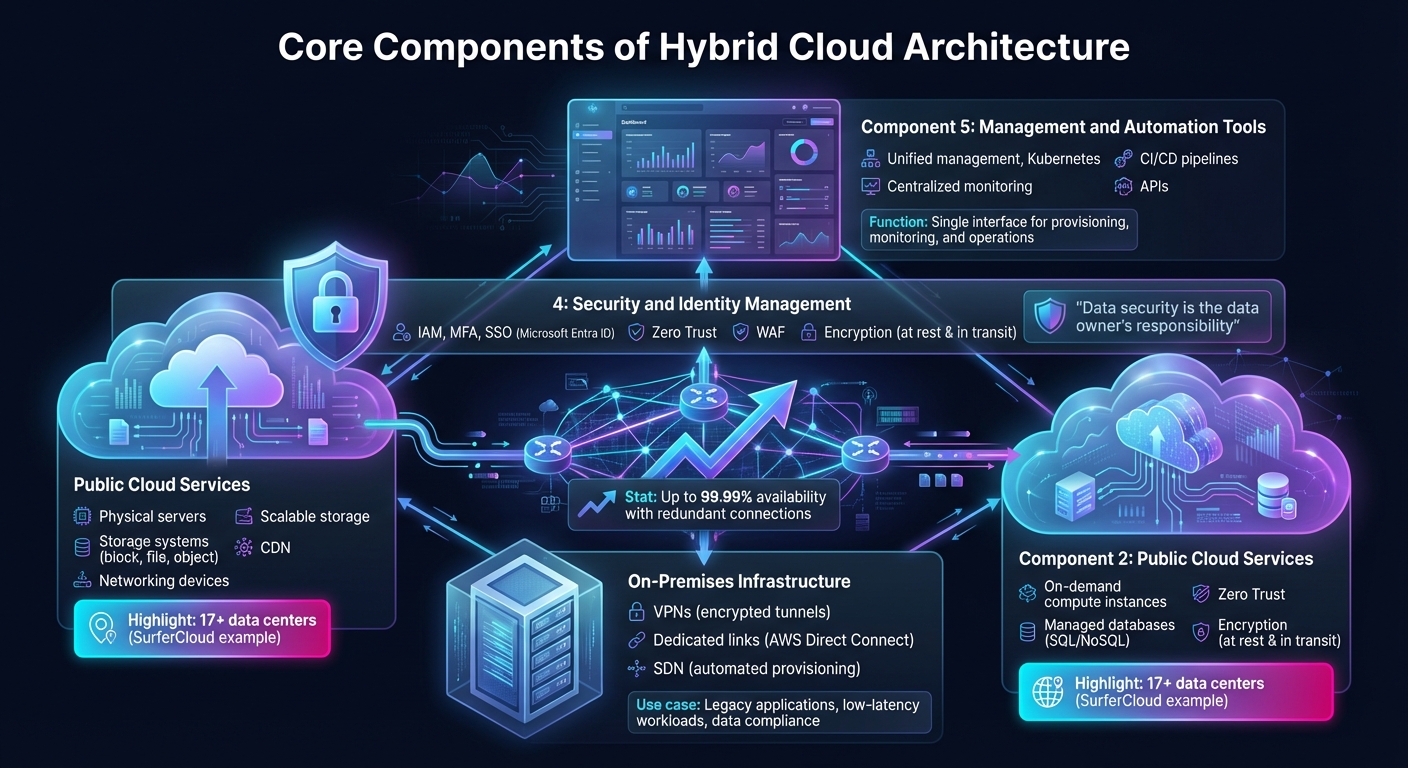
Hybrid cloud architecture combines on-premises systems with public cloud services, offering flexibility, scalability, and control. It supports workload portability, cost efficiency, and data compliance, making it ideal for industries like healthcare and finance. Key components include:
This setup balances performance, cost, and compliance, with tools like Kubernetes enabling seamless workload movement. Hybrid cloud strategies also optimize workload placement, enhance security, and support disaster recovery. Providers like SurferCloud offer global infrastructure to implement these systems effectively, ensuring scalability and compliance.
5 Essential Components of Hybrid Cloud Architecture
To build a hybrid cloud system that works seamlessly, several key components come together to form an effective infrastructure. Each plays a unique role in ensuring the system meets business needs while balancing flexibility, scalability, and security.
Here are the five essential components that make up a hybrid cloud setup:
At the core of a hybrid cloud is the on-premises infrastructure - your private data center. This includes physical servers, storage systems (block, file, and object storage), networking devices, and edge computing equipment housed in facilities your organization owns or leases [7]. This setup is often used for legacy applications that aren’t cloud-ready, workloads requiring low latency, or data that must comply with strict residency regulations [3][1]. By maintaining on-premises infrastructure, businesses can meet data sovereignty requirements while still taking advantage of cloud services for other operations.
Public cloud services provide the scalability and flexibility that hybrid environments need. These services include on-demand compute instances, managed databases (both SQL and NoSQL), and secure, scalable cloud storage [8]. For example, SurferCloud operates through a network of over 17 data centers, offering elastic compute servers, managed databases, and secure storage solutions. Additionally, public cloud providers enhance global content delivery with edge networks (CDNs) that speed up access for end users [7].
Networking acts as the bridge between on-premises systems and cloud environments, ensuring secure and efficient communication. Virtual Private Networks (VPNs) are a cost-effective option for creating encrypted tunnels over the internet, though they may have variable performance. For more consistent connectivity, dedicated links like AWS Direct Connect offer guaranteed bandwidth and stable latency, albeit at a higher cost [6][3]. Software-Defined Networking (SDN) simplifies network management by automating provisioning and optimizing traffic paths [1][2]. Some organizations also use private backbone networks provided by cloud vendors, which offer better reliability than public internet connections for transferring data between sites and virtual private clouds (VPCs) [10]. Redundant connections across different locations can achieve availability rates as high as 99.99% [10].
Security is a critical part of hybrid cloud architecture, ensuring protection across all environments. Identity and Access Management (IAM) systems unify access control, while multi-factor authentication (MFA) adds an extra layer of security. Tools like Microsoft Entra ID make Single Sign-On (SSO) possible, streamlining access across the hybrid setup [8][9]. Many modern systems adopt Zero Trust principles, requiring continuous verification for every access request, regardless of user or device [2][9]. Security is further strengthened with web application firewalls (WAF), encryption for data both at rest and in transit, and consistent policy enforcement through tools such as Azure Policy or VPC Security Groups [8][9].
"Data security is the data owner's responsibility, requiring organizations to meet consistent security, compliance, and regulation policies across hybrid cloud settings" [2].
A unified management layer is essential for overseeing resources across hybrid environments. These tools allow you to provision, monitor, and operate systems from a single interface [8]. Platforms like Kubernetes enable workload portability, while CI/CD pipelines automate application deployment. Centralized monitoring tools provide visibility into performance and security across all environments [8][9]. APIs and middleware facilitate data exchange and enable workloads to shift between environments based on business needs [3][1]. Additionally, virtual networks can extend between cloud and on-premises systems, allowing applications to operate as though they were running on the same network [8].
| Component Category | Key Technologies | Primary Function |
|---|---|---|
| Connectivity | VPN, Dedicated Links, SDN, APIs | Interconnects environments [1] |
| Compute | Virtual Machines, Containers, Serverless | Runs applications across environments [8] |
| Storage | Object, Block, File Gateways | Moves and synchronizes data [8] |
| Identity | IAM, Entra ID, SSO | Unified access control [9] |
| Management | Azure Arc, Anthos, Systems Manager | Centralized orchestration [8][9] |
In the next section, we’ll dive into how these components come together within the logical layers of hybrid cloud architecture.
Hybrid cloud architecture operates as a multi-layered system, seamlessly connecting on-premises and cloud resources. Each layer plays a distinct role: infrastructure teams manage resource provisioning, platform teams ensure workloads can move between environments, and operations teams maintain centralized oversight. Let’s break down how these layers work together.
At the base of this architecture is the infrastructure layer, which includes compute servers, storage systems, and networking equipment spanning data centers and public cloud environments [11][13]. Virtualization and software-defined technologies unify these resources into a single pool, making it easier to allocate workloads dynamically. This flexibility allows organizations to balance performance, compliance, and cost needs.
For instance, if you’re running virtual machines on-premises while leveraging SurferCloud’s elastic compute servers (spread across 17+ global data centers), this layer merges them into one cohesive resource pool. The result? A system capable of meeting diverse demands without being tied to a single environment.
Sitting atop the infrastructure layer, the platform layer ensures applications perform consistently across different environments. Tools like Kubernetes and Red Hat OpenShift empower developers to "build once and deploy anywhere" [13]. These platforms support microservices architectures, where applications are broken into smaller, independently deployable components [11].
Service meshes, such as Istio, simplify service-to-service communication by managing tasks like load balancing and encryption without requiring developers to modify their code [15]. This setup allows workloads to shift effortlessly between environments. For example, during a traffic surge, applications can "burst" into the cloud without needing major rewrites.
"The emergence of containerization has helped to truly tap into the benefits of hybrid clouds, with the focus shifting to easy portability of workloads."
The operations layer ties everything together, providing centralized control and oversight for the hybrid environment. Often described as a "single pane of glass", this layer focuses on three main areas: observability (tracking performance, logs, and metrics), security (managing IAM, encryption, and threat detection), and governance (ensuring compliance and controlling costs) [11][13][14].
Centralized operations can reduce overhead by up to 20% by standardizing IT workflows across environments [9]. Considering that operations and maintenance account for nearly 98% of a solution's lifetime costs [5], automating tasks in this layer can significantly improve cost efficiency. Whether it’s enforcing encryption standards, managing user permissions, or monitoring cloud spending, tools in this layer ensure consistent policies across the entire hybrid setup.
"The observability layer allows your admins to manage and simplify orchestration of what otherwise looks like cloud chaos."
- Susheel Gooly, Executive Certified IT Architect [13]
Crafting a hybrid cloud strategy involves making smart choices about workload placement, optimizing data flow, and ensuring robust security. The challenge lies in balancing performance, cost, and compliance without introducing unnecessary complexity. Here’s how to navigate these critical decisions.
Choosing which workloads stay on-premises and which move to the cloud starts with understanding data gravity - the idea that once data accumulates, moving it becomes costly and complicated. Instead of constantly transferring data, consider bringing the computing closer to where the data resides [5].
Begin by evaluating your workloads based on their dependencies and technical requirements. Applications with minimal dependencies or those built on third-party software are great candidates for rehosting (or lift-and-shift). On the other hand, resource-heavy applications with intricate dependencies may need to be refactored or modernized using APIs before migration [18].
| Migration Approach | Best For | Key Characteristic |
|---|---|---|
| Rehost (Lift & Shift) | Apps with minimal dependencies or third-party software | Quick migration with minimal changes |
| Refactor (Move & Improve) | Apps requiring better resource efficiency | Simplifies dependencies for cloud optimization |
| Rebuild (Rip & Replace) | Outdated systems with high legacy costs | Replaces older systems with cloud-native solutions |
A smart way to start is by migrating simple workloads first. These can serve as models for future deployments. At the same time, design your landing zone carefully, incorporating integrated networking patterns, resource hierarchies, and identity management from the outset [16].
Once workload placements are mapped out, the next step is addressing security and compliance.
Security in a hybrid cloud environment demands a layered approach that goes beyond simply replicating on-premises security measures. A defense-in-depth strategy tailored to meet U.S. regulatory standards is essential [8][20].
A solid identity and access management (IAM) framework is crucial. Use principles like least privilege, role separation, and standardized IAM policies across environments. Additionally, secure sensitive data during transit with protocols like IPSec for internet connections or MACsec (802.1ae) for high-speed private links [20].
Compliance with U.S. regulations such as HIPAA, PCI DSS, and FedRAMP often dictates where specific data can reside. Identifying these legal and regulatory requirements early on helps determine which data must remain on-premises [16][17]. Hybrid cloud setups excel in this area, allowing organizations to keep sensitive data on-premises while leveraging the cloud for processing, ensuring compliance [3].
Continuous monitoring is non-negotiable. Implement real-time security monitoring and centralized logging to spot unusual activity or misconfigurations. Event-driven automation can also speed up incident response, further enhancing security [20].
With security and compliance in place, focus shifts to optimizing performance and scalability.
Achieving high availability and effective disaster recovery requires careful planning around latency and bandwidth. For U.S.-based organizations, choosing data center locations that minimize latency for your primary users is critical. SurferCloud’s extensive network of 17+ global data centers offers the flexibility to meet these needs while adhering to compliance.
Storage optimization plays a major role in both performance and cost management. Choose storage classes based on how often data is accessed: Standard for high-throughput, frequent use; Nearline or Coldline for less frequent access (with retention minimums of 30 and 90 days, respectively); and Archive for long-term data storage (365 days) [17]. Similarly, match storage types to workload requirements: block storage for databases and IOPS-heavy applications, file storage for shared configurations, and object storage for backups or data lakes [17].
"Operations is 98% of a solution's lifetime costs. Automating operational tasks reduces these costs and contributes to the solution's overall reliability, availability, and security."
- IBM [5]
To handle demand spikes, auto-scaling is indispensable. Cloud bursting patterns, where on-premises applications temporarily extend into the cloud during peak usage, can help manage traffic surges without overprovisioning [8]. Centralized tools for unified monitoring and patching across environments further streamline operations [8][19]. These automation strategies not only cut operational costs but also boost reliability and performance.
With a well-thought-out hybrid cloud strategy, organizations can take full advantage of platforms like SurferCloud to deploy hybrid architectures effectively.

SurferCloud is designed to support hybrid deployments by combining elastic compute servers, cloud storage, networking, and security tools across 17+ global data centers. With this setup, public cloud compute servers provide the speed and flexibility needed for dynamic workloads, while on-premises infrastructure ensures control and stability for sensitive data [13]. Let’s dive into the core services that make these hybrid capabilities possible.
Elastic compute servers are a key component of hybrid architectures. They enable cloud bursting, which allows on-premises resources to seamlessly expand into the cloud during periods of high demand. This ensures consistent performance without the need to overinvest in physical hardware [14][21].
Cloud storage supports tiered strategies, helping businesses manage costs effectively. Frequently accessed or sensitive data can remain on-premises, while archival or backup data can be stored in the cloud. SurferCloud also offers managed databases that simplify managing distributed data across different environments. Additionally, CDN services improve content delivery speeds for users spread across various locations.
For secure connectivity, SurferCloud provides networking solutions like VPNs and encrypted channels using IPsec, which create secure, point-to-point links between on-premises infrastructure and SurferCloud's public cloud nodes [11][12][10].
Security is another cornerstone of SurferCloud’s offerings. Features like IAM with RBAC (role-based access control) and strong encryption protocols ensure data protection. Data is encrypted both at rest (using AES-256) and in transit (using TLS 1.2 or 1.3), safeguarding it from unauthorized access [11][22].
"Encryption isn't a standalone checkbox; it lives within broader control objectives"
- Andrius Minkevičius, Co-Founder, CTO & CISO at Copla [22].
SurferCloud’s services support various hybrid deployment strategies. Common patterns include cloud bursting to manage sudden demand spikes, disaster recovery setups for business continuity, and secure VPN-based connectivity to link on-premises data centers with cloud resources. For disaster recovery, SurferCloud’s global data centers provide geographically distributed backup locations, ensuring quick data recovery during outages [11][14].
A zero-trust approach is recommended for hybrid environments, where every connection is verified to secure the broader attack surface [14][12].
"A hybrid cloud gives you the control you need to avoid these kinds of costly or complicated processes"
With 24/7 customer support and flexible resource scaling, SurferCloud helps businesses implement these hybrid patterns while staying compliant with U.S. regulations like HIPAA, PCI DSS, and FedRAMP.
The hybrid cloud approach, as outlined earlier, offers a powerful combination of performance and security. By integrating on-premises systems, public cloud services, secure networking, and management tools, it creates a unified architecture that meets the needs of modern businesses. For U.S.-based companies, this strategy is particularly effective in adhering to strict regulatory requirements - keeping sensitive data securely on-premises while using public cloud resources for scalability and cost efficiency. The numbers back this up: organizations leveraging hybrid multicloud platforms at scale report 2.5 times more value compared to those relying on single-platform or single-vendor solutions [2].
The hybrid cloud market is booming, with a valuation of $125 billion in 2023 and an expected growth to $558.6 billion by 2032. Investments in hybrid cloud are delivering significant returns, with businesses seeing transformation value multiply by an average of 3x, and in some cases, up to 20x [2][4]. This growth highlights how hybrid cloud architectures allow companies to shift from large capital expenditures to more predictable operating expenses, all while maintaining the flexibility to handle seasonal traffic surges, such as during holidays or tax deadlines.
"A hybrid cloud lets a company choose what elements they like about public cloud or on-premises operations and which tradeoffs they find acceptable." - Chris Murphy, Oracle Content Director [3]
SurferCloud’s extensive global network - spanning 17+ data centers with elastic compute, storage, secure VPNs, and 24/7 support - demonstrates the infrastructure needed for a successful hybrid strategy. This balance of control and flexibility is what makes hybrid cloud architectures so effective. Interestingly, 68% of hybrid cloud adopters have already implemented formal policies for emerging technologies like generative AI, signaling a forward-thinking approach to innovation [2]. By blending the reliability of on-premises systems with the scalability of public cloud resources, businesses position themselves to drive long-term innovation in an increasingly cloud-centric world.
Hybrid cloud architecture brings a host of benefits to businesses, starting with flexibility. It allows companies to adjust resources seamlessly across on-premises, private, and public cloud environments. This means businesses can respond faster to shifting demands and new opportunities, keeping them agile in a competitive landscape.
Another standout advantage is cost management. By strategically running workloads in the most cost-effective environment, businesses can reduce hardware expenses and avoid overspending on public cloud resources. The hybrid model also supports scalability, making it easier to handle workload spikes, migrate tasks between environments, and tap into advanced tools like AI or IoT when needed.
On top of that, hybrid cloud enhances performance, compliance, and security. Sensitive or regulated data can stay on-premises or within specific regions, ensuring data residency and reducing latency. Meanwhile, public clouds extend global reach, enabling a balance between security and operational efficiency. This setup also helps maintain business continuity by distributing workloads across multiple platforms.
Hybrid cloud architecture strengthens data protection and ensures regulatory compliance by integrating strong security measures across both on-premises and cloud environments. Key components include identity and access management (IAM) to regulate permissions, encryption to safeguard data both at rest and during transit, and network protections such as segmentation and firewalls. Additionally, centralized logging and monitoring play a critical role in identifying anomalies, while automated compliance tools simplify meeting standards like PCI-DSS, HIPAA, and GDPR.
In a hybrid environment, maintaining consistent IAM policies, unified logging, and centralized key management is essential for seamless security across all platforms. Businesses using SurferCloud's global infrastructure benefit from features like hypervisor-based isolation and secure compute services, which enhance data confidentiality while integrating with broader security frameworks. This cohesive strategy enables continuous compliance, quick threat detection, and proactive risk mitigation, ensuring a reliable foundation for secure and compliant operations.
Management and automation tools play a crucial role in bringing together public cloud, private cloud, and on-premises resources within a hybrid cloud setup. Think of them as the nerve center that provides a single, unified interface for managing provisioning, configuration, monitoring, and operations across all platforms. By eliminating the need for custom orchestration, these tools save both time and effort.
Automation tools take over repetitive tasks, such as scaling resources, applying security updates, and enforcing compliance policies. This reduces manual intervention while ensuring consistency across different environments. They also support advanced practices like infrastructure-as-code (IaC) and continuous integration/continuous delivery (CI/CD), which allow teams to treat hybrid cloud resources as programmable assets. This approach not only makes businesses more agile but also helps them respond to shifting demands while keeping costs in check and maintaining governance.
For those using SurferCloud, the platform’s integrated management console and automation APIs make hybrid cloud operations easier. It offers a single dashboard to orchestrate compute, storage, networking, and security services seamlessly across both on-premises and cloud environments.