Top Tools to Evaluate Hard Drive Performance
Ensuring the optimal performance of your hard drives is...









When building multi-region cloud applications, choosing the right data replication method is critical for balancing performance, consistency, and availability. The two main approaches are synchronous replication and asynchronous replication:
Both methods have distinct use cases:
| Factor | Synchronous Replication | Asynchronous Replication |
|---|---|---|
| Consistency | Strong/Transactional | Eventual |
| Latency | High (waits for confirmation) | Low (instant local acknowledgment) |
| RPO (Recovery Point Objective) | 0 (no data loss) | Non-zero (seconds to minutes) |
| Distance Suitability | Short distances (under 186 miles) | Global |
| Cost | Higher | Lower |
Choose the method that aligns with your application's needs for data protection, performance, and budget.
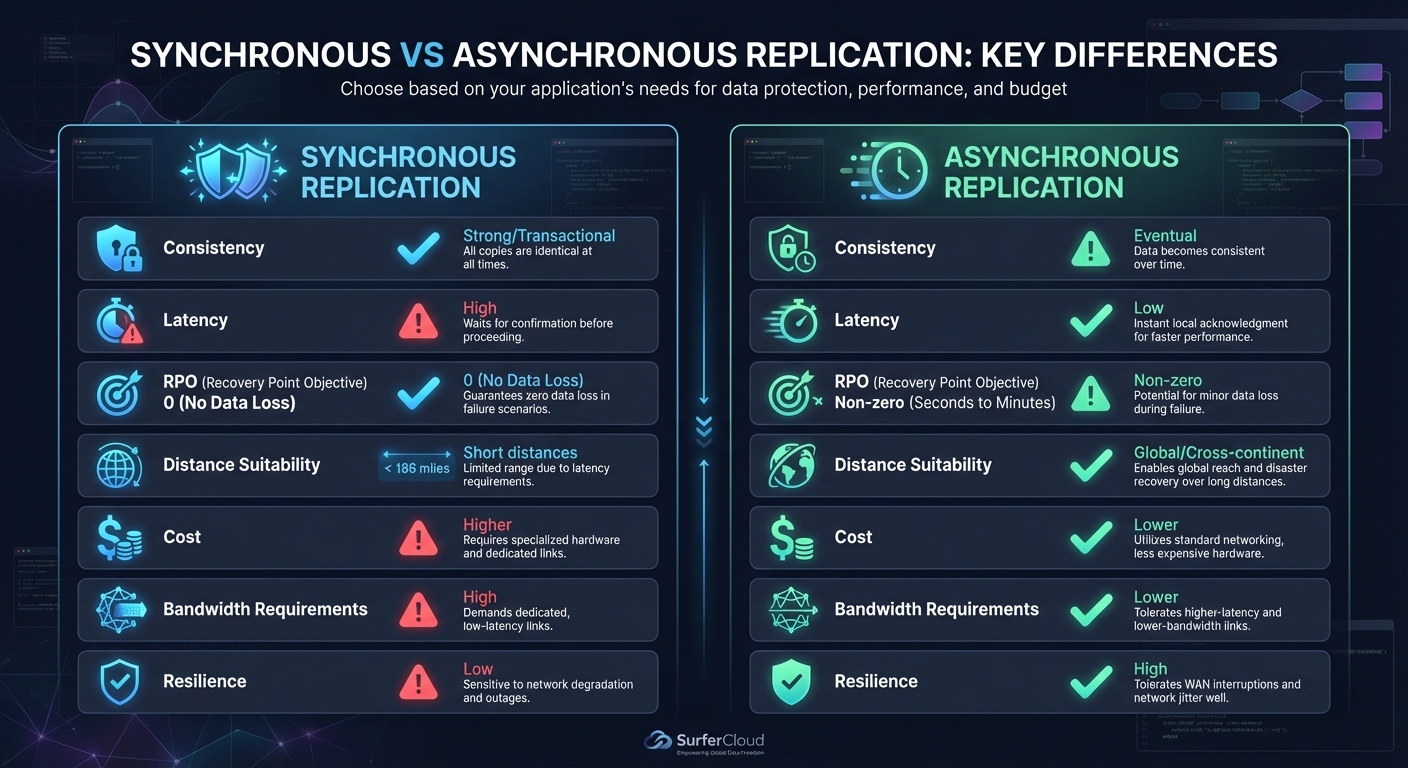
Synchronous vs Asynchronous Replication: Key Differences Comparison Chart
Synchronous replication ensures that a write operation is only confirmed after every replica - or at least a voting quorum - acknowledges the update [3][7]. This method guarantees strong consistency, meaning every replica always reflects the most up-to-date data. Mark Simborg from Pure Storage describes it well:
"Synchronous replication is a process of writing data to two systems at once, rather than one at a time. It allows for simultaneous updates of multiple repositories." [12]
This process is essential for understanding the advantages and trade-offs of using synchronous replication, especially in multi-region setups.
In a synchronous replication setup, the primary region first processes the write request and then sends the write simultaneously to all replicas. Unlike asynchronous replication, which we'll touch on later, this approach puts data consistency first, even if it results in higher latency. For global deployments, systems like Google Cloud Spanner rely on a Paxos-based model. Here, voting replicas decide on each write request, and the system commits the write only when a majority agrees [4][7]. To ensure durability in multi-region configurations, data is typically stored in at least four zonal copies spread across different geographic areas [4][9].
The standout advantage of synchronous replication is its ability to prevent data loss entirely. It achieves a Recovery Point Objective (RPO) of 0 seconds, ensuring no committed data is lost, even during a disaster [7]. This level of reliability is critical for industries like finance and healthcare, where even the smallest data discrepancies can have serious consequences [10][11].
Another advantage is its quick failover capability. If the primary zone fails, the system can transfer storage to a standby instance in a healthy zone in under a minute [3]. Strong consistency guarantees that every database read reflects the latest write, making synchronous replication a perfect fit for transactional applications like order processing or inventory management, where precision is non-negotiable [12][13].
However, these benefits come with some trade-offs, particularly in terms of performance and scalability.
One of the main challenges is latency, which increases with geographic distance. Synchronous replication is generally limited to a range of about 186 miles (300 km), restricting most deployments to availability zones within a single region [2][8][12].
Cost is another significant factor. Synchronously replicated regional disks are twice as expensive per byte compared to standard zonal disks because the data must be stored in two separate zones [7]. Additionally, maintaining the necessary high-bandwidth, low-latency network infrastructure to support synchronous replication adds to the overall expense. If there's network latency or a failure between regions, write operations may experience delays as the system prioritizes consistency.
Asynchronous replication operates on a "store-and-forward" model, where data is written to the primary storage first and remote updates are delayed until later [5]. The process prioritizes speed - data is immediately acknowledged by the primary storage, allowing applications to continue running without waiting for confirmation from remote locations.
When data arrives, it's written to the primary storage array, which promptly acknowledges the write, signaling the application that the transaction is complete [5]. This data is then logged in a journal and sent to one or more replication targets, either in near real-time or at scheduled intervals [5]. This approach makes it possible to replicate data across vast distances, even thousands of miles apart [2][15].
Take Google Cloud's asynchronous replication as an example. It aims for a Recovery Point Objective (RPO) of one minute and can handle up to 12.5 GB of compressed changes per minute (in 4 KB blocks) [2]. In the event of a regional outage, operators must halt replication and switch workloads to secondary disks [2].
This separation of local and remote operations results in noticeable performance improvements, as detailed below.
One of the standout advantages of asynchronous replication is its ability to enhance performance by separating write acknowledgment from remote updates. This design significantly reduces latency since the primary site doesn’t need to wait for the secondary site to confirm each write. As a result, application performance remains largely unaffected [16].
This makes asynchronous replication particularly suitable for deployments that span continents, where network latency can range from tens to hundreds of milliseconds [15]. For instance, Amazon Aurora Global Databases leverage asynchronous replication to achieve replication lags of less than one second, enabling businesses to maintain responsive applications while safeguarding data across multiple regions [17].
Another benefit is scalability. Asynchronous replication can handle increasing data volumes without requiring an always-on, high-speed connection for every transaction [16].
The trade-off for these performance gains is eventual consistency. As AWS Prescriptive Guidance explains:
"With asynchronous replication, when there is a failure in the primary Region, there is a high probability that write operations will be pending replication... This leads to a scenario where the latest data is unavailable until replication resumes" [1].
This means the secondary site may not reflect the most recent transactions, leaving it outdated during a failure [1][14]. Any writes that haven’t yet been replicated at the moment of a primary site failure risk being lost [1][6].
Additionally, the RPO can fluctuate depending on the volume of data being written. For example, if the disk change rate exceeds 12.5 GB per minute on Google Cloud, the replication lag could surpass its one-minute target [2].
Another drawback is that most asynchronous systems require manual failover. In the event of an outage, you must detect the failure, stop replication, and promote the secondary disk or database to primary status [2][6]. Google Cloud, for instance, doesn’t allow replication to resume on the same disk once it’s stopped. Instead, you’ll need to create a new secondary disk to restart the process [18][2].
Replication methods play a critical role in balancing latency and data integrity. When choosing between synchronous and asynchronous replication, the decision often boils down to prioritizing either performance or data protection. Synchronous replication ensures zero data loss but slows things down, while asynchronous replication boosts performance at the risk of potential data lag. The table and analysis below break down the trade-offs between these two approaches.
| Factor | Synchronous Replication | Asynchronous Replication |
|---|---|---|
| Distance Suitability | Short distances (typically under 186 miles) [12] | Global/Cross-continent [12] |
| Bandwidth Requirements | High; requires dedicated, low-latency links [12] | Lower; tolerates higher-latency links [12] |
| RPO (Recovery Point Objective) | Zero (no data loss) [20] | Non-zero (typically seconds to minutes) [2] |
| Consistency Model | Strong/Transactional Consistency [12] | Eventual Consistency [12] |
| Latency Impact | High (waits for remote acknowledgment) [20] | Low (instant acknowledgment locally) [12] |
| Cost | Higher (specialized hardware/bandwidth) [12] | Lower (standard resources) [12] |
| Resilience | Low; sensitive to network degradation [5] | High; tolerates WAN interruptions [5] |
The performance differences between synchronous and asynchronous replication are stark. Synchronous replication ensures zero data loss by waiting for remote acknowledgment before completing a write. However, this comes with a significant performance trade-off. According to Cockroach Labs, synchronous replication introduces high write latency, which can drastically reduce throughput [19].
For example, tests show that with just 10ms of network latency, synchronous replication achieved only 60% of the write throughput seen with local commits [20]. As the EDB team succinctly puts it:
"Synchronous replication in Postgres is expensive" [20].
This delay occurs because the primary server must idle while awaiting confirmation from the remote server, slowing operations considerably.
On the other hand, asynchronous replication offers near-local performance even across long distances [17]. This makes it a strong choice for disaster recovery, where the ability to maintain responsiveness despite distance is crucial [2].
Consistency also plays a significant role in choosing between the two. AWS Prescriptive Guidance highlights that synchronous replication across multiple regions:
"write latency increases by an order of magnitude" [1].
This means multi-region setups must weigh availability against consistency. Synchronous replication leans toward consistency, while asynchronous replication prioritizes availability and relies on the application to handle eventual consistency.
For disaster recovery scenarios involving long distances, asynchronous replication often wins out. Its ability to maintain resilience without severely impacting performance makes it a practical solution [2].

Deciding between synchronous and asynchronous replication hinges on three key factors: your tolerance for data loss (RPO), recovery speed (RTO), and budget.
Synchronous replication is ideal when zero data loss is non-negotiable. This makes it a go-to choice for financial systems, payment platforms, and real-time inventory management [7][21].
For Tier 1 applications, where maintaining data integrity is more critical than performance, synchronous replication shines. For example, in payment gateways, even a single lost transaction could have serious consequences. By replicating data across zones within the same region, synchronous methods can deliver up to 99.99% availability - higher than the 99.9% typical of standard zonal resources [21].
However, this level of reliability comes at a cost. Synchronous regional storage is about 1.5 to 2 times more expensive than zonal disks, as it duplicates data across two zones simultaneously [7]. Additionally, write speeds are approximately 10% to 20% slower compared to asynchronous replication [22]. Despite these drawbacks, for mission-critical workloads, the stronger consistency and faster failover justify the added expense.
Asynchronous replication is better suited for cross-region disaster recovery and applications that can tolerate slight delays in data synchronization. Systems like business intelligence tools, analytics platforms, backups, and reporting applications often work well with an RPO of one minute or more [2][21].
This approach protects against regional outages rather than just zonal failures. With SurferCloud's network of 17+ global data centers, you can replicate data across continents while avoiding the latency issues that synchronous writes would introduce. This method also reduces storage costs and ensures local application performance remains unaffected [2][21].
Another advantage is its cost-effectiveness. Asynchronous replication avoids the double storage costs of synchronous methods and can be paired with warm standby systems that activate only during failover events [7][21].
To choose the right replication method, consider your application's criticality, geographic requirements, and budget constraints. Here's a quick reference table:
| Use Case Scenario | Recommended Method | Key Reason |
|---|---|---|
| Financial Systems / Payments | Synchronous | Ensures RPO zero and strong consistency to prevent data loss [7][21] |
| Real-time Applications | Synchronous | Maintains a single source of truth across active-passive nodes [22] |
| Cross-Region Disaster Recovery | Asynchronous | Avoids long-distance latency penalties of synchronous methods [2][21] |
| Business Intelligence / Analytics | Asynchronous | Accepts minor data delays for reporting purposes [14] |
| Budget-Constrained Backups | Asynchronous | Reduces costs while ensuring off-site protection [7] |
| High-Volume Web Servers | Asynchronous | Focuses on user response time over data synchronization [14] |
When deploying across SurferCloud's global infrastructure, distance plays a crucial role. Synchronous replication is most effective within the same region, as using it across continents can significantly slow down write speeds. For long-distance setups, asynchronous replication keeps lag under one second while ensuring your primary application remains responsive [17].
To avoid overspending on synchronous replication for less critical systems, categorize your workloads based on their RPO and RTO requirements. For instance, Tier 1 workloads demand RPO/RTO of zero, Tier 2 can handle up to one hour, and Tier 3 may tolerate 12+ hours [21].
"Achieving RPO zero means using predominantly regional products for your application, which by default are resilient to zone-scale, but not region-scale, outages." - Google Cloud Architecture Center [21]
Lastly, regularly test your failover processes. Many disaster recovery plans fail during actual emergencies due to insufficient validation [21]. Conduct regular drills to confirm your replication strategy works as intended when you need it most.
Choosing between synchronous and asynchronous replication boils down to what matters most for your system - data integrity or performance. Synchronous replication ensures no data is lost by writing data simultaneously across zones. However, this comes with added write latency and nearly doubles storage costs[3][1][7].
On the other hand, asynchronous replication focuses on speed and availability. It commits data locally first and replicates it in the background, achieving a Recovery Point Objective (RPO) of about one minute for block storage or under one second for global databases[2][23]. The downside? There's a risk of losing recent transactions if a regional failure occurs[1]. These trade-offs are key to determining which replication strategy aligns with your goals.
SurferCloud effectively integrates both replication strategies to deliver reliable and tailored performance. With a network of over 17 global data centers, SurferCloud offers the infrastructure needed for both methods. For synchronous replication, customers can deploy across multiple zones within a single region, ensuring high availability with minimal latency. For asynchronous replication, its geographically distributed data centers enable efficient cross-region disaster recovery without the performance drawbacks of synchronous writes spanning continents.
Additionally, SurferCloud's compute and storage solutions include consistency groups, ensuring all volumes recover to the same point during failover[2]. This streamlined approach simplifies disaster recovery and reduces the complexity of maintaining data integrity across regions. Whether you need the strong consistency of synchronous replication or the resilience of asynchronous methods, SurferCloud’s adaptable architecture supports your specific RPO and RTO needs while keeping costs predictable through scalable solutions and 24/7 expert support.
Synchronous replication ensures strong consistency by writing data to both the primary system and the replica at the same time. This approach significantly reduces the risk of data loss but can result in higher latency. It also demands low-latency and highly reliable connections between regions to function effectively.
In contrast, asynchronous replication allows the primary system to handle writes without waiting for the replica to catch up. This approach lowers latency and reduces network overhead, making it a faster option in certain situations. However, it introduces replication lag and a risk of data loss if the primary system fails before the updates are fully replicated.
The choice between these two methods boils down to balancing performance with data consistency, based on the specific requirements of your multi-region setup.
Geographic distance heavily influences the choice between synchronous and asynchronous replication. With synchronous replication, data is transferred in real time between locations. While this ensures data consistency, it can also cause noticeable delays when the regions are far apart, as the system waits for confirmation before proceeding.
On the other hand, asynchronous replication is more forgiving of latency. It transfers data without requiring immediate acknowledgment, making it a practical option for setups spanning multiple regions. The decision ultimately hinges on your priorities - whether you need real-time consistency or can accommodate minor delays for smoother performance over long distances.
Synchronous replication tends to be more expensive than asynchronous replication. Why? It requires additional resources like higher bandwidth, specialized hardware, and increased CPU power to maintain data consistency across regions in real-time.
In contrast, asynchronous replication is a budget-friendly alternative. By allowing a slight delay in data replication, it uses fewer resources, making it a practical choice for situations where immediate data consistency isn't a top priority.
The decision between these two approaches boils down to your specific requirements - factors like performance expectations, budget constraints, and the criticality of real-time data synchronization will guide your choice.