Affordable and Reliable Philippines VPS Hosti
Finding the right VPS hosting solution in the Philippin...








Synthetic data is reshaping AI development by solving challenges like limited data, privacy concerns, and high costs. It is algorithm-generated data that mirrors real datasets without containing personal information, making it safer and faster to use. By 2030, synthetic data is expected to dominate AI projects, according to Gartner.
Here’s what you need to know:
Tools like MOSTLY AI, Gretel, and Synthesis AI make generating synthetic data easier, while platforms like SurferCloud provide the infrastructure for large-scale deployment. Whether for training AI models or testing systems, synthetic data offers a practical solution to modern data challenges.
Synthetic data refers to information generated by algorithms to mimic the statistical patterns of real-world data, without containing any personally identifiable information (PII). Unlike real data, which is directly collected from actual events or individuals, synthetic data is created using mathematical models and AI systems, ensuring it remains detached from any specific person.
For example, imagine an AI model trained on customer transaction data. It identifies patterns like how often people shop or seasonal buying trends. Using this knowledge, the model can produce new data points that resemble the original dataset but have no ties to actual customers. As Lightly.ai puts it:
"Synthetic data is artificially created information that doesn't come directly from real-world events. Instead, algorithms and AI models generate it to reflect the same statistical properties as real data" [4].
Techniques like Generative Adversarial Networks (GANs), Variational Autoencoders (VAEs), and statistical models such as Gaussian Copula allow synthetic data to replicate real-world data structures. These methods enable the creation of various types of synthetic data:
A notable example is Microsoft’s 2021 release of a database containing 100,000 synthetic faces, created from just 500 real identities. This showcases how synthetic data can achieve real-world accuracy while safeguarding privacy [5].
Synthetic data stands out for its ability to combine realism, scalability, and privacy compliance - qualities that make it an invaluable tool for AI development. Here’s a closer look at these traits:
Unlike anonymized data - which involves masking or shuffling real records - synthetic data doesn’t degrade in utility and is resistant to linkage attacks. It’s also distinct from dummy data, which serves as basic placeholders but lacks the statistical depth needed for AI training.
Another key advantage is automated labeling. Synthetic data often comes with pre-applied labels, saving significant time and cost compared to manual annotation. This is especially beneficial for training AI models in scenarios where real-world examples are rare, such as detecting fraud or identifying medical anomalies. In these cases, synthetic data can create diverse, labeled scenarios at scale, filling critical gaps in real-world datasets.
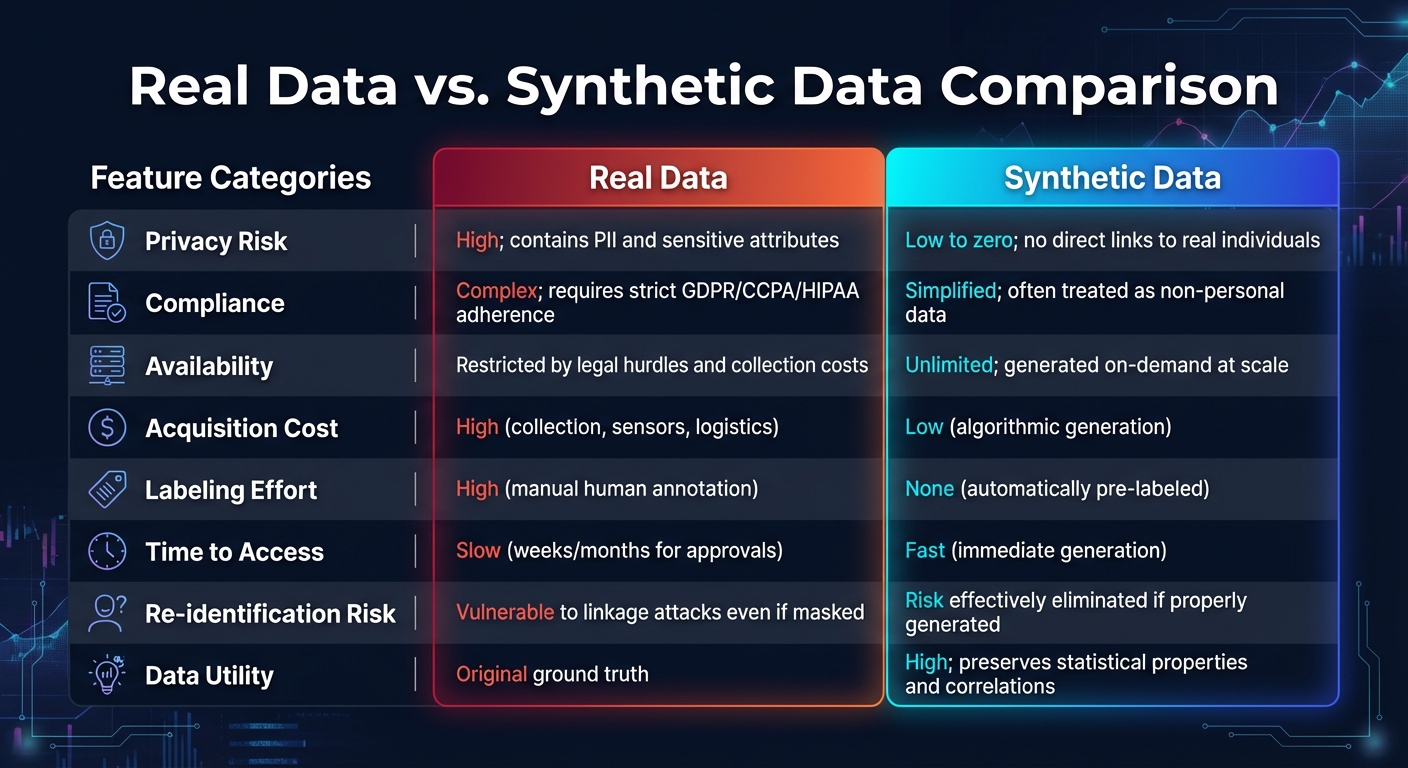
Real Data vs Synthetic Data: Key Differences in Privacy, Cost, and Compliance
Synthetic data addresses some of the biggest challenges in AI, including privacy concerns, limited data availability, and the high costs of development. By leveraging synthetic data, organizations can train models more efficiently, comply with regulations, and fill gaps in datasets - all without the traditional hurdles tied to real-world data.
One of the standout advantages of synthetic data is its ability to sidestep privacy issues. By creating artificial records that replicate the statistical patterns of real data - without containing any personally identifiable information (PII) - it eliminates the risk of re-identification. This makes it a safe choice for sensitive use cases, especially when you run AI models privately to maintain full control over your infrastructure.
Differential Privacy (DP) ensures that no single individual's data significantly influences the synthetic output. Kate Soule, Senior Manager of Exploratory AI Research at IBM, highlights this benefit:
"We want to clone the data almost exactly so that it's as useful as the real data but contains none of the sensitive private information" [6].
From a legal standpoint, synthetic data is often treated as anonymous rather than pseudonymized. This distinction exempts it from many of the stringent requirements under regulations like GDPR and CCPA. The proposed EU AI Act (May 2023) explicitly acknowledges synthetic data in Articles 10 and 54, emphasizing its role in meeting modern compliance standards [1]. By reducing the need for lengthy approval processes, synthetic data speeds up the "time to data" for researchers and developers. In fact, Gartner predicts that by 2030, synthetic data will surpass real data in training AI models [2].
When real-world data is hard to come by, synthetic data steps in to provide the volume and variety needed for effective AI training. This is especially useful for rare events like financial fraud, cybersecurity breaches, or uncommon medical conditions that don’t occur often enough to build comprehensive datasets.
Advanced techniques such as SMOTE and generative adversarial networks (GANs) help create balanced datasets by generating samples for underrepresented categories [4]. For industries without historical data, agent-based modeling can simulate interactions to produce baseline datasets [1] [3]. Combining synthetic data with real-world data can cut the reliance on actual data by up to 70% in tasks like object detection, all while maintaining model performance [4].
The growing interest in synthetic data is reflected in industry trends. Akash Srivastava, Chief Architect at InstructLab (IBM/Red Hat), underscores the importance of tailoring synthetic data:
"The examples through which you seed the generation need to mimic your real-world use case" [8].
Synthetic data comes pre-labeled, eliminating the need for costly and time-consuming manual annotation. It also reduces expenses tied to physical data collection and management. Gartner succinctly captures these benefits:
"Synthetic data generation accelerates the analytics development cycle, lessens regulatory concerns and lowers the cost of data acquisition" [2].
The scalability of synthetic data is another cost-saving factor. It can be generated on-demand at minimal expense and, because it contains no PII, it simplifies privacy management and reduces the need for expensive security measures. Teams can safely use synthetic data in testing, quality assurance, and staging environments without worrying about data leaks.
Here’s a quick look at how synthetic data stacks up against real data:
| Feature | Real Data | Synthetic Data |
|---|---|---|
| Privacy Risk | High; contains PII and sensitive attributes | Low to zero; no direct links to real individuals |
| Compliance | Complex; requires strict GDPR/CCPA/HIPAA adherence | Simplified; often treated as non-personal data |
| Availability | Restricted by legal hurdles and collection costs | Unlimited; generated on-demand at scale |
| Acquisition Cost | High (collection, sensors, logistics) | Low (algorithmic generation) |
| Labeling Effort | High (manual human annotation) | None (automatically pre-labeled) |
| Time to Access | Slow (weeks/months for approvals) | Fast (immediate generation) |
| Re-identification Risk | Vulnerable to linkage attacks even if masked | Risk effectively eliminated if properly generated |
| Data Utility | Original ground truth | High; preserves statistical properties and correlations |
Generating synthetic data can serve various purposes, from training machine learning models to simulating hypothetical scenarios. These methods range from advanced AI-driven techniques that replicate intricate data patterns to simpler statistical approaches based on mathematical rules. Here's a closer look at both categories.
Generative Adversarial Networks (GANs) rely on a competitive setup involving two neural networks: a generator and a discriminator. The generator creates synthetic data from random noise, while the discriminator tries to distinguish between real and fake data. This back-and-forth process continues until the generator produces data that closely mimics real-world samples [10]. GANs are particularly effective for creating high-quality images, videos, and time-series data on GPU cloud servers. However, they can be tricky to train and may encounter issues like mode collapse, where the generator produces limited variations [10].
Variational Autoencoders (VAEs) use an encoder-decoder structure. The encoder compresses input data into a compact, latent space, and the decoder reconstructs new data points from this compressed representation. VAEs are generally easier to train than GANs but sometimes produce outputs that appear less sharp [7]. They are especially well-suited for tasks involving continuous data and anomaly detection.
Transformer-based models, such as GPT, leverage self-attention mechanisms to identify patterns in sequential data. Organizations can access these capabilities through enterprise-grade AI model services to streamline deployment. These models excel at generating text, tabular data, and other structured sequences by producing outputs that are statistically consistent with the input data.
Diffusion models represent a newer approach in synthetic data generation, particularly for high-quality image and video synthesis [4]. These models generate data through a step-by-step process, allowing them to capture complex statistical details more effectively.
For scenarios requiring simplicity or specific constraints, statistical and rule-based methods offer practical alternatives.
Statistical methods focus on analyzing the distribution of real datasets to produce new data with similar characteristics. For example, the Gaussian Copula technique models marginal distributions and feature correlations to generate realistic tabular data while preserving dependencies [1]. On the simpler side, random sampling selects values from predefined distributions but may lack the sophistication needed for complex applications.
Rule-based methods rely on predefined logic to produce structured data. For instance, they can generate formatted outputs like credit card numbers or phone numbers while shuffling values to maintain statistical patterns [7]. Chiara Colombi, Director of Product Marketing at Tonic.ai, highlights their value:
"Rule-based data synthesis involves generating synthetic data through predefined rules and logic, providing high control, flexibility, and customization" [7].
These methods are particularly valuable in software testing and system validation, where adhering to strict formats is essential.
Agent-Based Modeling (ABM) takes a different route by simulating interactions between individual entities in a virtual environment. Each entity follows a set of rules, and their interactions generate complex system-level data. This method is increasingly applied in areas like epidemiology, autonomous driving, and traffic flow prediction [1].
Modern synthetic data tools often combine these techniques. For instance, statistical models might capture general trends, while rule-based methods ensure logical consistency by filtering out unrealistic records. In complex datasets, deep learning can model statistical distributions, and rule-based constraints can refine specific columns for added accuracy [7].
Choosing the right synthetic data tool depends on your specific data type and workflow needs. Here’s an overview of some key tools, highlighting their unique features and strengths.
MOSTLY AI uses deep generative models to create highly accurate tabular data while preserving complex relational and time-series structures. The platform organizes data into "Subject" tables (representing unique individuals) and "Linked" tables (sequences like transactions or orders), ensuring statistical integrity and usability [13]. To maintain privacy, it includes built-in controls that prevent overfitting and re-identification, ensuring synthetic records can't be traced back to real individuals [2].
The platform’s automated Model Insight Reports validate that the synthetic data retains the statistical properties and utility of the original dataset [2]. MOSTLY AI recommends starting with at least 5,000 subjects for training tabular datasets or 5,000 text records (up to 1,000 characters each) for text generation [13]. Its free version allows testing with up to 100,000 rows per day [9].
In a benchmarking study by the European Commission's Joint Research Centre, MOSTLY AI’s commercial solution outperformed SDV in synthetic data quality [9]. It also offers a "Turbo" mode with 1-minute training cycles, enabling rapid iteration [13]. For large datasets (over 10 million rows), sampling features make it easier to create manageable subsets for testing [13].
Next, let’s look at Gretel, which takes an API-centered approach.
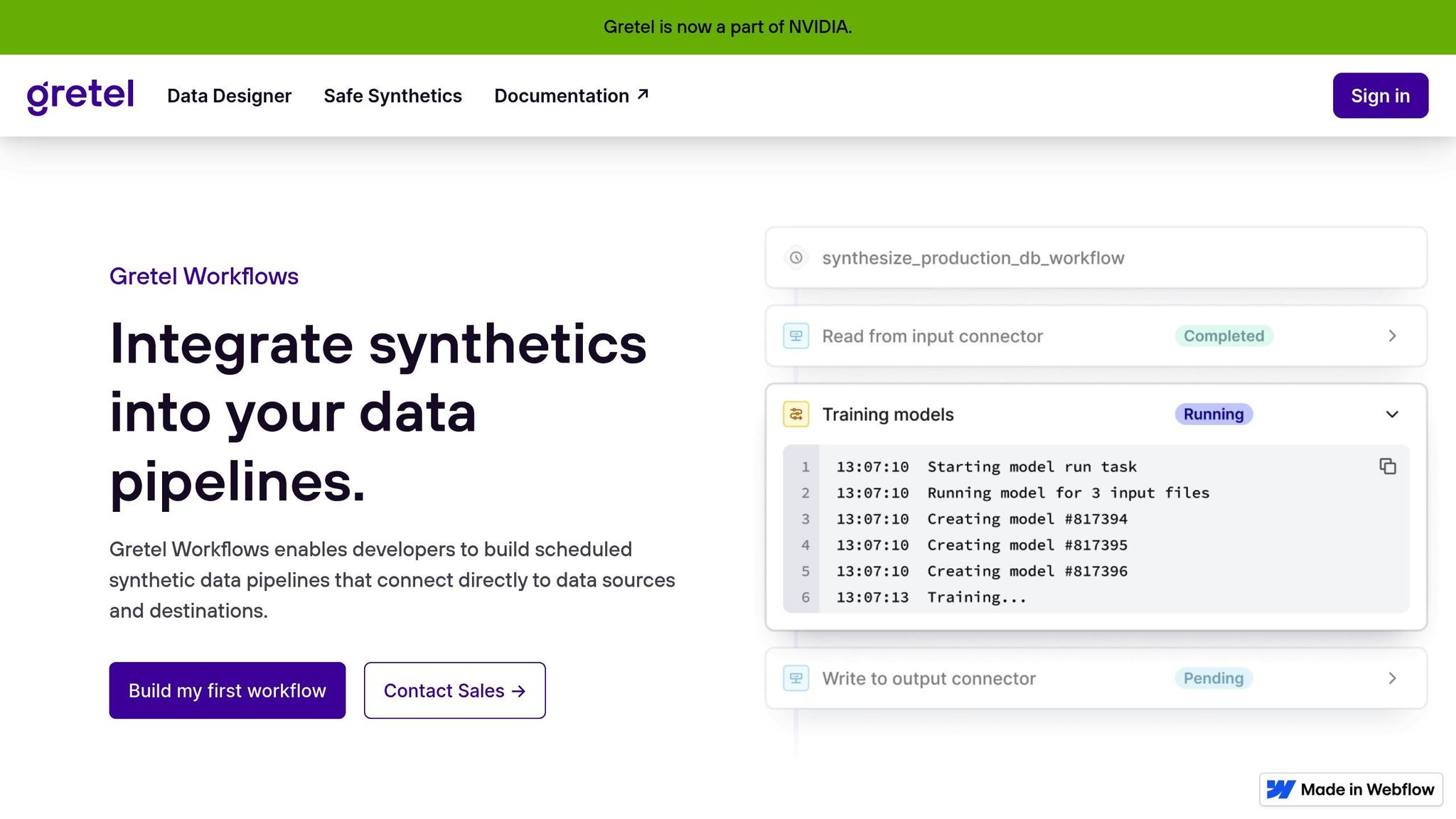
Gretel is designed for developers who want to integrate synthetic data generation directly into machine learning pipelines. It supports various data types - tabular, text, and image - making it ideal for teams looking to automate data creation within their workflows [14]. Its API-driven approach simplifies embedding synthetic data processes into continuous integration systems, offering flexibility for developers.

Synthesis AI focuses on generating synthetic image and video data for computer vision applications. By creating detailed 3D simulations with automated annotations, it serves industries like automotive and healthcare, where collecting real-world annotated data can be expensive or raise privacy concerns [4] [7]. Using a mix of synthetic and real data, some object detection tasks have reduced the need for real-world data by up to 70% without compromising performance [4].

SDV is an open-source Python library that specializes in relational and time-series data. It offers a Community version for research and proof-of-concept projects under the Business Source License (BSL), as well as an Enterprise version for handling interconnected datasets at scale [12]. SDV uses GANs and VAEs to model real data and generate synthetic versions while maintaining relationships across tables [7]. While powerful, it may require more manual setup compared to commercial platforms, making it better suited for those with technical expertise.
| Tool | Data Types Supported | Key Features | Primary Use Cases |
|---|---|---|---|
| MOSTLY AI | Tabular, Relational, Time-series, Text, Geolocation | Automated QA reports, privacy controls, 1-minute Turbo mode | Analytics, AI training, software testing, data sharing |
| SDV | Tabular, Relational, Sequential | Open-source Python library, customizable synthesizers | Research, proof-of-concepts, data science workflows |
| Gretel | Tabular, Text, Image | API-driven, ML workflow integration | Machine learning pipelines, rapid data generation |
| Synthesis AI | Image, Video | Computer vision focus, 3D simulations, automated annotation | Autonomous vehicles, healthcare imaging, visual AI training |
These tools highlight how synthetic data can address challenges like privacy, scalability, and performance. When choosing a tool, consider factors like your data type (structured or unstructured), integration needs (API or UI), and whether you require enterprise-grade privacy features or open-source flexibility. With Gartner predicting that synthetic data will dominate AI and analytics development by 2030 [2], selecting the right tool is more important than ever for staying competitive.
When it comes to deploying synthetic data tools, having a strong cloud infrastructure is non-negotiable. Generating synthetic data requires a system that can handle heavy processing loads while ensuring security and adaptability. SurferCloud provides the backbone needed to support synthetic data workflows, whether you're running small tests or scaling up to full production.
SurferCloud’s Virtual Private Servers (VPS) are designed to handle demanding tasks like training models such as GANs or VAEs. With dedicated CPU, RAM, and storage, you get consistent performance without interruptions. The platform allows for elastic scalability, offering configurations ranging from 1 to 64 CPU cores. This flexibility lets teams start with smaller projects and expand as their synthetic data requirements increase. For intensive tasks, the minimum setup includes 4+ CPU cores and 8 GB of RAM, making it a solid choice for large-scale data generation and model training.
The VPS environment is built with advanced security measures, including firewalls and DDoS protection (up to 5 Gbps in the free tier). Because resources are dedicated, your workflows won’t compete with other processes, ensuring smooth performance even during peak usage.
SurferCloud also integrates AI model APIs - such as Claude, OpenAI, Gemini, and Grok - directly into synthetic data workflows. These APIs make it easy to generate synthetic text, logs, and conversational data through prompt-based automation. The platform supports Python 3.8+ environments, meaning it works seamlessly with popular synthetic data libraries like SDV and CTGAN. For teams focused on automation, SurferCloud’s infrastructure supports continuous workflows for training, testing, and monitoring data drift, all without the hassle of managing separate API systems.
SurferCloud’s global data centers in locations like Los Angeles, Singapore, and Frankfurt bring synthetic data tools closer to users and data sources. This setup reduces latency, which is crucial for real-time processing. Additionally, it helps teams meet regional compliance standards like GDPR and HIPAA by enabling data storage and processing within specific jurisdictions.
To keep operations running smoothly, SurferCloud offers 24/7 expert support. This ensures that any technical issues during critical data generation cycles are resolved quickly, minimizing disruptions to AI projects. With this combination of global infrastructure and reliable support, SurferCloud provides a solid foundation for tackling the complexities of synthetic data generation.
Creating synthetic data comes with its own set of hurdles, one of the most prominent being collapse issues. This happens when a model repeatedly trains on synthetic data, causing it to rely on its own outputs rather than learning from actual patterns. The result? A lack of variety in the generated outputs, a problem known as mode collapse. To address this, it’s essential to root the generation process in real-world data, use a fixed taxonomy, and diversify the seed data. Blending information from various demographic groups and regions can also help maintain a broader perspective [8][3][4][15]. Akash Srivastava, Chief Architect at InstructLab, highlights the importance of this step:
"The examples through which you seed the generation need to mimic your real-world use case" [8]
Another key factor is implementing robust validation and quality checks to ensure the synthetic data aligns with standards for accuracy, usability, and privacy.
Ensuring synthetic data is effective requires validation on three fronts: fidelity, utility, and privacy [4][1].
While automated tools can streamline validation, manual review remains critical. Spot-checking 5 to 10 random samples can catch subtle issues that algorithms might miss. As Srivastava advises:
"You have to have a human in the loop for verification... Rely on metrics, rely on benchmarks, rigorously test your pipeline, but always take a few random samples and manually check" [8]
One recurring issue in synthetic data is bias amplification. If the original dataset contains biases, synthetic data can not only inherit but also exaggerate them [4][11][3]. To combat this, techniques like SMOTE or GANs can be used to oversample underrepresented groups deliberately [4][8].
Another challenge is privacy risks. In some cases, synthetic records can be reverse-engineered to uncover sensitive information [8][7]. Adding noise through differential privacy can reduce these risks, though it might come at the cost of accuracy [8][3].
For niche fields like healthcare or finance, involving subject matter experts is invaluable. Their expertise ensures the synthetic data captures real-world complexities that statistical methods alone might miss [11].
Synthetic data has evolved from a niche concept into a cornerstone of modern AI development. Gartner forecasts that synthetic data will soon dominate AI training datasets. This shift tackles pressing issues like safeguarding privacy while adhering to regulations such as GDPR, CCPA, and the EU AI Act. It also addresses the scarcity of data in specialized fields like autonomous driving and rare medical conditions, all while slashing data collection and labeling costs. In fact, combining synthetic and real data can reduce the reliance on real-world data by up to 70% without compromising performance [4].
However, these advancements are only possible with robust, scalable infrastructure. Generating synthetic data requires significant GPU power for training models like GANs and VAEs, as well as global data centers to meet regional data sovereignty laws. This infrastructure not only supports sophisticated synthetic data generation but also ensures seamless integration into AI workflows. For instance, SurferCloud provides the scalable tools needed for these complex processes, allowing organizations to dynamically adjust resources during intensive tasks and scale down afterward to manage costs. Additionally, low-latency API access ensures synthetic data can be smoothly incorporated into MLOps pipelines.
The key to success lies in balancing fidelity, utility, and privacy. Depending on the project, the focus might lean more heavily on privacy or fidelity, but maintaining a connection to real-world seed data and involving human oversight is crucial. As Gartner puts it:
"Synthetic data generation accelerates the analytics development cycle, lessens regulatory concerns and lowers the cost of data acquisition" [2].
Whether it’s for fraud detection, computer vision, or training large language models, synthetic data provides a practical and privacy-conscious solution. By combining cutting-edge generation techniques with dependable cloud platforms, organizations can create datasets that were once out of reach - either due to cost or feasibility. This approach enables AI innovation while ensuring compliance with regulations and maintaining operational efficiency.
Synthetic data offers a smart way to maintain privacy compliance by substituting real data with artificially created datasets. These datasets mirror the statistical patterns of the original data but exclude any personally identifiable information (PII). This method ensures sensitive details remain protected while still allowing the data to be useful.
Privacy protection can be further strengthened through techniques like differential privacy or adding controlled noise. These measures help synthetic data meet strict regulations, including GDPR and HIPAA. This means organizations can confidently share and analyze data without putting individual privacy at risk.
Synthetic data offers a powerful tool for advancing AI, but it’s not without its challenges. One major issue is the quality and realism of the data. If the synthetic data doesn’t accurately reflect the complexity of real-world scenarios, AI models might pick up on flawed patterns. This can lead to poor performance when facing real-world inputs. Additionally, rare edge cases or subtle correlations could be overlooked, making the models less dependable in real-world applications.
Another challenge revolves around bias. Synthetic data often mirrors the biases found in the original datasets or those embedded in the algorithms used to generate it. If these biases go unnoticed, they could inadvertently lead to unfair or discriminatory outcomes, which could harm users or perpetuate existing inequalities.
Lastly, privacy and security remain critical concerns. While synthetic data is typically designed to strip out personal information, errors in the generation process could still reveal sensitive details or enable re-identification. Addressing these risks requires rigorous validation of the data’s quality, ongoing monitoring for bias, and strong governance practices throughout the development process.
Synthetic data offers a game-changing way to reduce the expenses tied to training AI models. It sidesteps the need for costly data collection, cleaning, and annotation by enabling the creation of high-quality, diverse datasets whenever needed, tailored specifically to your project’s requirements.
By cutting reliance on real-world data, synthetic data can slash development time by 40–60%, saving businesses both time and money while speeding up AI model deployment. Plus, it eliminates the hefty costs of acquiring and labeling massive datasets, making it an efficient and budget-friendly option for advancing AI technologies.
Finding the right VPS hosting solution in the Philippin...
If you're looking to launch a WordPress blog and are co...

In 2025, AWS, Azure, and Google Cloud remain the top cl...