How the 2025 Multicloud Surge & New Inter
The cloud landscape is changing faster than ever. As 20...








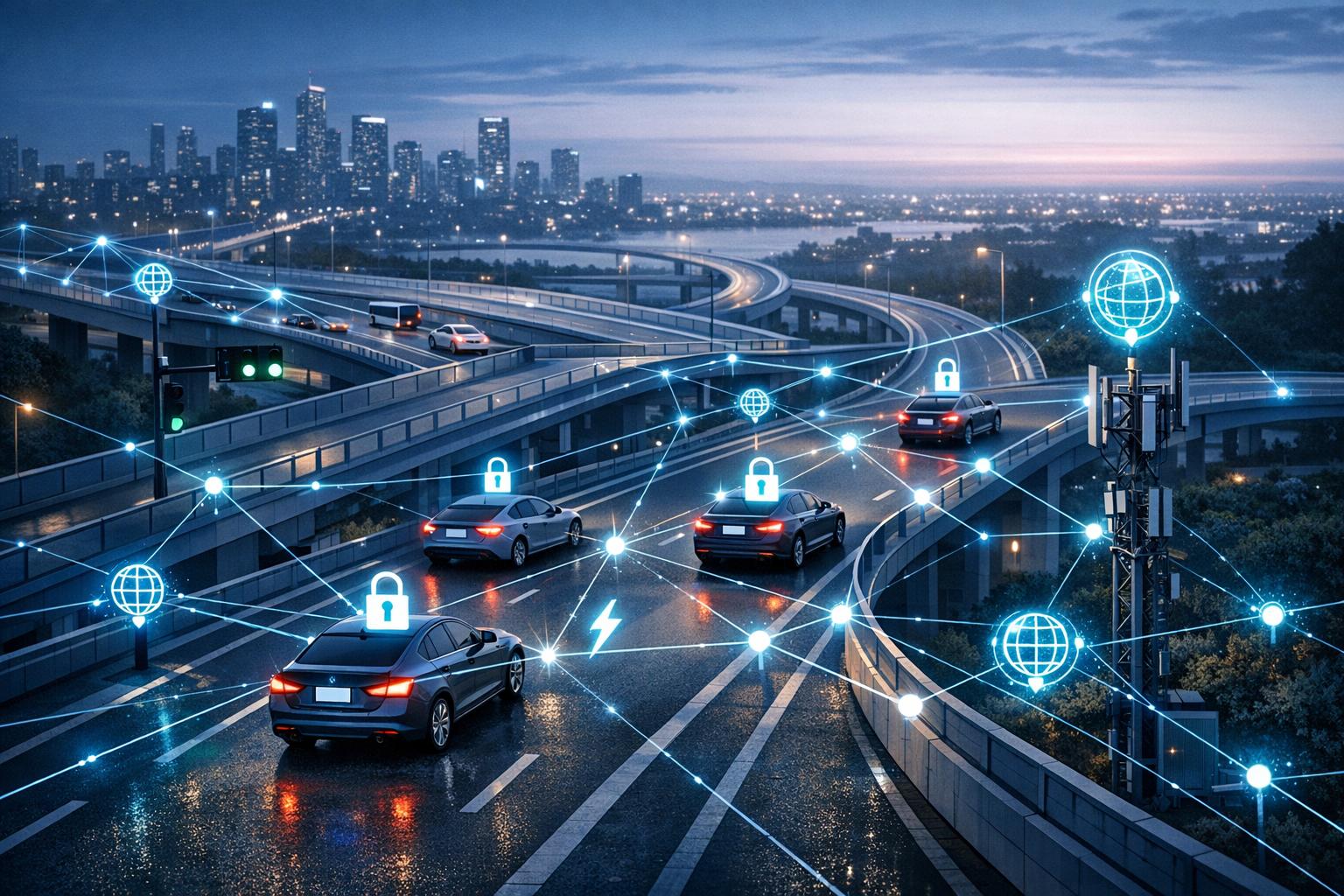
Edge computing is transforming autonomous vehicles by enabling faster, localized data processing for safer and smarter decisions. Traditional cloud systems, while powerful for large-scale analytics, struggle with latency and bandwidth limitations. Here's why edge computing is crucial for V2X systems:
Cloud systems are better suited for tasks like HD map updates and long-term traffic analysis but fall short for real-time safety needs. A hybrid approach combining edge and cloud systems balances speed, scalability, and reliability. This ensures autonomous vehicles can handle immediate hazards while benefiting from cloud-based analytics for broader insights.

Edge computing is reshaping Vehicle-to-Everything (V2X) communication by shifting data processing from far-off cloud servers to Road-Side Units (RSUs) and base stations located right along the roads. This setup keeps computational tasks close to where vehicles operate, creating a network of processing hubs that can handle critical decisions locally [9][1].
The system operates through a three-layer framework: the vehicle network layer processes immediate data from sensors like cameras and LiDAR, the edge cloud layer ensures real-time situational awareness at nearby RSUs, and the cloud layer focuses on long-term analytics [5]. This layered approach allows vehicles to handle urgent safety data efficiently without relying on centralized data centers. Together, these layers ensure fast, accurate responses.
Edge computing is key to delivering the ultra-low delays autonomous vehicles need for split-second decisions. By processing data directly at road-level RSUs, it avoids the delays caused by backhaul and core networks [9][5]. This is especially critical for scenarios like hazard detection and emergency braking [3].
"MEC pushes powerful computational and storage capacities from the remote cloud to the edge of networks in close proximity of vehicular users, which enables low latency and reduced bandwidth consumption." - Lei Liu et al., IEEE [9]
In real-world trials, edge computing at connected intersections reduced overall travel times by up to 14.3%, thanks to faster coordination and hazard management [5].
Edge computing doesn’t just reduce latency - it also optimizes how network bandwidth is used. Instead of sending up to 2 GB per second of raw sensor data to distant servers, edge nodes process the data locally and forward only the most relevant information to the cloud [9][1]. This approach prevents network congestion, which is critical as connected vehicles are expected to generate more than 200 petabytes of data annually by 2025 [5].
Some systems, like CAMEVAN, use algorithms to rank resources in real time. This ensures that urgent tasks are handled by the nearest edge node, while less time-sensitive operations are sent to the cloud [1]. This smart delegation keeps the network running smoothly without overloading any single component.
Edge computing also ensures that V2X systems remain operational during connectivity issues. Safety-critical algorithms and AI processes run locally on vehicles or nearby RSUs, eliminating the need for constant cloud access [5][11]. Technologies like Software Defined Networking (SDN) work alongside edge computing to manage disconnections and maintain vehicle-to-infrastructure communication [5].
This local processing is crucial for safety. RSUs act as localized hubs that provide real-time awareness even when backhaul networks are down [2][11]. This redundancy ensures that autonomous vehicles can still detect obstacles and perform emergency maneuvers without relying on the cloud [3].
Edge computing enhances security by reducing data exposure. Processing sensitive information locally at RSUs means less data travels across long-distance networks, lowering the risk of interception by up to 45% [10]. The distributed nature of edge systems also ensures that a single compromised node won’t jeopardize the entire V2X network. Edge nodes can perform real-time anomaly detection, identifying suspicious activity immediately and allowing for quick responses. In similar setups within healthcare IoT systems, strategic edge deployments cut unauthorized access attempts by 30% [10].
"Edge computing enables local processing of data, reducing the need for extensive data transmission and minimizing the attack surface." - Aaqib Nisar Bhat, Research Scholar, RIMT University [10]
Additional security measures, like Free Space Optical (FSO) communication integrated into RSUs, use narrow transmission beams that are resistant to RF interference [1].
Edge computing shines in scenarios where instant local awareness is critical. For example, in Non-Line-of-Sight (NLOS) situations, such as a cyclist hidden behind a parked bus, edge nodes merge sensor data to alert nearby vehicles immediately [6].
Other emerging use cases include using EV charging stations as edge nodes and tapping into the idle computing power of parked vehicles, turning them into "micro-clouds" for local data processing [11][9][1].
Cloud-based systems take a different approach from edge computing by centralizing data processing in remote data centers. Vehicles connect to these centers through cellular networks, often using the LTE-V2X "Uu" interface, which routes data via 4G/5G core networks. While this setup provides immense storage and computational power for tasks like analytics, it struggles to meet the real-time demands of autonomous driving.
One of the biggest hurdles for cloud systems is latency. Autonomous driving requires split-second decisions, but the round-trip delay from sending sensor data to a remote data center and back is much higher compared to edge-based solutions. For instance, tests on Smart Highway systems show that edge-based ITS-G5 technology reduces latency by 90% compared to cloud-based cellular systems. Similarly, LTE-V2X PC5 - designed for short-range edge communication - cuts latency by up to 50% compared to cloud-based LTE-V2X Uu setups [12].
This delay is especially critical at highway speeds, where safety systems need to predict and react to potential dangers several seconds ahead. As Shaoshan Liu and colleagues from IEEE put it, "The faster the autonomous driving edge computing system performs these complex computations, the safer the autonomous vehicle is" [3].
While cloud systems are excellent for tasks like HD map updates, long-term traffic analysis, and data storage - where immediate responses aren't required - they fall short when it comes to collision avoidance or emergency braking. The latency involved in cloud processing makes it unsuitable for these safety-critical functions.
Cloud-based V2X systems also face significant bandwidth challenges. Cellular networks are inherently imbalanced, offering much higher downlink speeds than uplink speeds. However, V2X relies heavily on uplink bandwidth to transmit massive amounts of sensor data to the cloud. Current 5G networks typically provide uplink speeds of around 100 Mbps, far below the 8 Gbps that vehicles can generate [13]. In real-world conditions, uplink speeds often max out at just 50 Mbps (5th percentile), creating a substantial gap between the data vehicles produce and what networks can handle [13].
This bottleneck isn't just inconvenient - it can be dangerous. In urban areas, where thousands of vehicles might simultaneously upload high-fidelity sensor data, network congestion can severely impact the reliability of safety-critical systems. And then there’s the cost: transmitting data at 50 Mbps costs roughly $16.88 per hour in the U.S. [13]. While cloud computing itself is relatively affordable - renting an NVIDIA H100 GPU costs about $2.49 per hour - the data transmission expenses far outweigh the processing costs.
Another limitation of cloud-based V2X systems is their reliance on constant connectivity. If cellular coverage drops or networks become congested, vehicles lose access to the remote processing power they depend on. Unlike edge systems, which can rely on local roadside units or onboard computation, cloud-based architectures require a stable connection to function properly.
As Jun Zhang and Khaled B. Letaief explain, "To store and process the massive amount of data generated by intelligent IoV, onboard processing and Cloud computing will not be sufficient, due to resource/power constraints and communication overhead/latency, respectively" [2]. This dependency raises concerns about reliability in scenarios like tunnels, rural areas, or network outages - situations where autonomous vehicles still need to operate safely. It also increases security risks, as connectivity gaps can leave systems vulnerable to attacks.
Centralized cloud systems present a larger attack surface because data must pass through multiple network layers - from the vehicle to cellular towers, through core networks, and finally to remote data centers. Each step creates opportunities for interception or tampering [7].
As noted in Foundations and Trends in Electronic Design Automation, "While the increasing connectivity among vehicles and infrastructures may help improve their perception of the environment... it also presents new challenges to ensure system safety and security... with the inevitably larger attack surface" [7].
Specific threats to cloud-based systems include message replay attacks, unauthorized sender access, and data breaches during transmission [5]. While technologies like Public Key Infrastructure (PKI) and blockchain can help mitigate these risks through digital signatures and immutable transaction logs, the centralized nature of cloud systems means a single breach could compromise data from thousands of vehicles at once.
Despite these challenges, cloud-based V2X systems excel at tasks that don't require immediate responses. For example, HD map generation benefits from the immense processing power available in data centers, which can aggregate and analyze data from thousands of vehicles to produce detailed road maps. Other suitable applications include long-term traffic analysis, fleet management, and over-the-air software updates.
Cloud systems also shine in object detection tasks when bandwidth allows. For instance, a cloud-based NVIDIA H100 GPU can process models 4–19 times faster than an edge-focused NVIDIA Jetson Orin chip [13]. Even with network transfer times factored in, a complex model like EfficientDet D7 can be executed in 184 ms via the cloud - far faster than the 1,955 ms required for on-vehicle processing [13].
Additionally, cloud systems offer efficiency through statistical multiplexing. Since the average U.S. car is driven only about an hour a day, a shared pool of cloud resources can serve multiple vehicles more efficiently than dedicated onboard hardware [13]. This makes cloud infrastructure a cost-effective option for non-critical applications where processing tasks can be queued during downtime.
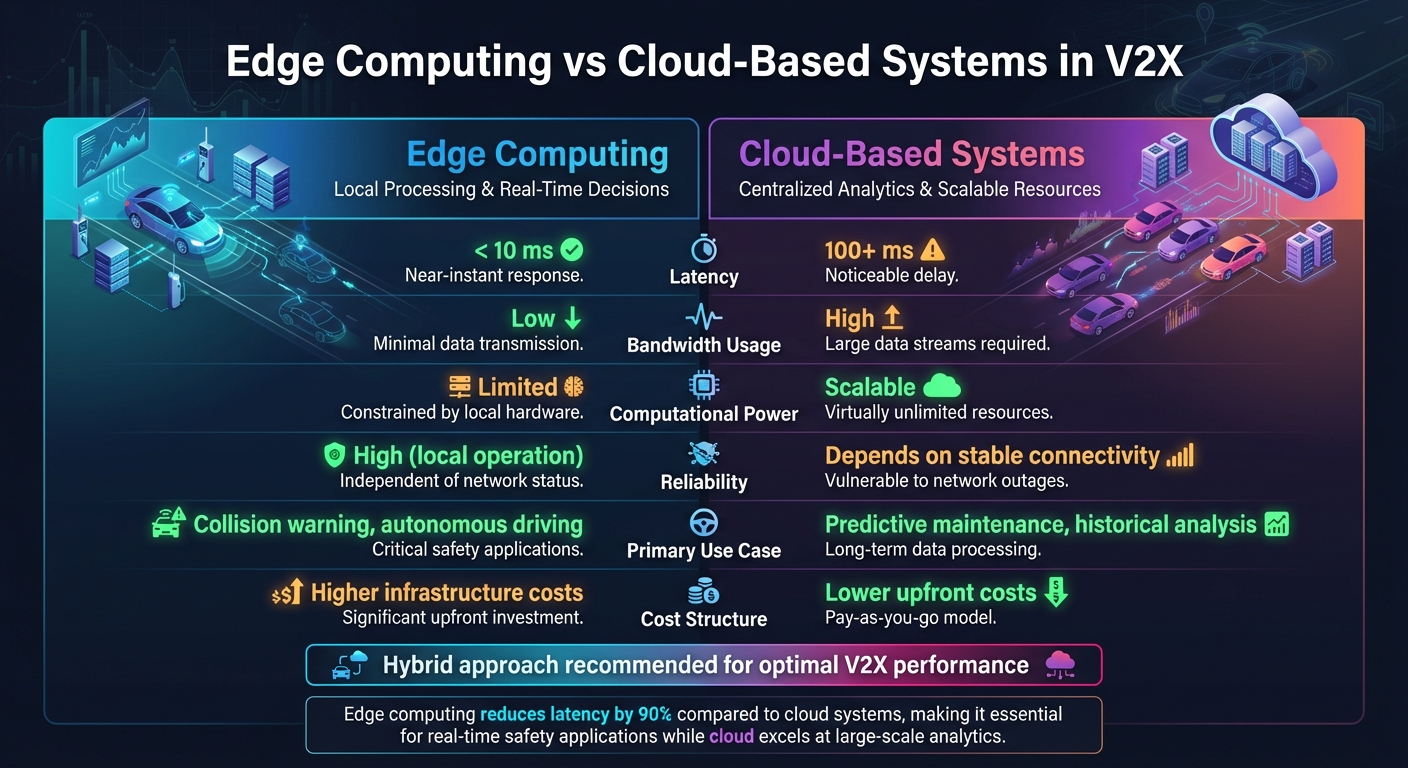
Edge Computing vs Cloud-Based Systems in V2X: Performance Comparison
Edge computing and cloud systems each bring their own strengths and challenges to the table. When combined, they can create a more efficient setup for V2X solutions.
Edge computing shines with ultra-low latency, making it ideal for real-time safety tasks like collision avoidance [5][8]. By processing data locally, it reduces bandwidth usage, but its capabilities are limited by smaller computing power and storage compared to centralized data centers [1][5]. Additionally, managing hardware spread across different locations, each with unique configurations, adds complexity [1].
On the other hand, cloud-based systems are perfect for large-scale data processing and long-term analytics. They offer scalable resources for tasks such as generating HD maps and predictive maintenance [16]. Their pay-as-you-go model also reduces upfront costs. However, the high latency caused by data traveling to distant data centers makes them unsuitable for real-time safety applications [1][4]. Bandwidth limitations are another drawback, as transmitting raw sensor data can strain networks and increase costs [1][5].
| Feature | Edge Computing | Cloud-Based Systems |
|---|---|---|
| Latency | < 10 ms | 100+ ms |
| Bandwidth Usage | Low | High |
| Computational Power | Limited | Scalable |
| Reliability | High (local operation) | Depends on stable connectivity |
| Primary Use Case | Collision warning, autonomous driving | Predictive maintenance, historical analysis |
| Cost Structure | Higher infrastructure costs | Lower upfront costs |
Edge computing's decentralized setup creates a larger attack surface, requiring strong security measures to address local vulnerabilities [7]. Meanwhile, cloud systems rely heavily on stable internet connections, making them less reliable in areas with poor coverage or during network outages [5].
These differences highlight the potential of a hybrid approach, where edge computing and cloud systems work together to maximize the strengths of each. This combination is especially relevant for real-world V2X applications, where balancing speed, scalability, and reliability is crucial. Leveraging SurferCloud’s edge infrastructure can help achieve optimal performance for these scenarios.

SurferCloud operates 17+ global data centers strategically located near vehicles and roadside infrastructure. This setup ensures split-second responses, which are essential for safety-critical systems like collision avoidance [17][18]. By placing computing resources closer to where the action happens, SurferCloud provides the scalability and on-demand processing that V2X systems rely on.
The platform’s elastic compute servers handle the massive and fluctuating data loads generated by connected vehicles and road networks. With each vehicle producing over four terabytes of data continuously [5] and road networks experiencing varying demands [4], the ability to scale processing power dynamically is key. These servers allow autonomous fleets to offload intensive tasks, such as processing data from cameras, lidar, and radar, while still delivering the split-second decisions required for safe autonomous driving [4][14].
"MEC pushes powerful computational and storage capacities from the remote cloud to the edge of networks in close proximity of vehicular users, which enables low latency and reduced bandwidth consumption." – Lei Liu et al. [18]
By prioritizing local data processing, SurferCloud reduces bandwidth congestion by filtering raw sensor data directly at the edge. This approach becomes even more critical with projections estimating 400 million connected vehicles on the road by 2025, highlighting the importance of efficient edge computing to handle such immense data volumes [18][5].
To support its edge infrastructure, SurferCloud offers 24/7 expert support to manage the challenges of distributed edge nodes. These edge data centers, often located in remote areas, require constant monitoring to meet the high availability demands of autonomous systems [17]. Around-the-clock management ensures that dual power sources remain operational and that infrastructure can adapt to unexpected events like traffic incidents or network disruptions [17].
Edge and cloud systems each play unique roles: edge computing is essential for real-time safety, while cloud systems handle long-term analytics. For example, edge computing supports the ultra-low latency needed for safety-critical tasks like collision avoidance and emergency braking, whereas cloud platforms excel in training AI models and optimizing route planning with vast datasets [19]. These complementary strengths shape the roadmap for V2X developers.
"Cloud computing at the edge of the network, close to the vehicle and ITS sensor, can provide a solution for latency and bandwidth constraints" - IEEE Transactions on Intelligent Transportation Systems [4]
For developers working on V2X systems, a hybrid approach is the way forward. Edge infrastructure should handle tasks that demand immediate responses, such as cooperative awareness messages, hazard detection, and junction scheduling - an optimization that can cut travel times by up to 14.3% [1]. Meanwhile, cloud resources are better suited for non-urgent tasks like firmware updates and long-term data analysis.
Safety-critical applications need local processing. For instance, a vehicle traveling at 60 mph requires several seconds to predict hazards and initiate emergency braking [3]. Processing sensor data locally at roadside units or base stations ensures that only actionable insights are sent to the network, reducing data load and improving response times [19]. This makes edge processing indispensable for maintaining safety.
As V2X systems continue to evolve, infrastructure must scale to meet future demands. Supporting interoperability between C-V2X and DSRC technologies and ensuring secure local processing will be crucial for enhancing both performance and privacy [15][20][19]. As NVIDIA aptly puts it, "Organizations centralize when they can and distribute when they have to" [8]. This principle should guide every architectural decision in V2X development.
Looking ahead, with over 75% of newly manufactured vehicles expected to feature V2X capabilities by 2030 [20], today's infrastructure investments must prepare for a future with hundreds of millions of connected vehicles. A hybrid architecture, combining the low latency of edge computing with the scalability of cloud analytics, is key to meeting the demands of autonomous driving and ensuring the reliability of V2X systems.
Edge computing plays a crucial role in boosting the safety of autonomous vehicles within V2X (Vehicle-to-Everything) systems by processing data closer to the vehicles and roadside infrastructure. This proximity significantly cuts down communication delays, enabling real-time decision-making and quicker responses to potential hazards.
By allowing immediate risk assessments and delivering timely alerts, edge computing helps vehicles respond more effectively to sudden changes in their environment. This improves safety while also ensuring better coordination between vehicles and the world around them.
Edge computing and cloud systems approach V2X communication differently, each offering distinct advantages.
Edge computing handles data processing closer to the source - like within vehicles or roadside units. This setup delivers extremely low latency, making it perfect for critical tasks such as collision avoidance or real-time sensor analysis. By keeping these processes local, edge computing eliminates the delays that can occur when data needs to travel to distant servers, a common challenge for cloud-based systems.
Another benefit of edge computing is its ability to ease bandwidth usage. It processes only the most urgent data locally, whereas cloud systems often require large datasets to be transmitted, which can put a strain on network resources. Moreover, edge computing proves to be more reliable in areas where connectivity might be spotty. On the other hand, cloud platforms shine when it comes to scalability and storage, making them ideal for non-urgent tasks like fleet analytics or training machine learning models.
In short, edge computing is the go-to for real-time, safety-critical V2X operations, while cloud systems handle large-scale data needs and long-term resource management effectively.
Combining edge computing with cloud computing brings a powerful boost to Vehicle-to-Everything (V2X) systems by utilizing the best of both worlds. Edge computing manages critical, time-sensitive tasks right where the action happens - locally - allowing for split-second decisions crucial for safety and navigation. On the other hand, the cloud takes care of more demanding processes, such as analyzing large datasets, storing information over the long term, and managing system updates, ensuring the system can scale and adapt as needed.
This synergy enables V2X systems to operate with faster, more dependable performance while tapping into the immense computational and storage capabilities of the cloud. By working together, edge and cloud computing create an efficient and responsive framework for connected and autonomous vehicles.