Edge Computing vs. Cloud Computing: What's th
In recent years, both edge computing and cloud computin...









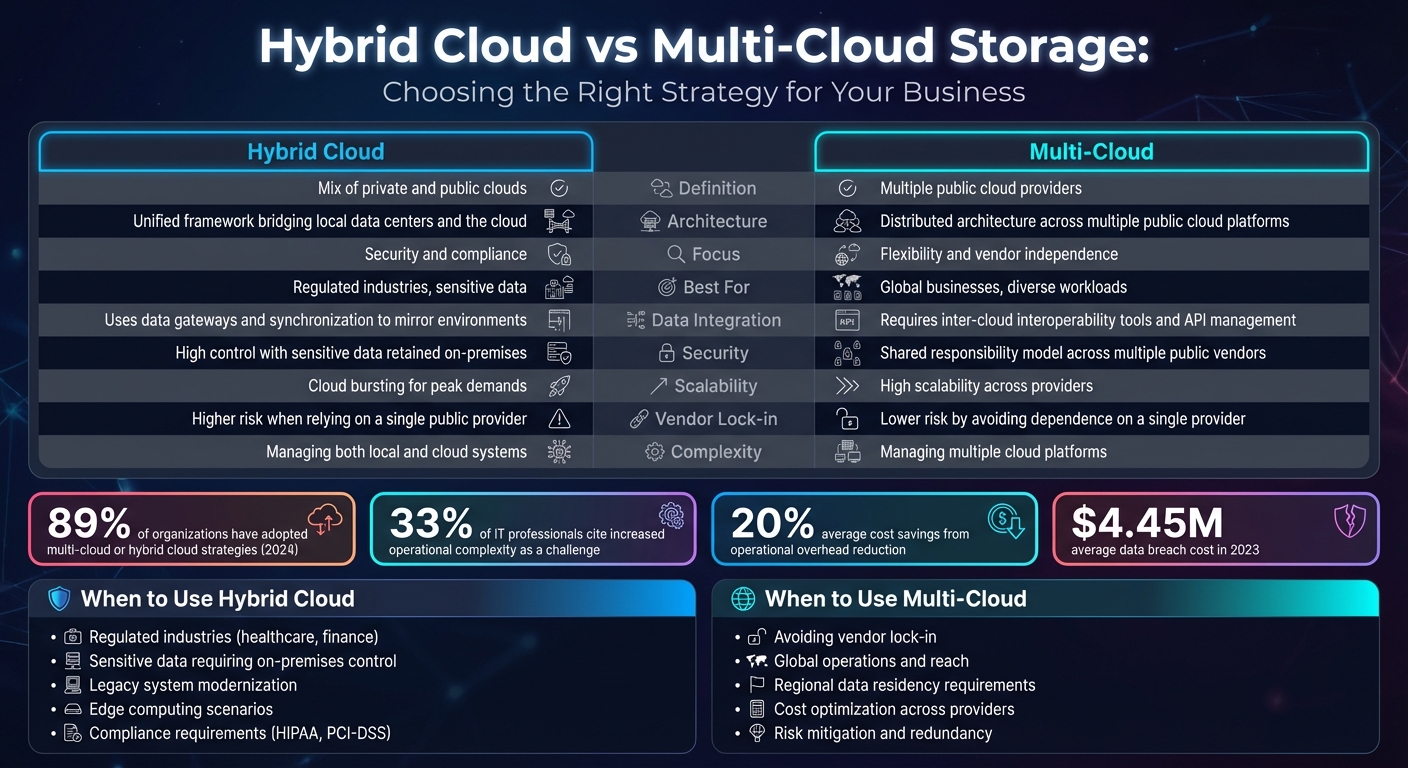
When it comes to managing data, hybrid cloud and multi-cloud storage offer two distinct strategies. Here's the quick breakdown:
| Feature | Hybrid Cloud | Multi-Cloud |
|---|---|---|
| Definition | Mix of private and public clouds | Multiple public cloud providers |
| Focus | Security and compliance | Flexibility and vendor independence |
| Best for | Regulated industries, sensitive data | Global businesses, diverse workloads |
| Scalability | Cloud bursting for peak demands | High scalability across providers |
| Complexity | Managing both local and cloud systems | Managing multiple cloud platforms |
Both approaches have their strengths and challenges, so your choice depends on your data needs, regulatory requirements, and scalability goals.
Hybrid Cloud vs Multi-Cloud Storage: Key Differences and Features Comparison
Hybrid cloud storage combines private, on-premises storage with public cloud services, using data gateways and synchronization tools to maintain consistent data across both environments [3].
This setup is particularly useful for managing data strategically. Sensitive information, like HIPAA-regulated records or real-time operational data, is typically stored on private servers to ensure low latency and better control. Meanwhile, non-critical data, such as marketing assets, backups, or archives, is stored in the public cloud. This approach allows organizations to run applications in the public cloud while keeping critical data secure on private servers.
"Hybrid cloud storage mixes public cloud storage with on-premises storage and facilitates the transfer of data assets between the two types of environments." - IBM [3]
A key feature of hybrid cloud storage is automated data tiering. This process shifts less frequently accessed data to more affordable cloud storage tiers while keeping high-demand data on-site. Additionally, during peak traffic periods, "cloud bursting" enables workloads to temporarily move to the public cloud, ensuring smooth operations without overloading private servers.
Next, let’s dive into the core features that make hybrid cloud storage so effective.
The backbone of hybrid cloud storage is its integration layer. Data gateways act as secure bridges between private systems and cloud services, while synchronization software ensures that updates in one environment are mirrored in the other, maintaining data consistency no matter where it resides.
Centralized management tools provide a unified interface to monitor usage, track spending, and manage capacity across both private and public environments. This single console simplifies oversight, allowing IT teams to control access, enforce compliance, and monitor operations seamlessly.
Hybrid systems also offer elastic scalability, adjusting to real-time needs. When private data centers reach capacity, workloads can expand into the public cloud, eliminating the need for costly hardware over-provisioning. During quieter times, resources can scale down to save costs.
Automated data tiering is another standout feature. Frequently accessed data stays on high-performance local storage, while less-used information is moved to mid-tier or archival cloud storage, optimizing both performance and costs without manual effort.
One of the biggest advantages is enhanced security for sensitive data. Organizations can keep regulated information, such as healthcare records or financial transaction data, on-premises, maintaining strict control over access. Meanwhile, the cloud can handle less sensitive tasks like analytics or administrative workloads.
Regulatory compliance is also easier to manage. Storing sensitive data on-premises helps organizations navigate complex rules around data residency and jurisdiction.
Operational flexibility is another plus. Many businesses aim to reduce operational overhead by integrating IT processes across hybrid environments, often achieving cost savings of around 20% [8]. This flexibility allows them to shift workloads between private and public systems as needs evolve.
The hybrid model also offers cost advantages. By combining fixed investments in private infrastructure with the pay-as-you-go nature of public cloud services, businesses can reduce upfront expenses while maintaining control over critical systems.
Disaster recovery is another key benefit. If a private data center fails, workloads can automatically shift to the cloud, minimizing downtime. Many organizations aim for 99.99% availability by using hybrid disaster recovery strategies [8], ensuring data remains accessible through automated failover systems.
Despite its advantages, hybrid cloud storage comes with challenges. Integration costs can be high, as setting up data gateways, synchronization tools, and upgraded network infrastructure often requires significant upfront investment.
Managing a hybrid system can also be complex. IT teams must handle multiple vendor contracts, diverse management tools, and sometimes incompatible systems. Any gaps in visibility can lead to security risks or compliance breaches.
Latency is another concern. Transferring data between private and cloud environments can cause delays, especially for applications that frequently access cloud-stored data. This makes strategic data placement critical.
Hidden costs, like data egress fees for retrieving cloud-stored data, can add up quickly. Frequent cloud bursting or continuous synchronization may also increase expenses. Additionally, maintaining private cloud hardware and software incurs ongoing costs, regardless of cloud usage.
Finally, hybrid systems depend heavily on reliable connectivity. Network outages can disrupt access to cloud-stored data or prevent cloud bursting altogether. To mitigate this, organizations often invest in redundant connectivity options, which can further increase costs and complexity.
Multi-cloud storage involves using services from at least two separate public cloud providers to run applications and manage data. This approach helps organizations avoid relying on a single provider, reducing risks tied to technical failures or unfavorable commercial terms [9][10]. It allows businesses to distribute workloads across multiple vendors, aligning each task with the provider that offers the best capabilities, pricing, or geographic reach.
"Multi-cloud is the deliberate use of cloud services from at least two independent providers to run applications, data, and analytics. The goal is aligning specific workloads with the best-fit capabilities, locations, and risk profile." - Cloudera [10]
This setup offers flexibility by enabling organizations to choose specialized tools, such as advanced AI engines or analytics platforms, tailored to their needs [9][10]. Below, we break down the key features that define multi-cloud storage.
One of the biggest advantages of multi-cloud storage is the freedom it provides. Organizations aren’t locked into a single provider and can switch if pricing or service quality declines [9][11]. This flexibility also supports cost optimization, as workloads can be shifted to providers offering the best balance of price and performance [9].
Real-world examples highlight these benefits. In February 2025, TIM Brasil, which serves over 50 million customers, migrated 16 petabytes of data and 8,000 workloads to a multi-cloud setup. This move cut customer service inquiry handling times by an average of 50% [11].
Multi-cloud environments also unlock access to specialized tools. For instance, the Cloudera Lakehouse Optimizer has been shown to accelerate query speeds by up to 13 times in such setups [10]. Additionally, geographic distribution boosts both resilience and performance. Conduent, for example, processes nearly 13 million tolling transactions daily using a multi-cloud architecture to reduce latency [11].
Providers like SurferCloud demonstrate the strength of the multi-cloud approach by offering secure, scalable, and high-performance storage solutions. With 17+ global data centers and round-the-clock expert support, they ensure reliability and efficiency.
While multi-cloud storage has clear advantages, it also brings complexity. Each cloud provider operates with its own APIs, tools, service agreements, and billing systems. This means IT teams must navigate and master multiple platforms, often requiring advanced orchestration tools [9][2].
Security is another major hurdle. Differences in identity management systems can create inconsistent permissions and broaden the attack surface [2][10].
"Use one pane of glass per problem, not per vendor. The point is fewer blind spots and faster MTTR, not tool bingo." - Cloudera [10]
Organizations can address these challenges by adopting policy-as-code approaches to enforce consistent security and compliance rules across all platforms [10]. However, costs can also become an issue. Data egress fees and inter-provider transfers can quickly add up, leading to higher operational expenses [9][2][10].
Lastly, achieving seamless integration across various platforms requires careful planning from the start. Without adopting open and portable technologies early on, businesses risk creating new silos, undermining the flexibility that multi-cloud strategies aim to provide [10].
Hybrid cloud storage brings together private infrastructure with public cloud resources, while multi-cloud storage relies on multiple public cloud services from various providers. In simpler terms, hybrid cloud combines on-premises systems, like data centers or local hardware, with public cloud capabilities. On the other hand, multi-cloud focuses exclusively on using services from different public cloud vendors, often without involving a private infrastructure component. These setups differ significantly in how they handle data placement, connectivity, and management.
"A hybrid cloud infrastructure blends two or more different types of clouds, while multi-cloud blends different clouds of the same type. You might say hybrid cloud is like combining apples and oranges, while multi-cloud is like combining different types of apples." - Cloudflare
Hybrid cloud architectures are often used to keep sensitive or performance-critical data on-premises, ensuring security and low latency. In contrast, multi-cloud setups spread data across various public cloud providers, taking advantage of their specialized features and global reach. As of 2024, a striking 89% of organizations have adopted strategies that incorporate either multiple public clouds or hybrid cloud infrastructure [4].
The connectivity needs also highlight their distinctions. Hybrid cloud storage relies on data gateways, VPNs, and synchronization tools to ensure consistency between on-premises systems and the cloud. Multi-cloud environments, however, require tools that manage interoperability between different public cloud platforms, including their APIs and security configurations. Additionally, hybrid cloud setups often use cloud bursting to handle sudden traffic surges. These architectural differences have a direct impact on data integration, security, scalability, and the level of vendor dependency.
| Parameter | Hybrid Cloud Storage | Multi-Cloud Storage |
|---|---|---|
| Definition | Blend of public cloud and private/on-premises infrastructure | Use of multiple public cloud services from different vendors |
| Architecture | Unified framework bridging local data centers and the cloud | Distributed architecture across multiple public cloud platforms |
| Data Integration | Uses data gateways and synchronization to mirror environments | Requires inter-cloud interoperability tools and API management |
| Security | High control with sensitive data retained on-premises | Shared responsibility model across multiple public vendors |
| Scalability | Scalable through techniques like "cloud bursting" | Highly scalable and flexible across multiple vendor pools |
| Vendor Lock-in | Higher risk when relying on a single public provider combined with on-premises systems | Lower risk by avoiding dependence on a single provider |
| Management Complexity | Complex due to managing both local hardware and cloud software | Complex, requiring management of diverse vendor APIs and consoles |
Hybrid cloud storage is ideal for organizations that need to balance regulatory compliance with flexibility. For example, industries like finance, healthcare, and oil and gas often store sensitive data - such as personally identifiable information (PII) or medical records - on-premises to meet stringent regulations, while using the cloud for less-sensitive tasks like analytics or testing environments [12].
This model also works well for businesses that need to store critical data locally but want to use the cloud for cost-effective solutions like disaster recovery or cloud bursting. Picture an e-commerce company handling a surge in traffic during a holiday sale: they can temporarily expand into the public cloud when their on-premises servers reach capacity [12].
Hybrid cloud storage shines in edge computing scenarios, too. Think of factory floors using predictive maintenance systems or retail kiosks processing transactions - these setups benefit from processing data locally for low latency while syncing with a central cloud [12]. Similarly, organizations with legacy mainframes can modernize step by step, migrating components to the cloud while keeping core systems on-premises [12]. For advanced use cases like AI and big data analytics, businesses often rely on the public cloud for its immense computing power to train models, while keeping proprietary datasets secure in private storage [12].
These examples show how hybrid cloud storage can handle a variety of needs, paving the way to explore multi-cloud strategies.
Multi-cloud storage is a smart choice for organizations aiming to avoid vendor lock-in while leveraging the strengths of multiple cloud providers. By spreading data across different clouds, businesses reduce their reliance on a single provider’s pricing or infrastructure [13].
"Multi-cloud is not just a technical term, but a strategic approach that involves distributing computing resources, applications, and data across multiple cloud environments." - Ben Herzberg, Satori [13]
This strategy allows companies to align specific workloads with the provider that offers the best tools for the job, whether it’s scalable storage, robust identity management, or cutting-edge AI services [14]. It’s also an effective way to meet regional data residency requirements. For instance, if a primary provider doesn’t have a data center in a country where data must stay, a secondary provider can step in to fill that gap [13]. Plus, organizations can optimize costs by matching workloads to the provider offering the best combination of pricing and performance [14].
Another major benefit is risk mitigation. If one provider experiences downtime, workloads can shift to another, ensuring continuous availability and minimizing disruptions [14]. However, managing multiple providers comes with its own challenges, which influence how organizations approach integration.
With these use cases in mind, the next section will dive into the challenges of integrating hybrid and multi-cloud storage models.
Hybrid and multi-cloud storage systems come with plenty of advantages, but integrating them can be a tricky process. The challenge lies in managing multiple environments that weren’t originally designed to work together without issues.
One of the biggest hurdles is maintaining data consistency. Keeping data synchronized across different storage platforms requires specialized tools or services to ensure that updates in one location are accurately reflected elsewhere [3]. On top of that, moving data between clouds or from the cloud to on-premises systems can rack up hefty egress fees, creating unexpected costs if workloads aren’t carefully planned [15][8].
Security and compliance also pose significant challenges. Each cloud provider has its own security protocols and compliance standards, making it tough to maintain uniform policies across all platforms [15]. A striking statistic highlights this risk: 47% of companies have at least one exposed storage bucket or database open to the internet [16]. Often, these vulnerabilities arise from misconfigurations that go unnoticed due to fragmented management systems. Given that the average data breach cost hit $4.45 million in 2023 [16], these gaps can have serious financial consequences.
Another issue is management visibility. When working with multiple cloud providers, monitoring tools often operate in silos, with performance data spread across various dashboards. This fragmentation makes it hard to connect the dots or pinpoint performance issues across different storage environments [15][3]. To cut operational overhead by as much as 20%, businesses need unified control planes that bring together these separate systems. However, implementing such solutions involves navigating complex pricing structures and onboarding processes [8][3].
Connectivity and latency add yet another layer of complexity. Placing workloads closer to data sources can help reduce latency, but managing these distributed setups requires a cohesive network strategy. Without careful planning, companies risk ending up with a disconnected patchwork of systems that are harder to manage than the original infrastructure they aimed to improve [8][1].
These integration challenges highlight the need for thoughtful planning and robust solutions to fully unlock the potential of hybrid and multi-cloud storage systems.
To decide between hybrid cloud and multi-cloud storage, start by categorizing your data based on sensitivity and how often it's accessed. For highly sensitive data - like patient records or financial transactions - consider a hybrid cloud approach that keeps such information on-premises. This setup helps avoid compliance headaches down the line. For less critical data, public cloud storage can be a cost-effective option [3][6]. Additionally, take a close look at your industry's regulatory requirements to fine-tune your strategy.
Regulations often play a pivotal role in this decision. Industries like healthcare, banking, and government must comply with standards such as HIPAA or PCI-DSS. In these cases, hybrid cloud storage offers the physical control necessary to meet compliance needs [3][4]. On the other hand, if avoiding vendor lock-in is a bigger concern and regulations are less stringent, multi-cloud offers the flexibility to negotiate better deals and switch providers as needed [7][1][4].
Your current infrastructure and technical expertise also matter. Organizations heavily invested in legacy systems - like mainframes or specialized hardware with intricate dependencies - may find hybrid cloud a more practical choice. It allows for gradual modernization without the high costs of an abrupt overhaul [4][5]. However, if your IT team is smaller, multi-cloud could be a better fit since public cloud providers handle much of the maintenance [7][3]. That said, be aware that 33% of IT professionals identify increased operational complexity as a significant challenge in hybrid cloud setups [7].
Workload needs are just as important as compliance considerations. For businesses with seasonal traffic spikes - like e-commerce during the holidays - hybrid cloud provides the flexibility to "burst" workloads into the public cloud when on-premises capacity is maxed out [7][3]. On the other hand, if your customer base is spread across the globe, multi-cloud allows you to store data in specific regions, reducing latency and adhering to local data residency laws [7].
Cost is another key factor. Multi-cloud typically has lower upfront costs and uses pay-as-you-go pricing models. However, egress fees and managing multiple subscriptions can lead to unpredictable expenses [7][1][4]. Hybrid cloud, while requiring higher initial investment in on-premises hardware, offers more predictable costs for steady workloads over time [7][3][6]. By 2025, 51% of IT spending in key categories was projected to shift from traditional on-premises solutions to public cloud [7]. Ultimately, your choice should align with your financial strategy and long-term business goals.
Pick the strategy that aligns best with your business goals. Hybrid cloud is ideal if you need to maintain strict control over sensitive data and comply with regulations like HIPAA or PCI-DSS. On the other hand, multi-cloud is a better fit if you’re looking to avoid vendor lock-in and require global redundancy. The growing adoption of both approaches highlights their effectiveness in different scenarios.
Your decision should consider factors like data sensitivity, regulatory requirements, existing infrastructure, and budget. Hybrid cloud works well for businesses with legacy systems, while multi-cloud offers greater flexibility for global operations.
One key challenge to address is the complexity of managing these systems. Both approaches demand robust management tools and well-defined security policies from the start. It’s worth noting that 33% of IT professionals identify increased operational complexity as a significant hurdle in hybrid cloud deployments [7]. Proper planning is crucial to avoid pitfalls.
SurferCloud supports both strategies with its 17+ global data centers, elastic compute servers, secure storage solutions, and round-the-clock support. Whether you’re keeping sensitive data on-premises while tapping into public cloud resources or spreading workloads across multiple environments, partnering with a reliable cloud provider can help streamline the process.
Hybrid cloud storage blends on-premises or private cloud resources with public cloud services, giving businesses the ability to store data in the most effective location. This setup keeps sensitive or time-critical workloads in a private environment for better security, compliance, and performance, while taking advantage of the scalability of public clouds to handle less-critical data. It’s also a smart way to manage costs - store "cold data" in affordable public storage and keep "hot data" close to applications for quick access.
Unlike a multi-cloud strategy that relies on multiple public cloud providers and can limit control over where data resides, hybrid cloud storage offers more flexibility, continuity, and governance. It provides a reliable on-site backup in case of public cloud outages and allows IT teams to optimize workloads across environments, leveraging existing skills and infrastructure. For businesses in the U.S., this means cutting costs, simplifying compliance, and scaling seamlessly - all without losing control over their data.
SurferCloud’s hybrid cloud storage solution showcases these advantages. It combines secure, scalable on-premises storage with a globally integrated public cloud infrastructure. This unified system makes it easy for businesses to balance performance, costs, and compliance.
Choosing between hybrid cloud and multi-cloud storage comes down to what your business prioritizes. A hybrid cloud setup blends private infrastructure - whether on-premises or dedicated - with public cloud services. This gives you tight control over sensitive data while still taking advantage of the flexibility and cost savings public cloud solutions offer for less critical workloads. On the other hand, multi-cloud involves working with multiple public cloud providers. This approach helps avoid being locked into a single vendor, optimizes costs, and lets you pick the best tools for specific tasks.
When making your decision, think about factors like data security and compliance, workload demands, cost considerations, and integration challenges. For instance, if your business needs to maintain strict control over sensitive data or relies on legacy systems, hybrid cloud might be the better fit. If flexibility and spreading workloads across multiple providers to manage costs are more important, multi-cloud could be the way to go.
SurferCloud supports both strategies, offering secure private cloud infrastructure and smooth integration with public cloud platforms. This allows businesses to craft a storage solution that matches their specific needs.
Managing hybrid and multi-cloud storage systems isn’t exactly a walk in the park. One of the biggest hurdles is dealing with the operational complexity of juggling multiple platforms. Each platform comes with its own set of tools, interfaces, and monitoring systems, which can quickly lead to inefficiencies and make consistent management feel like an uphill battle.
Then there’s the issue of security and compliance. Every cloud provider has its own policies, and this can open the door to misconfigurations - potentially exposing sensitive data. On top of that, cost management can spiral out of control. With spending spread across different clouds, it’s tough to get a clear, centralized view of where the money is going. And let’s not forget about performance - ensuring everything runs smoothly means constant monitoring and fine-tuning to address latency, data transfers, and meeting service-level agreements (SLAs).
A unified management platform can be a game-changer for tackling these challenges. By consolidating tools, ensuring consistent security measures, and offering centralized cost tracking, businesses can simplify their hybrid and multi-cloud operations. For instance, SurferCloud provides integrated solutions that help streamline operations, tighten security, and keep costs in check, making cloud management far less daunting.