CDN vs Cloud Server: What Should You Use for
CDN vs Cloud Server: What Should You Use for Global Web...









Zero Trust orchestration simplifies security across multi-cloud environments like AWS, Azure, and SurferCloud by centralizing authentication and authorization. Instead of relying on traditional network perimeters, it focuses on identity-driven policies to minimize risks and ensure consistent security. Here’s what you need to know:
Each approach has strengths and challenges, but all prioritize continuous verification to protect multi-cloud setups. With 92% of organizations using multiple cloud providers, adopting Zero Trust is essential for reducing vulnerabilities while maintaining operational efficiency.
AWS weaves Zero Trust principles into its architecture by combining identity controls with network safeguards. As highlighted in the AWS Security Blog:
"The best security doesn't come from making a binary choice between identity-centric and network-centric tools, but rather by using both effectively in combination with each other" [6].
Amazon VPC Lattice simplifies the complexity of multi-cloud orchestration by providing consistent service-to-service connections across various VPCs and accounts. This ensures smooth workload management across diverse cloud environments. Meanwhile, AWS Verified Access integrates seamlessly with third-party Identity Providers and device management tools, enabling secure access to corporate applications without relying on VPNs. These features are key to creating unified security across multi-cloud deployments. By embedding connection points directly into its services, AWS delivers a cohesive security framework that supports scalable and secure operations.
Traditional VPNs often struggle to keep up with the demands of modern workloads. AWS addresses this challenge with services designed to scale automatically alongside your environment. For instance, AWS IAM handles millions of requests per second on a global scale, ensuring that every API call is authenticated and authorized without any drop in performance [6]. Additionally, AWS SigV4 ensures every interaction with AWS APIs is uniquely authenticated, no matter the network location. This architecture eliminates the need for manually managing fragmented security systems, allowing your multi-cloud environment to grow effortlessly while maintaining robust security. This scalability underscores AWS's commitment to Zero Trust principles.
AWS strengthens security through micro-segmentation, using tools like Security Groups and AWS PrivateLink to restrict lateral movement and authorize only specific flows between components. With Amazon Verified Permissions, developers gain centralized, fine-grained control over application permissions using the Cedar policy language, making it easier to manage permissions at scale. These measures reinforce the integrated and scalable security framework AWS promotes. Even internally, AWS adheres to Zero Trust principles - when AWS Auto Scaling interacts with the Amazon EC2 API, it operates under a service-linked role with short-term credentials. This ensures that even internal AWS services function without inherent network trust, maintaining strict containment and security boundaries [6].
At the heart of Azure's Zero Trust strategy is Microsoft Entra ID, which acts as the central control hub. It evaluates real-time signals - like user identity, device health, location, and risk level - before granting access to resources across platforms, including Azure, AWS, and GCP [12]. This identity-driven approach ensures consistent authentication policies are applied across all environments, aligning with the principles of Zero Trust.
Azure Arc takes this a step further by extending Azure's control to non-Azure environments. It allows AWS virtual machines, GCP Kubernetes clusters, and on-premises servers to be managed through Azure's platform. This means you can apply Azure Policies and Microsoft Defender protections uniformly, regardless of where your resources reside [11]. For security operations, Microsoft Sentinel centralizes SIEM and SOAR capabilities, pulling in data from Microsoft 365, Azure, and third-party clouds like AWS Security Hub and GCP Security Command Center [11]. This consolidation gives security teams a unified dashboard for threat detection and automated responses, reducing the complexity of juggling multiple security tools [9]. Together, these integrations lay the groundwork for secure and efficient operations across hybrid and multi-cloud environments.
Azure's orchestration framework is designed to scale effortlessly alongside growing infrastructures. Azure Virtual WAN supports up to 50 Gbps throughput per hub and connects as many as 1,000 branch sites [10]. For managing access at scale, tools like Just-In-Time (JIT) VM Access and Privileged Identity Management (PIM) ensure administrative permissions are granted only when necessary. By default, management ports like RDP and SSH are closed, significantly reducing exposure to potential attacks [12][14].
To further enhance scalability, Azure Logic Apps automates remediation workflows, enabling quick responses to security incidents across connected cloud environments without requiring manual intervention [11]. This automation ensures that even as your infrastructure expands, security and operational efficiency remain intact.
Azure reinforces its security posture with the "Assume Breach" principle, using tools like Network Security Groups (NSGs), Application Security Groups (ASGs), and Azure Firewall to limit lateral movement in the event of a breach [13]. Microsoft Defender for Cloud provides unified compliance visibility across Azure, AWS, and GCP, ensuring consistent security monitoring [11].
Additionally, Automated Investigation and Remediation (AIR) in Microsoft 365 Defender takes on routine security incidents, freeing up SOC analysts to focus on more complex threats [9]. This combination of proactive defense measures and automation strengthens Azure's ability to handle security challenges while reducing the workload on security teams.
SurferCloud's Zero Trust framework shifts away from traditional network boundaries, focusing instead on identity-based security. It authenticates services, containers, and virtual machines (VMs) based on their inherent identity. By leveraging tools like API gateways, sidecar proxies, and the Secure Production Identity Framework for Everyone (SPIFFE), SurferCloud ensures a unified application of security policies across its 17+ global data centers [3][4]. This setup simplifies the challenges of managing diverse cloud environments, enabling seamless integration with your existing AWS, Azure, or GCP resources while maintaining consistent security measures across all platforms.
To handle dynamic workloads, SurferCloud employs a service discovery mechanism that keeps tabs on resource states in a centralized registry [15]. This is especially critical for resources like containers, serverless functions, and VMs that frequently scale up or down. The orchestration framework separates tasks using a control plane for policy management and a data plane for traffic handling, often implemented through sidecar proxies [5]. By reducing dependency on traditional load balancers, this model supports efficient scaling across various cloud platforms. As your infrastructure expands, SurferCloud ensures performance keeps pace without sacrificing security, with every transaction undergoing thorough verification.
SurferCloud's Zero Trust approach verifies every request at the application layer, eliminating reliance on compromised network credentials alone. Backed by 24/7 expert support and integrated security tools across its global data centers, it provides continuous monitoring and automated threat response. This ensures that security policies are consistently enforced across all regions. These robust measures place SurferCloud among the top providers in delivering unified, multi-cloud Zero Trust orchestration.
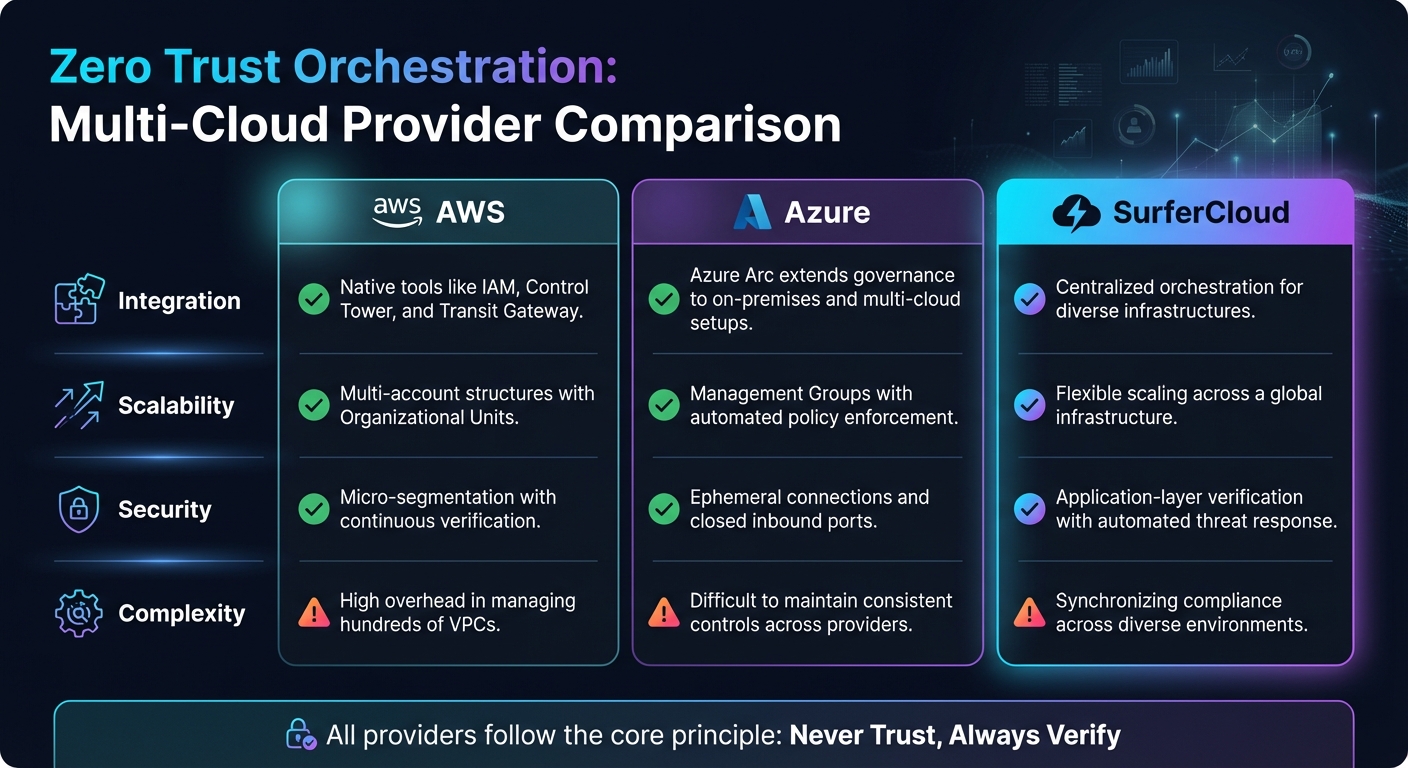
AWS vs Azure vs SurferCloud Zero Trust Orchestration Comparison
This section dives into how different providers approach Zero Trust orchestration, highlighting their strengths and the challenges they face in areas like integration, scalability, security, and operational complexity.
Each provider brings something distinct to the table. AWS, for instance, shines when it comes to native integration with its own services, such as IAM, AWS Verified Access, and VPC Lattice. This setup allows for precise, identity-based access control [2]. But scaling this across hundreds of accounts and VPCs can get tricky. Issues like overlapping CIDRs due to poor IP planning can disrupt routing and compromise security [17].
Azure, on the other hand, leverages tools like Entra ID and Management Groups with Azure Policy to enforce security policies across tenants. It also uses identity and device health for context-aware access [11][1]. However, when you start integrating Azure with other cloud environments, inconsistent security protocols and controls can widen the attack surface [1].
Then there's SurferCloud, which focuses on unified security policies across its 17+ global data centers, backed by 24/7 expert support. While this centralized approach simplifies integration, managing compliance and sensitive data across various platforms remains a challenge due to differences in encryption practices and documentation standards [1].
To make things clearer, here’s a quick comparison of their capabilities and trade-offs:
| Dimension | AWS | Azure | SurferCloud |
|---|---|---|---|
| Integration | Native tools like IAM, Control Tower, and Transit Gateway [17] | Azure Arc extends governance to on-premises and multi-cloud setups | Centralized orchestration for diverse infrastructures |
| Scalability | Multi-account structures with Organizational Units [17] | Management Groups with automated policy enforcement [11] | Flexible scaling across a global infrastructure |
| Security | Micro-segmentation with continuous verification [16][17] | Ephemeral connections and closed inbound ports [1] | Application-layer verification with automated threat response |
| Complexity | High overhead in managing hundreds of VPCs [17] | Difficult to maintain consistent controls across providers [1] | Synchronizing compliance across diverse environments [1] |
Despite their differences, all three providers adhere to the core principle of Zero Trust: "Never Trust, Always Verify" [16][1]. That said, the ease or difficulty of implementing these strategies often depends on your current infrastructure and compliance needs.
Selecting the right Zero Trust orchestration strategy for multi-cloud environments starts with a clear understanding of your organization’s unique needs and existing infrastructure. AWS stands out for its deep native integrations, Azure excels with unified SIEM and policy management, and SurferCloud offers centralized orchestration across its 17+ data centers, backed by 24/7 expert support. Despite their differences, all these approaches are built around the core Zero Trust principle: continuous verification in distributed environments.
With 92% of organizations currently using or planning to use multiple cloud providers [19], the challenge of orchestrating security across diverse platforms is unavoidable. Rick Clark, Global Head of Cloud Advisor at UST, emphasizes this shift:
"The enterprises that thrive in a multi-cloud world will treat security as a product of their platform strategy, not a patch" [7].
This means moving away from one-time authentication and embracing continuous verification of user identity, device health, and behavior throughout every session [1]. To address these challenges, organizations can adopt several actionable strategies:
Misconfigurations remain a leading cause of cloud breaches, often stemming from the complexity of enforcing consistent policies across different providers [7].
Ultimately, there’s no universal solution. Organizations heavily invested in AWS often rely on its native tools, while those prioritizing unified threat detection lean toward Azure. Regardless of the platform, key practices like micro-segmentation to limit breach impact, closing inbound firewall ports through brokered connections, and adopting an "assume breach" mindset with automated incident response are essential [1]. With 73% of enterprises adopting a hybrid cloud model as of 2024 [8], these strategies have become critical for securing today’s diverse cloud environments. A combination of integration, continuous verification, and automation is the cornerstone of effective Zero Trust in multi-cloud setups.
Zero Trust orchestration strengthens security in multi-cloud environments by removing implicit trust and continuously validating users, devices, and workloads. Instead of relying on traditional firewalls and VPNs, this method uses granular, policy-driven micro-segmentation to minimize the risk of lateral threat movement.
By enforcing consistent security controls across all cloud platforms and on-premises systems, businesses can streamline operations, cut costs, and enhance performance. Outdated security tools can be phased out, and policies can be centrally managed, making it easier to scale as workloads increase. For SurferCloud customers, this translates to a secure, scalable, and efficient multi-cloud setup that enables global growth without unnecessary complexity or unexpected expenses.
Zero Trust orchestration strengthens security in multi-cloud setups by moving away from traditional perimeter-focused defenses. Instead, it relies on identity verification and continuous monitoring to safeguard workloads across platforms like AWS, Azure, and SurferCloud. This ensures that security policies are applied consistently and in real time, no matter where the workload resides.
Key features such as micro-segmentation, TLS/SSL inspection, and secure workload communication play a vital role in stopping threats before they can spread. Additionally, cloud-native policy enforcement ensures that uniform security rules are maintained across all platforms. This system adapts dynamically to the requirements of different cloud providers, delivering a scalable and cohesive defense for your data and applications in complex multi-cloud environments.
Adopting Zero Trust in multi-cloud environments is no small feat. Each cloud provider comes with its own set of tools, APIs, and networking setups, which can dramatically increase the potential attack surface. This makes it more challenging to maintain uniform security measures and raises the risk of unauthorized lateral movement between workloads. On top of that, the absence of unified visibility across different cloud platforms often leads to fragmented security policies and overlooked vulnerabilities.
Managing identity and access in this environment is another hurdle. Users and services must be authenticated and authorized across multiple platforms, which complicates identity and access management (IAM). Implementing principles like least privilege and micro-segmentation requires sophisticated identity solutions and automation, but standardizing these across various clouds can be a tough task. Plus, compliance requirements differ by region, adding yet another layer of complexity.
Providers like SurferCloud can help tackle these issues by delivering integrated Zero Trust controls, centralized visibility, and scalable security solutions across their global data centers. This approach not only ensures consistent security but also helps cut down on operational headaches and costs.