Unlock New Possibilities with Premium VPS Hos
For businesses targeting the dynamic South American mar...








When managing hybrid cloud environments, open-source tools can save costs, improve flexibility, and prevent vendor lock-in. These tools support automation across public clouds, private clouds, and on-premises infrastructure. Here's a quick look at seven top tools:
Quick Comparison:
| Tool | Licensing | Key Features | Best For |
|---|---|---|---|
| OpenTofu | MPL-2.0 | Multi-cloud IaC, modular workflows | Hybrid cloud IaC |
| Pulumi | Apache 2.0 | Code-based IaC, multi-language | Developers preferring code-first |
| Ansible | GPLv3 | Agentless automation, YAML playbooks | IT automation |
| OpenStack | Apache 2.0 | Modular private cloud, scalability | Private cloud setups |
| Terraform | Business Source | Declarative IaC, drift detection | Hybrid cloud automation |
| Crossplane | Apache 2.0 | Kubernetes-native control plane | Kubernetes-centric environments |
| Apache Airflow | Apache 2.0 | Workflow orchestration, Python-based | Data pipelines |
Each tool has strengths suited to specific needs, from cloud provisioning to workflow automation. Start by evaluating your infrastructure and team expertise to choose the right fit.
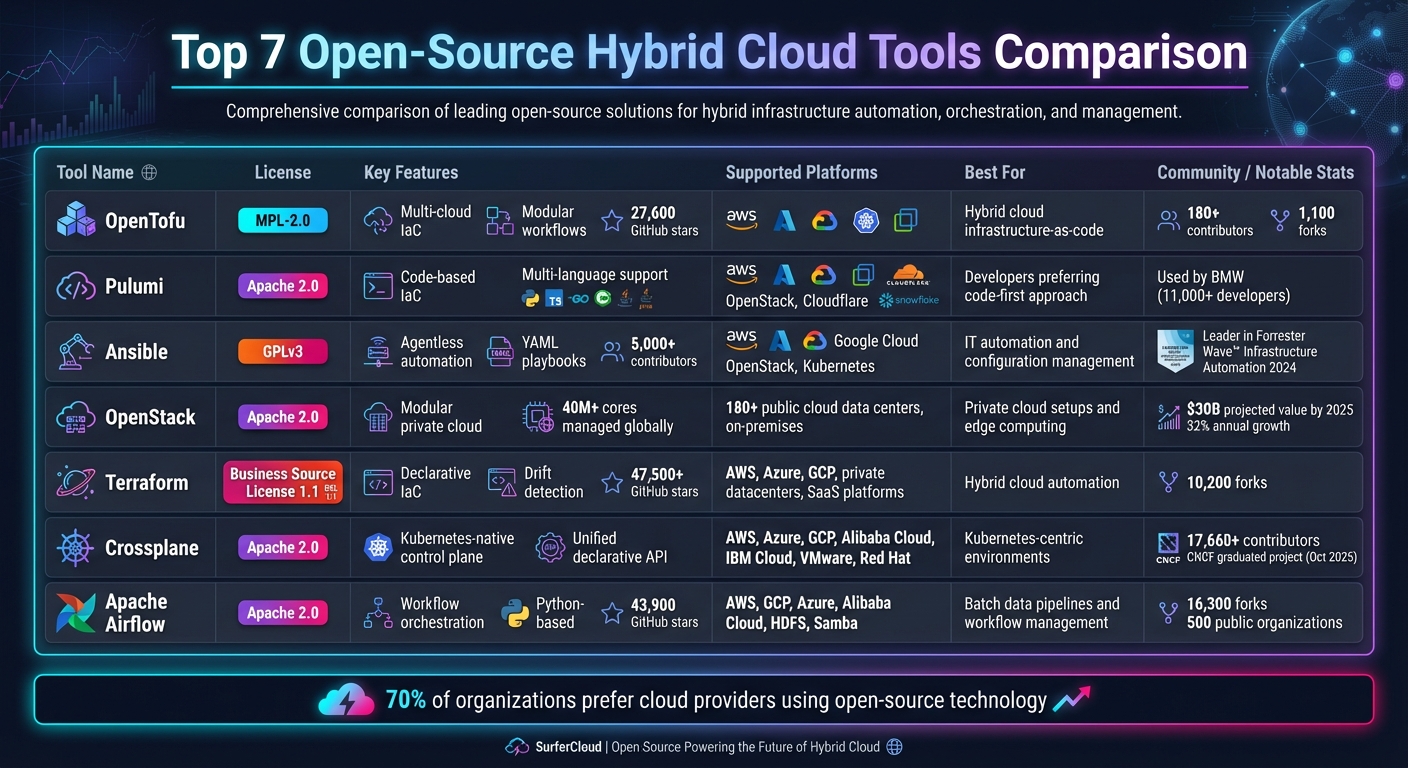
Comparison of 7 Open-Source Hybrid Cloud Tools: Features, Licensing, and Best Use Cases

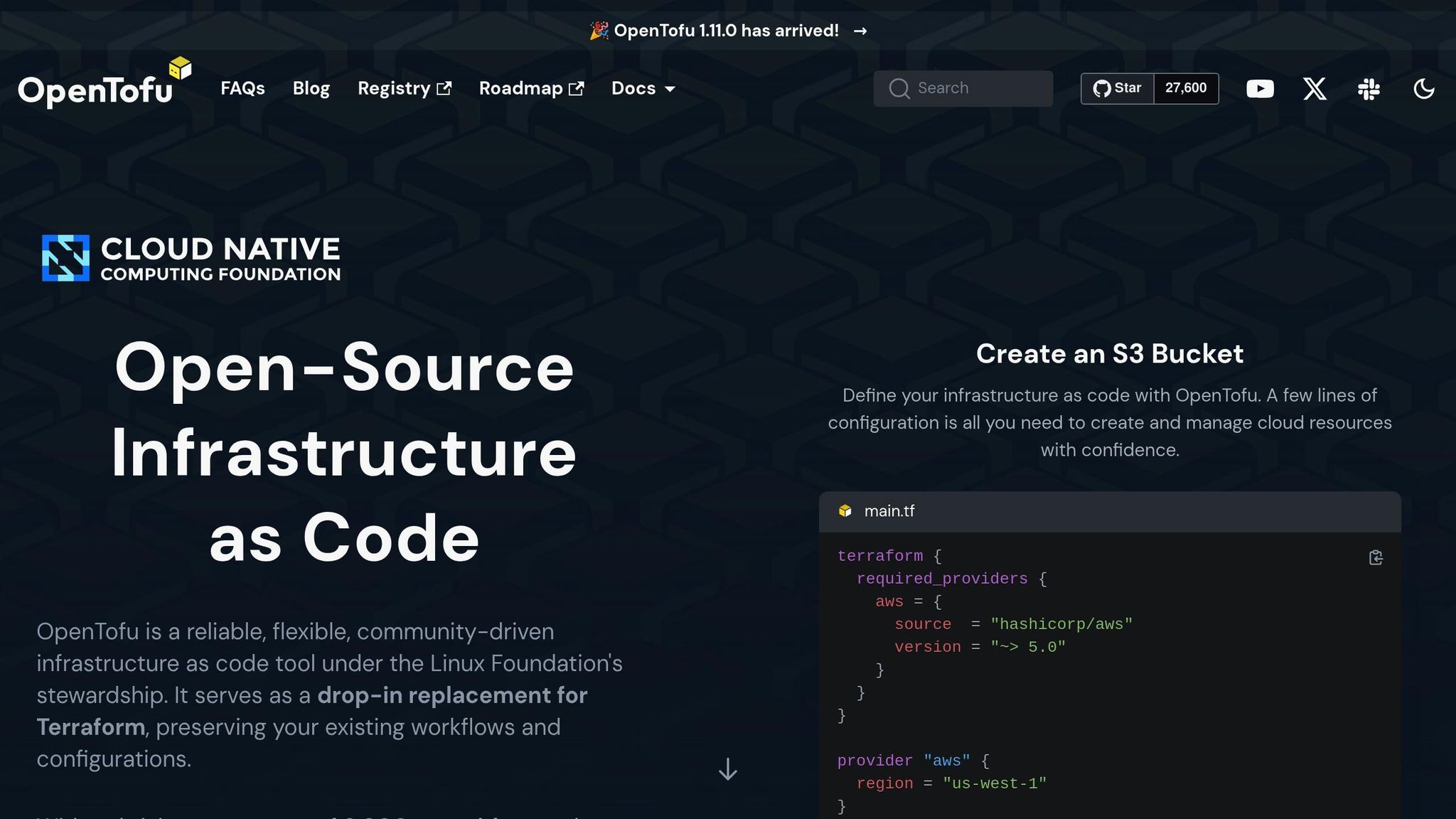
OpenTofu is a community-driven infrastructure-as-code (IaC) tool, licensed under MPL-2.0. With 27,600 stars and 1,100 forks on GitHub, it's backed by contributions from over 180 developers [7].
The MPL-2.0 license ensures businesses can use, modify, and deploy OpenTofu without worrying about licensing fees or unexpected policy changes. As the OpenTofu Community puts it:
"We firmly believe that Terraform should remain open-source because it is a project many companies use, and many contributors have made Terraform what it is today." [6]
This open licensing model provides the flexibility needed to handle the complexities of hybrid cloud environments.
OpenTofu integrates seamlessly with thousands of providers, including AWS, Azure, GCP, Kubernetes, and VMware. This means you can manage both cloud-based and on-premises resources through a unified workflow. By defining your infrastructure in simple configuration files, OpenTofu takes care of the intricate logic behind the scenes. The OpenTofu Registry further simplifies this process by offering access to providers and reusable modules, making cross-cloud orchestration more manageable.
OpenTofu employs a declarative approach to automation. It builds a resource graph, generates an execution plan, and then applies changes in a controlled manner. Features like the -exclude flag and dynamic for_each loops make it easier to deploy resources across multiple clouds with fewer errors and faster results.
Designed with scalability in mind, OpenTofu’s modular structure supports the self-service deployment of compliant infrastructure. Sensitive data remains secure with built-in client-side state encryption for remote backends. Additionally, it allows individual components to scale independently, making it simple to create or tear down parallel environments as needed.
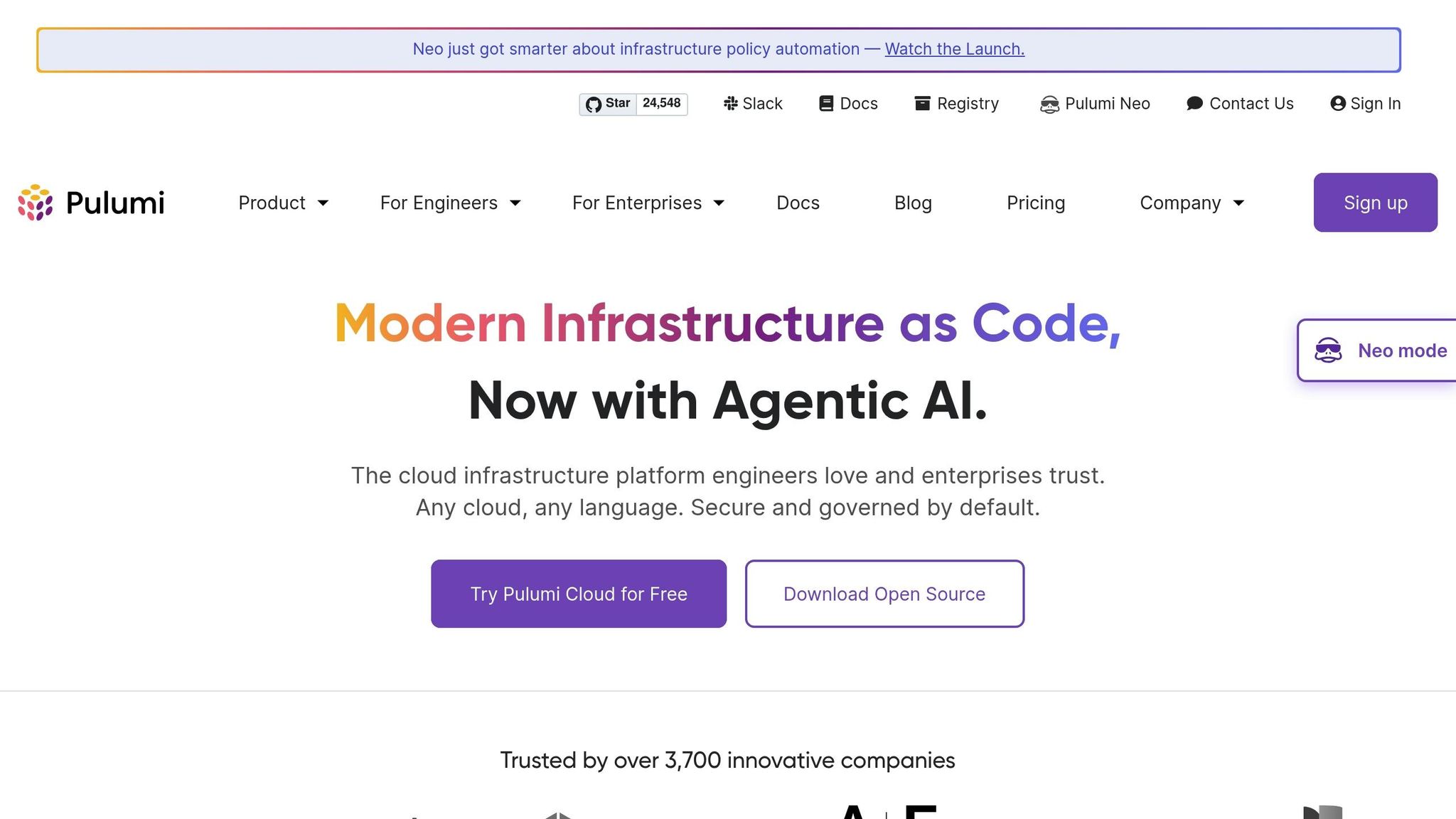
Pulumi is an infrastructure-as-code platform built on an open-source core under the Apache 2.0 license. It supports a wide range of cloud providers and thousands of resources, making it a versatile choice for managing modern infrastructure [10][14].
With the Apache 2.0 license, Pulumi gives users the freedom to use, modify, and deploy its core engine and SDK as needed [8]. You can opt for Pulumi Cloud for managed state or choose a DIY backend, utilizing AWS S3 or local storage, to maintain full control over your infrastructure metadata [9]. This flexibility ensures that your automation workflows remain entirely under your control, whether you're operating in public clouds, private data centers, or a mix of both. This approach also bolsters Pulumi's capability to work seamlessly across multi-cloud setups.
Pulumi excels at simplifying operations across diverse environments. It offers a single workflow that works with AWS, Azure, GCP, VMware, OpenStack, and Kubernetes [11]. For instance, BMW leveraged Pulumi to create a robust cloud development platform that now supports over 11,000 developers globally [9]. Beyond traditional cloud providers, Pulumi also integrates with SaaS platforms like Cloudflare and Snowflake, ensuring consistent workflows across various infrastructures [13].
Pulumi’s unified cloud management paves the way for powerful automation. It enables developers to write infrastructure code using familiar programming languages such as TypeScript, Python, Go, C#, or Java [8]. Austin Byers, Principal Platform Engineer, highlights the importance of this feature:
"Nothing is better than having standard programming languages for building and managing infrastructure." [12]
Pulumi's Automation API takes automation a step further by embedding Pulumi into larger applications, enabling the creation of custom internal developer platforms [13]. For example, Werner Enterprises dramatically reduced provisioning times - from 3 days to just 4 hours - using Pulumi Neo, an AI-powered automation tool [10].
Pulumi’s component model allows organizations to define reusable patterns for infrastructure, which can be applied across different cloud and on-premises environments [13]. Pulumi ESC simplifies secrets management by centralizing it across providers like HashiCorp Vault and AWS Secrets Manager, while dynamic OIDC credentials eliminate the need for static secrets [8]. Additionally, CrossGuard enforces security and compliance policies during deployment, catching misconfigurations before they reach production [11]. Pulumi also includes drift detection, which identifies and resolves manual changes made outside the code, ensuring your infrastructure remains in its intended state [9].
Ansible is an open-source IT automation tool available under the GNU General Public License version 3 (GPLv3). This makes it a budget-friendly choice for businesses aiming to automate hybrid cloud environments without the burden of licensing fees. With contributions from over 5,000 developers driving its growth [15], Ansible has become one of the most widely used platforms in automation. It was even recognized as a leader in the "Forrester Wave™: Infrastructure Automation Platforms, Q4, 2024" [4].
The community edition of Ansible provides an accessible starting point for organizations of all sizes. Built primarily in Python, with additional components, this open-source platform thrives on its large contributor base, which continuously develops new modules and plugins. Its open nature ensures transparency and security, allowing businesses to review and audit automation content - especially vital when managing sensitive hybrid cloud setups. Many organizations start with the free version and later upgrade to the Red Hat Ansible Automation Platform for enhanced security, enterprise support, and advanced tools like automation mesh. This open foundation allows Ansible to bring together various cloud environments seamlessly.
Ansible simplifies configuration and deployment across public cloud providers like AWS, Azure, and Google Cloud, as well as private clouds such as VMware and OpenStack. It also supports cloud-native platforms like OpenShift and Kubernetes - all through a single automation language. Since Ansible uses an agentless architecture, no extra software is needed on managed nodes. It typically relies on OpenSSH for Linux/Unix systems and WinRM for Windows. A real-world example comes from the Asian Development Bank, which saved hundreds of work hours annually by automating its IT infrastructure using Ansible [4].
Ansible's approach to automation is built on its easy-to-read YAML playbooks, making it straightforward to use. Its idempotent modules ensure consistency by preventing configuration drift, while dynamic inventory plugins automatically update host data from cloud providers. For added security, Ansible Vault allows users to encrypt sensitive information like API keys and passwords within playbooks and inventory files.
Ansible’s automation mesh spreads workloads across multiple nodes, improving resilience in complex hybrid environments. Its modular design supports a wide range of operating systems, including Red Hat Enterprise Linux, Debian, Ubuntu, macOS, FreeBSD, Windows, and even z/OS UNIX. This versatility means you can manage diverse environments with a single tool. Developers can also extend Ansible by writing custom modules in any language that outputs JSON. Additionally, organizations can speed up automation efforts by using pre-built roles and collections from Ansible Galaxy, making it easier to handle common hybrid cloud tasks efficiently.
OpenStack stands out among open-source hybrid cloud tools for its ability to offer tailored solutions, automation, and scalability across diverse IT setups. Released under the Apache License 2.0, this open-source cloud computing platform has made a significant mark, managing over 40 million cores globally across a wide range of industries [5]. The OpenInfra Foundation even refers to it as the "de facto private cloud" [1]. OpenStack is built from modular components like Nova for compute, Neutron for networking, Cinder for storage, and Keystone for identity management. This modularity allows organizations to pick and deploy exactly what they need, driving the OpenStack services market toward an estimated $30 billion value by 2025, with a projected annual growth rate of 32% [18].
Thanks to the Apache License 2.0, OpenStack ensures full code transparency and eliminates vendor lock-in, giving organizations the freedom to adapt the platform to meet their compliance and operational needs without worrying about proprietary limitations. For instance, Walmart uses OpenStack to manage over 170,000 cores across more than 30 regions, enabling it to handle massive traffic surges during peak shopping periods [5]. Cost-wise, managed OpenStack services start at around $356 per month for a hyperconverged three-server setup, while public cloud instances can be as affordable as $0.0494 per hour [17].
OpenStack provides a unified set of APIs and software components that work seamlessly across both on-premises data centers and more than 180 OpenStack-powered public cloud data centers worldwide [5]. This consistency simplifies hybrid cloud deployments, making it easier for businesses to shift workloads between public and private infrastructure as needed. A prime example is CERN, which operates an OpenStack cloud with over 300,000 cores to process data for the Large Hadron Collider [19].
Automation is a cornerstone of OpenStack, with tools like the Heat orchestration service, which uses templates to simplify the deployment of complex cloud applications. Mistral takes automation further by enabling workflow management through YAML-based definitions. The Magnum project enhances container orchestration by integrating platforms like Kubernetes, Docker Swarm, and Apache Mesos as first-class resources. Blizzard Entertainment uses OpenStack's autoscaling features to handle the demands of popular games like Overwatch [5]. Additionally, the Ironic component extends automation to bare metal servers, treating physical hardware with the same flexibility as virtual machines. Together, these tools create a robust automation framework that supports OpenStack's scalable design.
OpenStack's horizontal scalability allows businesses to expand capacity simply by adding more standard hardware servers. Its modular design ensures that organizations can deploy only the components they need, minimizing unnecessary overhead. AsvinChandar Selvaraj, Senior Manager of Converged Infrastructure at FICO, highlights this stability:
"OpenStack is very stable with the recent releases and I have no complaints for running cloud native applications and containers in my private cloud" [16].
Moreover, OpenStack integrates with Kubernetes through projects like Magnum and Kuryr, enabling seamless coexistence of containerized and traditional workloads. This flexibility makes it a strong choice for orchestrating resources across on-premises and cloud environments. Industries like telecommunications and retail have embraced OpenStack for edge computing and 5G infrastructure deployments [5], further showcasing its adaptability to modern IT demands.
Terraform is a tool designed to manage hybrid cloud infrastructure, operating under the Business Source License 1.1 starting in early 2026 [22]. Even with its "source-available" label, Terraform has gained significant traction, boasting over 47,500 stars and 10,200 forks on its GitHub repository. It uses HashiCorp Configuration Language (HCL) to define infrastructure states while automating the underlying processes [20].
Terraform simplifies infrastructure management across a mix of environments. It integrates workflows for public clouds like AWS, Azure, and GCP, as well as private datacenters and SaaS platforms [20]. Its extensive provider ecosystem - featuring thousands of community and HashiCorp-maintained providers in the Terraform Registry - allows teams to manage resources like compute instances and DNS entries through a consistent, declarative approach. Kevin Defvies, an Information Systems Engineer at Decathlon, shared:
"With Terraform, infrastructure development and deployment that used to take more than a week can now be done in less than 30 minutes." [21]
For teams just starting their hybrid cloud automation journey, the HCP Terraform Free tier offers support for up to 500 managed resources with unlimited users [21].
Terraform enhances efficiency by generating an execution plan that outlines proposed changes, ensuring safer operations in complex environments [20]. It constructs a resource graph to pinpoint dependencies and parallelizes tasks that don’t rely on one another, speeding up provisioning. Scott Sanders, Vice President of Infrastructure at GitHub, highlighted its benefits:
"Terraform has helped us create a self-service business model for our development teams...it reduces friction for developers by eliminating the need to track down reviews and approvals." [21]
Terraform also includes drift detection, which continuously monitors infrastructure against its state file to identify and address unauthorized manual changes across both on-premises and cloud environments. By integrating with Sentinel, it supports policy as code, enforcing security and compliance rules before provisioning resources [23]. This ensures a streamlined and secure approach to deployment.
Terraform’s modular architecture is key to its adaptability in hybrid cloud environments. Teams can create reusable modules to standardize configurations across various setups. Thomas Chalmers of Deutsche Bank described the impact:
"You are able to write the Terraform IaC to create cloud resources that are published to our trusted private module registry…that's a paradigm shift." [21]
The state file acts as a single source of truth, mapping configurations to real-world resources, whether they’re in public clouds or private datacenters. This consistency allows teams to manage the full lifecycle of infrastructure - from provisioning to the automated teardown of temporary resources - using the same workflow across all environments [21].
Crossplane builds on earlier hybrid cloud automation tools by introducing a Kubernetes-native control plane. It’s an open-source control plane framework governed by the Apache 2.0 license, designed to transform Kubernetes into a centralized control plane for managing hybrid cloud environments [25]. The project, which officially graduated under the CNCF on October 28, 2025, boasts an impressive community with over 17,660 contributors, a health score of 84/100, and a Slack group exceeding 13,400 members [25][27].
Crossplane simplifies hybrid cloud management by providing a unified declarative API that reduces the complexity of managing resources across multiple environments, including AWS, Azure, GCP, Alibaba Cloud, IBM Cloud, VMware, and Red Hat [24]. Instead of requiring teams to master separate tools for each platform, Crossplane enables resource provisioning through Kubernetes-style definitions. Its custom resources, known as Managed Resources (MRs), extend Kubernetes capabilities to control external services like AWS RDS databases or GCP storage buckets [26]. This approach promotes portability and consistency, eliminating vendor lock-in and ensuring a seamless experience across on-premises and cloud-based systems.
Crossplane’s unified resource management also brings powerful automation features. The control plane continuously monitors configurations and automatically corrects any drift that might occur [26]. For example, Michelin reported cutting platform costs by 44% in June 2025 after adopting Crossplane for infrastructure management [27]. Its Composition feature allows teams to create custom APIs using straightforward pipelines in widely used programming languages, reducing the need for complex controller development [26]. Daniel Mangum, a key contributor to Crossplane, highlighted its growth:
"Crossplane's maturity has been particularly visible in the recent year, as evidenced by its contribution to the CNCF, the publication of a stable v1.0 version, and widespread adoption in enterprise settings." [24]
With the release of Crossplane v2, the platform introduced an Operations engine for handling non-resource tasks like certificate monitoring, rolling upgrades, and scheduled maintenance. These operations can be triggered as one-time events, cron jobs, or based on specific events [26].
Crossplane’s Package Manager streamlines the deployment of consistent control plane configurations across multiple regions and services, ensuring standardized infrastructure management regardless of the cloud provider [26]. In January 2026, Galaxy FinX successfully managed over 100 Kubernetes clusters spread across global regions by combining Crossplane with GitOps and Argo CD [27]. Its extensibility allows organizations to introduce new infrastructure types through Providers and create custom APIs with Configurations, making it adaptable to the evolving demands of hybrid cloud environments [26]. These features make Crossplane a versatile tool for scaling and standardizing hybrid cloud operations.
Apache Airflow wraps up this list as a powerful workflow orchestration platform tailored for batch-oriented data pipelines. Released under the Apache License 2.0 [32], it has garnered about 43,900 stars and 16,300 forks on GitHub, with nearly 500 public organizations relying on it as of January 2026 [32]. Airflow 3.0, the latest major release, launched on April 22, 2025 [28]. Its architecture is built to handle diverse hybrid cloud environments effectively.
Airflow is well-suited for hybrid cloud deployments, thanks to its official Helm Chart, which simplifies deployment on both on-premises systems and Kubernetes clusters in the cloud [30][31]. It supports a broad range of providers, including AWS, Google Cloud Platform, Microsoft Azure, and Alibaba Cloud, alongside on-premises technologies like HDFS and Samba [28][30]. With more than 80 provider packages available, teams can connect to third-party services without the hassle of building custom integrations [31]. The Task SDK further streamlines the process by separating DAG (Directed Acyclic Graph) authoring from core system components, ensuring workflows remain consistent and adaptable across various environments [30].
One of Airflow’s standout features is its ability to define workflows entirely in Python, making it easy to integrate with version control systems, collaborate across teams, and conduct thorough testing [29]. The platform supports dynamic pipeline generation, enabling pipelines to adapt to external parameters at runtime [28]. Built-in scheduling and monitoring tools, along with the ability to backfill historical data or retry failed tasks, make managing complex workflows much easier [29]. Airflow also uses the Jinja templating engine to enhance customization and parameterization within workflows [29]. However, it's important to note that Airflow is designed specifically for finite, batch-oriented workflows and isn’t intended for continuous or event-driven streaming processes [29].
Airflow employs a modular architecture and message queues to coordinate tasks across unlimited workers. As noted on its official site, "Airflow™ is ready to scale to infinity" [28]. The release of Airflow 3 introduced new features like the Edge Executor, which improves remote task execution across distributed hybrid cloud environments [33]. Additionally, users can create custom operators and extend libraries to align the platform with their specific infrastructure requirements [28].
The seven open-source tools covered in this guide offer a powerful way to manage hybrid cloud environments without being tied to a single vendor. They eliminate costly licensing fees while delivering the transparency and flexibility that proprietary solutions often lack. In fact, 70% of organizations now prefer cloud providers that rely on open-source technology [1].
These tools shine because of their open architecture, which promotes vendor independence. With open-source platforms, you gain full control over key processes like container orchestration, infrastructure provisioning, and workflow management. Whether you're working with Kubernetes, Terraform, or Apache Airflow, you decide how and where your workloads operate. Technology analyst Christopher Tozzi highlights this advantage:
"If you want lower costs, less lock-in risk, and more flexibility, an open source hybrid cloud platform may better suit your needs" [3].
However, open-source platforms do require a more hands-on approach. To make the most of them, start by evaluating your organization’s technical readiness and workload needs - whether you're managing virtual machines, containers, or data pipelines. Match these needs to the strengths of each tool. For smoother operations, adopt consistent automation languages, such as Ansible’s YAML, Terraform’s HCL, or Pulumi’s code, to handle provisioning, security, and compliance [2].
A unified automation strategy is key to a successful hybrid cloud setup. Avoid relying on scattered scripts by choosing tools that let your team work within a single automation framework. This approach simplifies everything from initial deployment to ongoing tasks like security updates and compliance management [2].
And don’t forget: selecting the right tool is only the beginning. As Wallace D. Wattles wisely said:
"It is essential to have good tools, but it is also essential that the tools should be used in the right way" [2].
For long-term success, implement centralized visibility solutions to monitor costs and resource usage across your multi-cloud environments. Tap into the thriving communities behind these open-source projects for guidance and innovation. By choosing the right tools and using them effectively, you’re setting the foundation for a streamlined and efficient hybrid cloud strategy.
Open-source hybrid cloud tools give businesses the ability to blend public and private cloud resources without being tied to a single vendor. This approach not only avoids vendor lock-in but also helps manage costs more effectively. Instead of paying for expensive proprietary software, businesses can focus on the infrastructure they actually use, keeping budgets under control.
Because the code is open and supported by a global community, companies can tailor these tools to their specific needs. They can add or remove features as required and benefit from quicker bug fixes and security updates contributed by developers worldwide. These tools also make it easier to move workloads between providers or expand into new regions without requiring major changes to applications.
Another advantage of open-source ecosystems is the collaborative environment they foster. Businesses gain access to a wealth of shared knowledge, including detailed documentation, forums, and integration options. This collaborative spirit streamlines automation, strengthens security compliance, and speeds up hybrid cloud deployments - helping companies reach their digital transformation goals more efficiently.
To pick the best open-source tool for your hybrid cloud setup, start by identifying your business goals. Are you aiming to cut costs, improve scalability, or boost security? Once you’ve nailed down your priorities, look for tools that align with those objectives. Open-source solutions are particularly well-suited for hybrid cloud environments because they provide flexibility, cost efficiency, and scalability - all while steering clear of vendor lock-in.
Here’s how you can evaluate your options:
By carefully aligning your technical needs with the tool’s capabilities and validating its effectiveness through a pilot, you can make an informed decision and set your hybrid cloud strategy up for success.
OpenTofu and Pulumi are both open-source tools designed for Infrastructure-as-Code (IaC), but they cater to different workflows and preferences.
OpenTofu is a community-driven fork of Terraform, sticking to a declarative syntax (HCL or JSON). Its workflow is straightforward: write → plan → apply. This simplicity makes it a great fit for teams already comfortable with Terraform’s ecosystem or those who prefer a clear, declarative approach to managing infrastructure.
Pulumi, in contrast, lets you define infrastructure using general-purpose programming languages like TypeScript, Python, Go, .NET, or Java. This opens up the flexibility to use loops, conditionals, and reusable code, offering more programmatic control. Pulumi also supports a wide range of cloud providers, making it versatile for different environments.
When choosing between the two, it often comes down to your team’s preferred workflow and language familiarity. OpenTofu works well for those leaning toward declarative configurations, while Pulumi is ideal for teams that want to leverage familiar programming languages for infrastructure management. Both tools are capable of handling resources in hybrid-cloud setups, including platforms like SurferCloud.